Genesis 44
Targum Onkelos Etheridge · Tap a verse to see its cross-references.
Benjamin and the Silver Cup
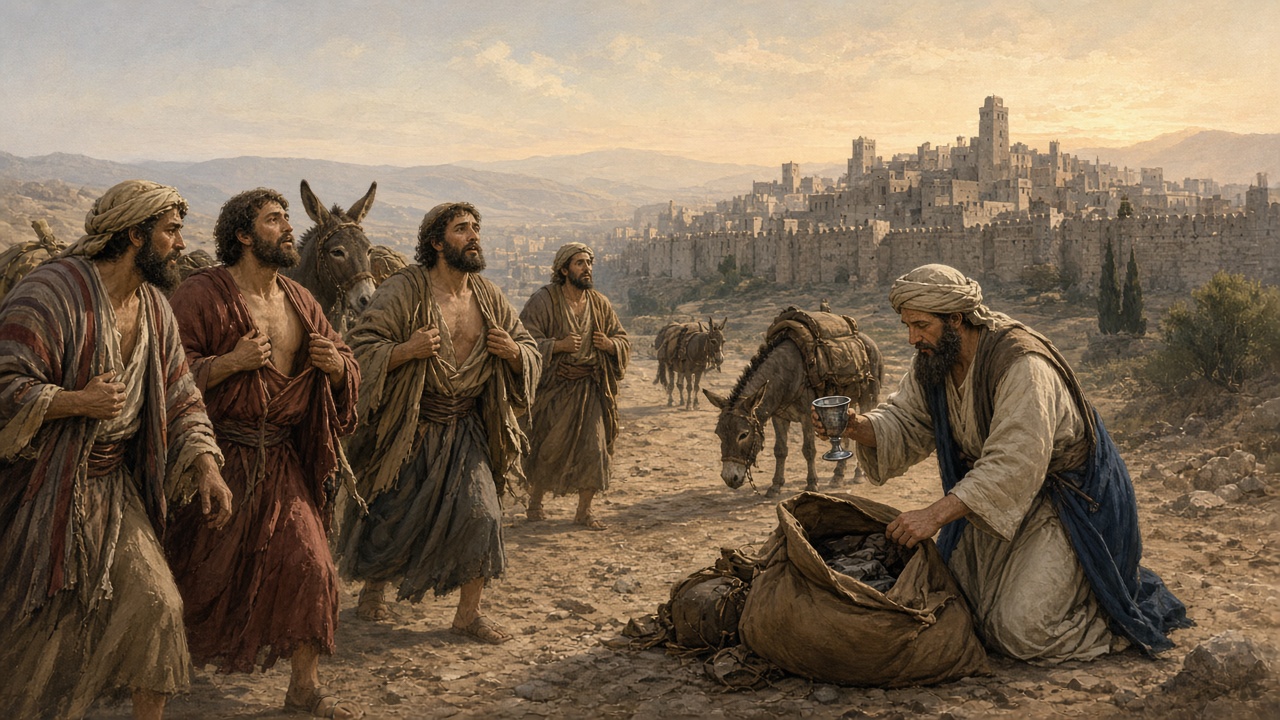
1And Joseph commanded the steward of his house, saying, Fill the men’s bags with corn as much as they can carry, and put each man’s money in the mouth of his baggage. 2And put my cup, the silver cup, in the mouth of the youngest one’s baggage, and his purchase-money. And he did according to Joseph’s word which he spake. 3The morning lightened, and the men were sent away, they and their asses. 4They had not gone far from the city, when Joseph said to him who was set over his house, Arise, follow after the men, and overtake them, and say to them, Why have you rendered evil for good? 5Is it not this from which my lord drinketh, and, behold, by which inquiring he inquireth? You have done the thing that is evil.
6And he overtook them, and spake with them these words. 7And they said, Why does my lord speak these words? Be it far from thy servants to do according to this thing! 8Behold, the money which we found in the mouth of our baggages we brought to thee again from the land of Kenaan; how then should we steal from the house of thy lord vessels of silver, or vessels of gold? 9With whomsoever of thy servants it is found, let him die; and we also will be servants to my lord. 10And he said, According to your words, so let it be. With whomsoever it is found, he shall be my servant, but you will be acquitted. 11And they made haste, and brought down every man his baggage to the ground; and every man opened his baggage. 12And he searched, beginning with the greatest and finishing with the least; and the chalice was found in the baggage of Benjamin. 13And they rent their clothes, and laded every man his ass, and returned to the city.
14And Jehuda entered and his brothers into Joseph’s house, for he was still there; and they fell before him on the ground. 15And Joseph said to them, What work is this which you have done? Did you not know that a man like me divining can divine? 16And Jehuda said to him, What shall we say to my lord? What shall we speak? How shall we be justified? Before the lord there is sin found in thy servants. Behold, we are the servants of my lord; we also and he in whose hand the chalice hath been found. 17But he said, Far be it from me to do so: the man in whose hand the chalice has been found shall be my servant; but go you up in peace to your father.
Judah Pleads for Benjamin
18And Jehuda came near to him and said, We beseech my lord, let thy servant speak a word before my lord, and let not thine anger be great with thy servant; for as Pharoh so art thou. 19My lord asked his servants, saying, Have you a father or a brother? 20And we told my lord, We have an aged father, and the youngest (son) is the son of his old age; his brother is dead; and he only remains of his mother, and his father loves him. 21And thou saidst to thy servants, Bring him down to me, and let me set mine eyes upon him. 22And we told my lord, His father cannot part with the youth; for if our father should part with him, he would die. 23And thou saidst to thy servants, If your youngest brother come not down with you, you shall not see my face again. 24And it was when we had gone up to our father, we told him these words of my lord. 25And our father said to us, Return, and buy us a little corn. 26And we said, We cannot go down: if our youngest brother go down with us, we will go down; for we shall not be able to see the man’s face unless our youngest brother go down with us. 27And thy servant our father said to us, You know that my wife bare me two (sons). 28One went forth from me, and I have said, Dying he is dead; and I have not beheld him since. 29And if you take this one also from me, and death happen to him, you will bring down my age with evil unto sheol. 30And now, when I come to thy servant my father, and the youth be not with us, and his soul loveth him as his (own) soul; 31When he seeth that the youth is not with us, he will die; and thy servant will have brought down the age of thy servant our father with mourning unto Sheol. 32For thy servant was surety for the youth with our father, saying, If I bring him not to thee, let my father hold me guilty all the days. 33And now let thy servant remain instead of the youth, as the servant of my lord, and let the youth go up with his brothers. 34For how can I go up to my father, and the youth be not with me? Lest I should see the evil that will come upon my father!
Did you know?
The Hidden Cup and Judah's Plea
- Judah, Jacob's fourth son by Leah, speaks for the brothers and offers to remain as a slave in the boy's place so that Benjamin may return with his brothers. Easton's Bible Dictionary (1897) notes that Judah had earlier intervened to spare Joseph's life, and that he took the lead in the family's affairs, including in the appeal recorded in this chapter.Sources: Judah (patriarch) · the Bible text itself
- Benjamin was the younger of Jacob's two sons by Rachel; she died giving birth to him and called him Ben-oni, "son of my pain," before his father named him Benjamin. The brothers tell Joseph that the boy is the only son of his mother still living, and that their father believes the other was torn to pieces. They say this to Joseph himself—Rachel's elder son, loved by Jacob as the child of his old age—while still speaking to him as a lord equal to Pharaoh.Sources: Benjamin (patriarch) · Joseph (son of Jacob) · the Bible text itself
- On Joseph's orders, the steward hid Joseph's silver cup—the cup he drank from and used for divination—in Benjamin's sack, along with the silver paid for the grain. When it was found, the brothers tore their clothes and returned to the city. Joseph then asked whether they did not know that a man like him could divine the truth, although the narrative shows that he had arranged for the cup to be found.Sources: the Bible text itself
Notes written with AI assistance from open sources (Theographic Bible Metadata, CC BY-SA 4.0; Easton’s Bible Dictionary, public domain) and reviewed before publishing.
Places in this chapter
- Canaan · 32.767, 35.333 · verse 8
Only places identified with high confidence are shown (90% or more according to the scholarly sources compiled by OpenBible). Period map: DARE (Digital Atlas of the Roman Empire), CC BY 4.0; modern map: © OpenStreetMap contributors; places: OpenBible.info (CC BY 4.0).
Credits and license for this translation
Targum Onkelos Etheridge
The Targums of Onkelos and Jonathan Ben Uzziel On the Pentateuch With The Fragments of the Jerusalem Targum From the Chaldee by J. W. Etheridge, M.A. First Published 1862-65.
Public Domain
Language: English
2020-12-20
Section headings adapted from the Berean Standard Bible (public domain); they are not part of this translation’s text.
Source: http://ebible.org/engoke/ · eBible.org