Genesis 40
Targum Onkelos Etheridge · Tap a verse to see its cross-references.
The Cupbearer and the Baker
1And after these things the cupbearer and the baker of the king of Mizraim offended their master, the king of Mizraim. 2And Pharoh was angry with two of his chiefs, with the chief of the cupbearers and with the chief of the bakers. 3And he gave them into ward in the house of the captain of the executioners (killers) in the house of the prison, the place where Joseph was confined. 4And the captain of the executioners appointed Joseph with them, and he ministered to them, and they were certain days inward. 5And they dreamed a dream, both of them, each man his dream in one night, each man according to the interpretation of his dream, the cupbearer and the baker of the king of Mizraim, who were confined in the house of the bound. 6And Joseph came to them in the morning, and saw them, and, behold, they were melancholy. 7And he asked the chiefs of Pharoh who were with him inward, in his master’s house, saying, Why are your faces evil today? 8And they said to him, We have dreamed a dream, and there is no interpreter of it. And Joseph said to them, Are not interpretations from before the Lord? Relate it now to me.
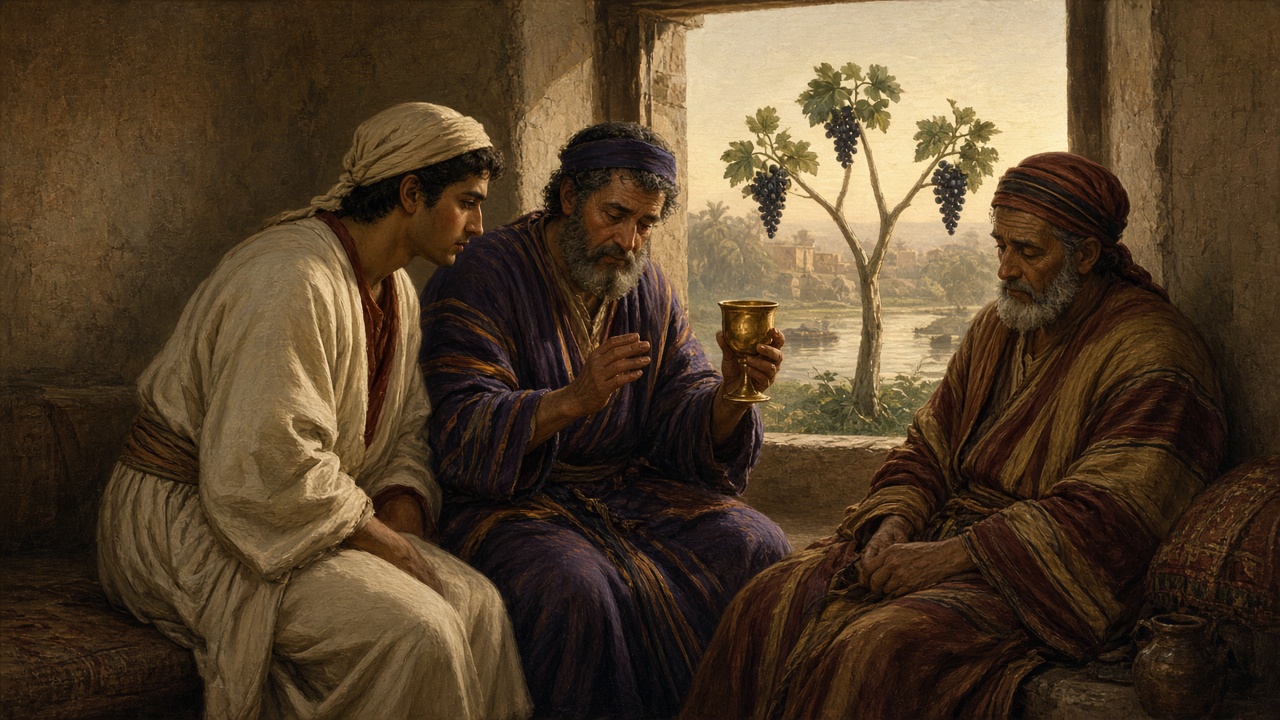
9And the chief of the cupbearers related his dream to Joseph, and said to him, In my dream, behold, a vine was before me, 10and in the vine were three branches: and it was, as it sprouted, it produced buds, and, having flowered, ripened clusters of grapes. 11And the cup of Pharoh was in my hand; and I took grapes and expressed them into Pharohs cup, and gave the cup into Pharoh’s hand. 12And Joseph said to him, This is the interpretation: the three branches are three days. 13At the end of three days, Pharoh will remember thee and restore thee to thy service, and thou wilt give the cup into Pharoh’s hand, according to thy former custom when thou wast cupbearer to him. 14But let remembrance of me be with thee when it shall be well with thee, and do me favour, I beseech thee, and remember me before Pharoh, and deliver me from this prison. 15For I was verily taken by fraud from the land of the Hivraee, and here have I done nothing evil that I should be imprisoned.
16And when the master of the bakers saw that he had interpreted pleasantly, he said to Joseph, I also (was) in my dream, and, behold, three baskets of confectionery were upon my head, 17and in the upper basket were all (sorts of) food for Pharoh, the work of the baker; and the birds ate them from the basket that was on my head. 18And Joseph answered and said, This is the interpretation of it: The three baskets are three days; 19At the end of three days will Pharoh remove thy head from off thee, and will hang thee upon a gibbet, and the birds will eat thy flesh from off thee.
20And it was on the third day, the day of the nativity of Pharoh, that he made a feast for all his servants and he took the, head of the chief cupbearer and the head of the chief of the bakers in the midst of his servants. 21And he restored the cupbearer to his office, and he gave the cup into Pharoh’s hand. 22And the chief of the bakers he hanged, as Joseph had interpreted to them. 23Yet the chief cupbearer did not remember Joseph, but forgat him.
Did you know?
Dreams in Pharaoh's Prison
- Pharaoh was angry with two officers, the chief cupbearer and the chief baker, and put them in the house of the captain of the guard, the same prison where Joseph was confined. The captain assigned them to Joseph, who became their personal attendant.Sources: the Bible text itself
- On the same night the cupbearer and the baker each dreamed, and Joseph said that interpretations belong to God. He took the three branches and the three baskets to mean three days: Pharaoh would lift up the cupbearer's head and restore him, but lift off the baker's head and hang him on a tree. On the third day, Pharaoh's birthday, the king held a feast for his officials, restored the cupbearer, and hanged the baker.Sources: the Bible text itself
- Joseph asked the cupbearer to remember him and mention him to Pharaoh after his restoration. He said he had been kidnapped from the land of the Hebrews and had done nothing for which he should have been put in the dungeon. Easton's Bible Dictionary (1897) identifies the Pharaoh of Joseph's days as probably Apopi, or Apopis, the last of the Hyksos kings; some argue instead that Joseph came to Egypt later, under Thothmes III.Sources: the Bible text itself · Pharaoh (of Joseph)
Notes written with AI assistance from open sources (Theographic Bible Metadata, CC BY-SA 4.0; Easton’s Bible Dictionary, public domain) and reviewed before publishing.
Places in this chapter
Only places identified with high confidence are shown (90% or more according to the scholarly sources compiled by OpenBible). Period map: DARE (Digital Atlas of the Roman Empire), CC BY 4.0; modern map: © OpenStreetMap contributors; places: OpenBible.info (CC BY 4.0).
Credits and license for this translation
Targum Onkelos Etheridge
The Targums of Onkelos and Jonathan Ben Uzziel On the Pentateuch With The Fragments of the Jerusalem Targum From the Chaldee by J. W. Etheridge, M.A. First Published 1862-65.
Public Domain
Language: English
2020-12-20
Section headings adapted from the Berean Standard Bible (public domain); they are not part of this translation’s text.
Source: http://ebible.org/engoke/ · eBible.org