Genesis 3
Targum Onkelos Etheridge · Tap a verse to see its cross-references.
The Serpent’s Deception
1And the serpent ( chivja) was more crafty than all the animals of the field which the Lord God bad made. And he said to the woman, Is it in truth (that) the Lord said, You shall not eat of every tree of the garden? 2And the woman said to the serpent, Of the fruit of the trees of the garden we may eat; 3but of the fruit of the tree which is in the midst of the garden, the Lord hath said, You shall not eat of it, nor approach to it, lest you die. 4And the serpent said to the woman. Not to die will you die: 5for it is manifest before the Lord, that in the day in which you eat of it your eyes will be opened, and you will be ( ki-rabrebin) as the Great-ones, knowing good and evil. 6And the woman saw that the tree was good to eat, and that it was salutary to the eyes, and a tree desirable to contemplate; and she took of its fruitage ( aiba) and ate; and she gave to her husband with her, and he ate. 7And the eyes of both of them were opened, and they knew that they were naked; and they sewed for themselves the leaves of the fig tree, and made for themselves cinctures.
God Arraigns Adam and Eve
8And they heard the voice of the Word of the Lord God walking in the garden in the evening of the day; and Adam and his wife hid themselves from before the Lord God among the trees of the garden. 9And the Lord God called to Adam and said to him, Where art thou? 10And he said, The voice of Thy Word heard I in the garden, and I was afraid, because I (was) naked, and I would hide. 11And He said, Who showed thee that thou wast naked? Of the tree of which I commanded that eating of it thou shouldst not eat, hast thou eaten? 12And Adam said, The woman whom Thou gavest (to be) with me, she gave to me of the tree, and I did eat. 13And the Lord God said to the woman, What is this that thou hast done? And the woman said, The serpent led me astray, and I did eat.
The Fate of the Serpent
14And the Lord God said to the serpent, Because thou hast done this, more accursed art thou than all cattle, and than all the beasts of the held; upon thy belly shalt thou go, and the dust shalt thou eat all the days of thy life. 15And I will put enmity between thee and between the woman, and between thy son and her son. He will remember thee, what thou didst to him (at) from the beginning, and thou shalt be observant unto him at the end.
The Punishment of Mankind
16And to the woman He said, Multiplying, I will multiply thy sorrows and thy pains. In sorrow shalt thou bring forth children; and unto thy husband shall be thy desire, and lie. He shall rule over thee. 17And unto Adam He said, Because thou hast obeyed the word of thy wife, and hast eaten of the tree (about) which I commanded thee, saying, Thou shalt not eat of it, accursed is the ground on thy account. With labour shalt thou eat from it all the days of thy life. 18Thorns and thistles it shall put forth for thee, and thou shalt eat the herb of the field. 19In the sweat of thy face shalt thou eat bread, until that thou return to the earth, because from it thou wast created; for dust thou art, and to dust thou wilt return.
20And Adam called the name of his wife Hava, because she was the mother of all the children of men.
The Expulsion from Paradise
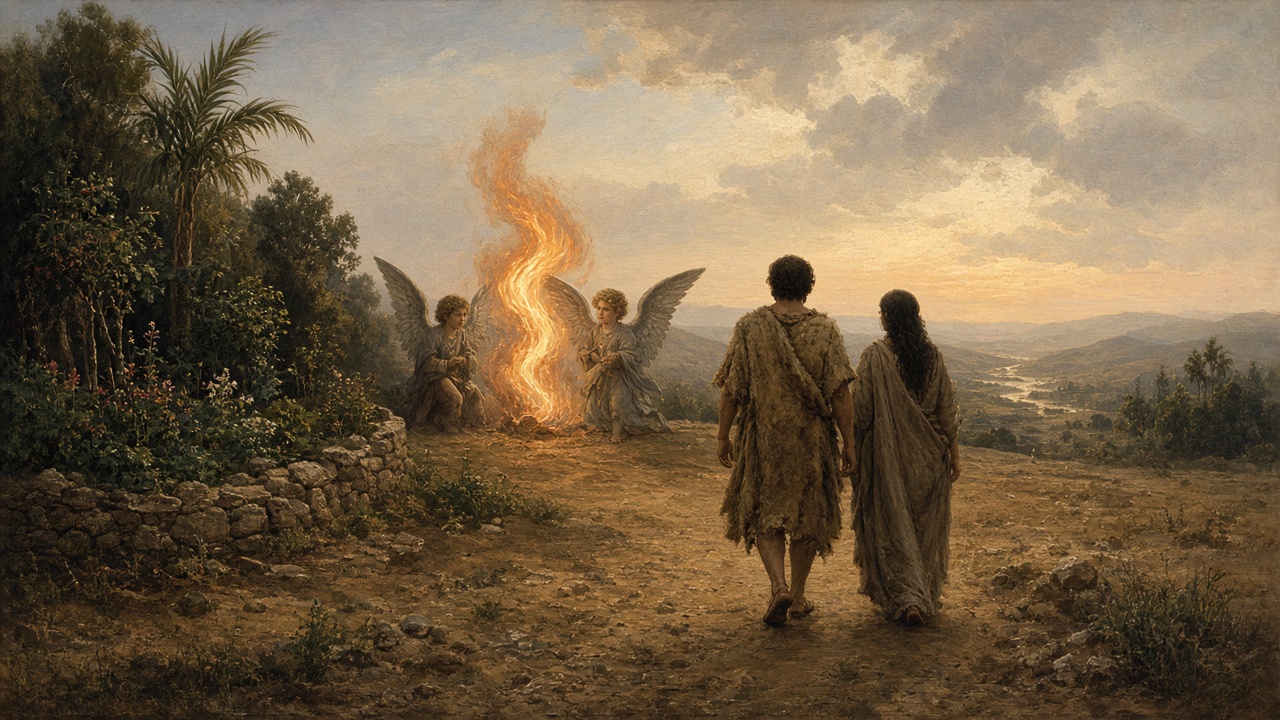
21And the Lord God made for Adam and for his wife vestments of honor upon the skin of their flesh, and clothed them.
22And the Lord God said, Behold, man is become singular (or alone, yechid) in the world by himself, knowing good and evil; and now, lest he stretch forth his hand and take also of the Tree of Life, and eat, and live forever. 23And the Lord God sent him forth from the Garden of Eden to till the ground from whence he had been created. 24And He drove out the man, and before the garden of Eden he caused to dwell the kerubaya, and the sharp sword which revolved to keep the way of the Tree of Life.
Did you know?
The Fall and Exile from Eden
- A traditional reference explains Adam as “red,” a Babylonian word used as the generic name for man, with the same meaning in Hebrew and Assyrian, and links the name to his being formed from the dust of the earth. In this chapter that origin returns in the judgment: he will toil for his food until he returns to the ground, for he is dust and to dust he will return, and he is sent to work the soil from which he was taken.Sources: Adam · the Bible text itself
- In this chapter Adam gives his wife the name Eve, meaning “life” or “living,” because she would be the mother of all the living.Sources: Eve · the Bible text itself
- The site of the garden of Eden, from which the man is driven in this chapter, has been much discussed and placed in Armenia, west of the Caspian Sea, in Media, near Damascus, in Palestine, in southern Arabia, and in Babylonia. A traditional geographical note looks for it along the Tigris and the Euphrates, in the land of Shinar, or Babylonia.Sources: Eden · the Bible text itself
Notes written with AI assistance from open sources (Theographic Bible Metadata, CC BY-SA 4.0; Easton’s Bible Dictionary, public domain) and reviewed before publishing.
Credits and license for this translation
Targum Onkelos Etheridge
The Targums of Onkelos and Jonathan Ben Uzziel On the Pentateuch With The Fragments of the Jerusalem Targum From the Chaldee by J. W. Etheridge, M.A. First Published 1862-65.
Public Domain
Language: English
2020-12-20
Section headings adapted from the Berean Standard Bible (public domain); they are not part of this translation’s text.
Source: http://ebible.org/engoke/ · eBible.org