Exodus 24
Targum Onkelos Etheridge · Tap a verse to see its cross-references.
The Covenant Sealed
1And He said to Mosheh, Come up before the Lord, thou and Aharon, Nadab and Abihu, and seventy of the elders of Israel; and they shall worship at a distance. 2And Mosheh shall draw nigh alone before the Lord, but they shall not draw nigh, nor shall the people ascend with them.
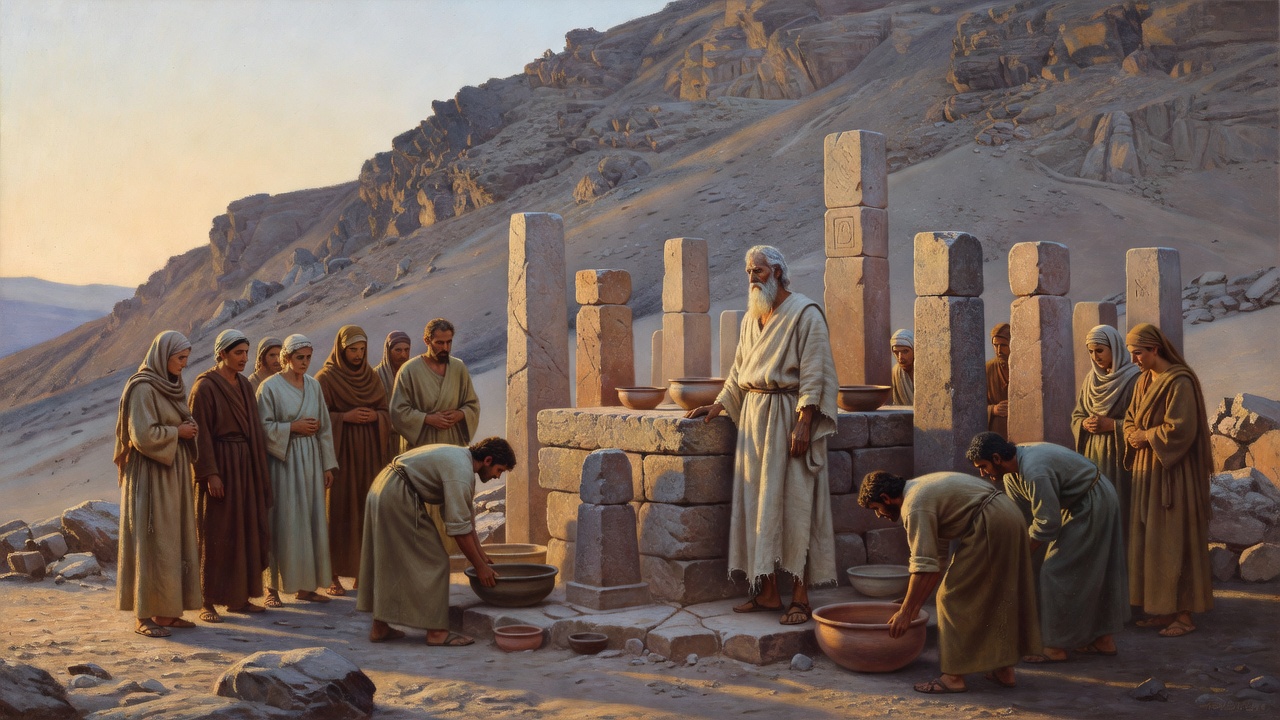
3And Mosheh came and recited to the people all the words of the Lord and all the judgments; and all the people answered with one voice and said, All the words that the Lord hath spoken will we do. 4And Mosheh wrote all the words of the Lord. And he arose in the morning, and builded an altar at the lower part of the mountain, and twelve pillars, according to the twelve tribes of Israel. 5And he sent the firstborn sons of Israel, and they offered holocausts, and sacrificed oxen (as) consecrated victims before the Lord. 6And Mosheh took half of the blood and set it in basins, and half the blood he sprinkled upon the altar. 7And he took the Book of the Covenant, and read before the people; and they said, All that the Lord hath spoken we will do and obey. 8And Mosheh took the blood and sprinkled it upon the altar to propitiate for the people, and said, Behold the Blood of the Covenant which the Lord hath ratified with you upon all these words.
9And Mosheh and Aharon, Nadab and Abihu, and seventy of the elders of Israel went up. 10And they saw the Glory of the God of Israel, and under the throne of His glory as the work of a precious stone, and as the face of heaven for its clearness. 11Yet the princes of the sons of Israel were not hurt; and they saw the Glory of the Lord, and rejoiced in their sacrifices which were accepted with favour, as though they had eaten and drunk.
Moses on the Mountain
12And the Lord said to Mosheh, Come up into My Presence in the mountain, and be there, and I will give thee the tablets of stone, and the law and the precepts, as I have written (them), that thou mayest teach them. 13And Mosheh arose and Jehoshua his minister, and Mosheh ascended the mountain on which was revealed the Glory of the Lord. 14But to the elders he said, Wait for us here until we return to you: and, behold, Aharon and Hur are with you: whosoever hath a (matter for) judgment, let him bring it before them.
15And Mosheh ascended the mountain, and the cloud covered the mountain; 16And the glory of the Lord dwelt upon Mount Sinai, and the cloud enveloped it six days. And He called to Mosheh on the seventh day out of the midst of the cloud. 17And the appearance of the Glory of the Lord was as the appearance of devouring fire on the summit of the mountain in the eyes of the sons of Israel. 18And Mosheh entered into the midst of the cloud, and ascended the mount; and Mosheh was in the mount forty day and forty nights.
Did you know?
The Covenant at Mount Sinai
- Easton's Bible Dictionary (1897) says Mount Sinai, also called Horeb, was the mountain district the Hebrews reached in the third month after the Exodus, where they remained encamped for about a year. It notes that the last twenty-two chapters of Exodus, all of Leviticus, and Numbers 1–11 record what took place during that stay.Sources: Mount Sinai
- The LORD tells Moses to come up with Aaron, Nadab and Abihu, and seventy of Israel's elders, yet Moses alone is to approach, while the others worship at a distance and the people do not go up. Nadab was Aaron's eldest son and Abihu his second; Easton's Bible Dictionary (1897) notes that the two brothers went with their father and the elders only part of the way up the mountain.Sources: the Bible text itself · Aaron · Nadab · Abihu
- Moses then climbs farther with Joshua, his attendant, and leaves Aaron and Hur with the elders so that anyone with a dispute can go to them. Easton's Bible Dictionary (1897) calls Joshua Moses' servant, who accompanied him part of the way up Sinai, and identifies Hur, the husband of Miriam, as the man associated with Aaron in charge of the people while Moses was absent on the mountain.Sources: the Bible text itself · Joshua · Hur
Notes written with AI assistance from open sources (Theographic Bible Metadata, CC BY-SA 4.0; Easton’s Bible Dictionary, public domain) and reviewed before publishing.
Credits and license for this translation
Targum Onkelos Etheridge
The Targums of Onkelos and Jonathan Ben Uzziel On the Pentateuch With The Fragments of the Jerusalem Targum From the Chaldee by J. W. Etheridge, M.A. First Published 1862-65.
Public Domain
Language: English
2020-12-20
Section headings adapted from the Berean Standard Bible (public domain); they are not part of this translation’s text.
Source: http://ebible.org/engoke/ · eBible.org