Exodus 14
Targum Onkelos Etheridge · Tap a verse to see its cross-references.
Pharaoh Pursues the Israelites
1And the Lord spake to Mosheh, saying, 2Speak with the sons of Israel that they return and encamp before Pum-Hiratha, between Migdol and the sea, before Beel Zephon: you shall encamp before it by the sea. 3And Pharoh will say of the children of Israel, They are bewildered in the land, the desert hath got hold of them: 4And I will harden Pharoh’s heart, and he will pursue them; and I will be glorified in Pharoh and in all his host; and the Mizraee shall know that I am the Lord. And they did so.
5And it was seen by the king of Mizraim that the people had gone. And the heart of Pharoh and of his servants was turned to the people; and they said, What is this that we have done, that we have sent Israel away from serving us? 6And he set his chariot in order, and took his people with him. 7He took also six hundred select chariots, and all the chariots of the Mizraee, and appointed strong men over them. 8And the Lord hardened the heart of Pharoh king of Mizraim, and he pursued after the children of Israel. But the children of Israel went forth with uncovered head. 9And the Mizraee followed after them, and overtook them while encamping by the sea; all the chariot horses of Pharoh, and his horsemen, and his army, by Pum-Hiratha which is before Beel Zephon.
10And Pharoh drew nigh, and the sons of Israel lifted up their eyes, and, behold, the Mizraee were coming after them: and they were greatly afraid, and the children of Israel cried before the Lord. 11But to Mosheh they said, Was it because there were no graves in Mizraim that thou hast taken us to die in the wilderness? What is this that thou hast done to bring us out of Mizraim? 12Was not this the word which we spake with thee in Mizraim, saying, Let us alone, and we will serve the Mizraee? For better would it have been for us to serve the Mizraee, than to die in the wilderness. 13And Mosheh said to the people, Fear not, stand still (or, be ready) and see the Lord’s deliverance which He will work for you this day; for as you have seen the Mizraee this day, you will see them no more forever: 14The Lord will fight for you the fight, and you shall be quiet.
Parting the Red Sea
15And the Lord said to Mosheh, I have heard thy prayer. Speak to the children of Israel that they go onward: 16And thou, take thy rod and stretch forth thy hand over the sea, and divide it, and the children of Israel shall go in the midst of the sea on dry ground. 17And I, behold, I will harden the hearts of the Mizraee, and they will go in after them; and I will be glorified by Pharoh and by all his army, by his chariots and his horsemen; 18And the Mizraee shall know that I am the Lord, when I have been glorified by Pharoh and his chariots and his horsemen.
19And the angel of the Lord who went before the camp of Israel passed by and came behind them; and the column of the cloud passed from before them and abode behind them. 20And it entered between the camp of the Mizraee and the camp of Israel; and was a cloud and darkness to the Mizraee, but unto Israel a light all the night: and that came not near to this all the night.
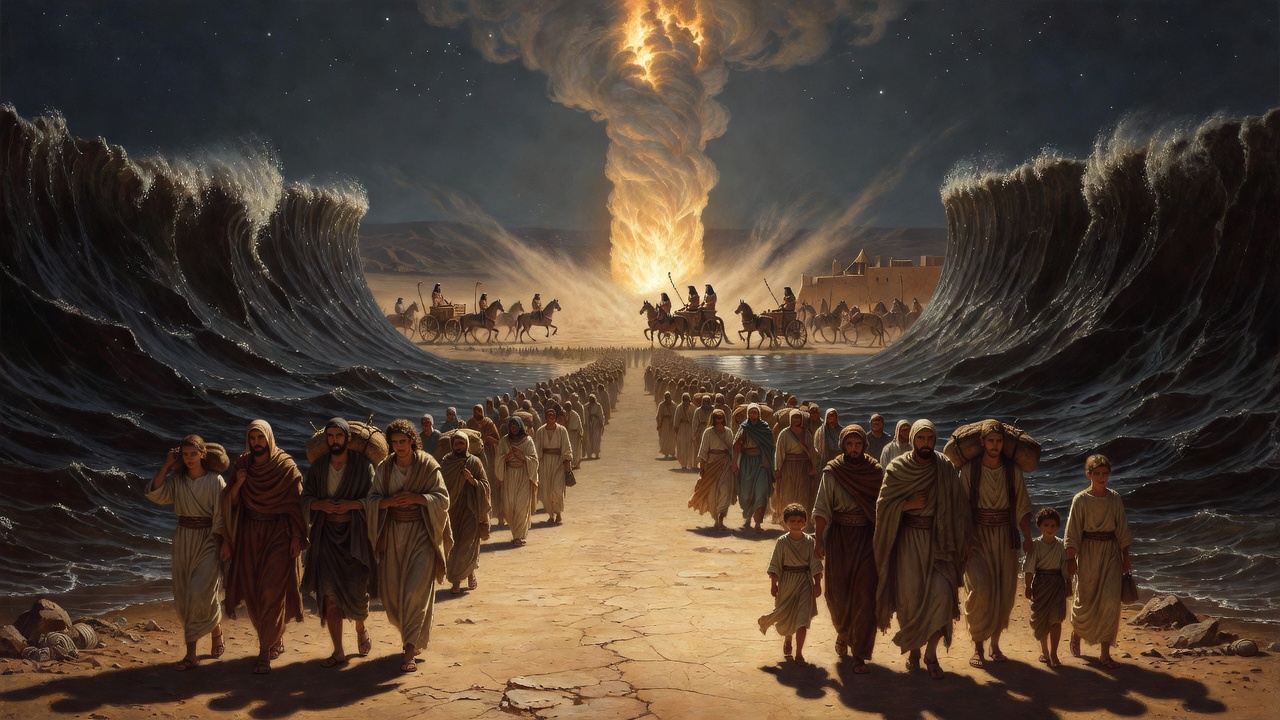
21And Mosheh stretched forth his hand over the sea; and the Lord drave the sea by a mighty east wind all the night, and caused the sea to be dry, and the waters were disparted; 22And the children of Israel went into the midst of the sea upon dry ground; and the waters were to them a wall on their right hand and on their left. 23And the Mizraee followed and entered in after them, all the horses of Pharoh, and his chariots and horsemen, into the midst of the sea. 24And it was in the morning watch that the Lord looked upon the host of the Mizraee from the column of fire and cloud, and perturbed the host of the Mizraee. 25And he removed the wheels of the chariots, so that they drave them by strength; and the Mizraee said, Let us flee from before Israel; for this is the power of the Lord which hath done battle for them against Mizraim.
26And the Lord said to Mosheh, Stretch forth thy hand over the sea, and the waters shall return upon the Mizraee, upon their chariots and their horsemen. 27And Mosheh stretched out his hand over the sea, and the sea returned, at the time of the morning, unto its strength; and the Mizraee fled before it; and the Lord drowned the Mizraee in the midst of the sea. 28And the waters returned and covered the chariots and horsemen and all the host of Pharoh who had gone after them into the sea, and there remained of them not one. 29But the children of Israel walked on dry land in the midst of the sea; and the waters were a wall to them on their right hand and on their left.
30And the Lord delivered Israel that day from the Mizraee, and Israel saw the Mizraee dead upon the shore of the sea. 31And Israel saw the Power of the Great Hand which the Lord had made (to appear) in Mizraim; and the people feared before the Lord, and believed in the Word of the Lord, and in the prophetic (work) of Mosheh His servant.
Did you know?
Israel trapped between Pharaoh and the sea
- Israel was told to turn back and camp before Pi-hahiroth, between Migdol and the sea, directly opposite Baal-zephon, so that Pharaoh would think the wilderness had boxed them in. Pi-hahiroth means place where the reeds grow, though the Septuagint and the Coptic read farmstead, and Baal-zephon means Baal of the north.Sources: the Bible text itself · Pi-hahiroth · Baal-zephon
- Easton's Bible Dictionary (1897) describes Baal-zephon as an Egyptian town on the shores of the Gulf of Suez, probably modern Jebel Deraj or Kulalah on the western shore, and notes that Egyptian Baal-zapuna was a place of worship. Some have identified Pi-hahiroth with Ajrud, a fortress between Etham and Suez. The entry on Pi-hahiroth adds that the condition of the Isthmus of Suez at the time of the Exodus is not exactly known, so Pi-hahiroth and Israel's other camps in Egypt cannot be definitely located; the isthmus has been formed by deposits of the Nile.Sources: Baal-zephon · Pi-hahiroth
- Easton's Bible Dictionary (1897) says the Pharaoh of the Exodus was probably Menephtah I, the fourteenth and eldest surviving son of Rameses II, and that he resided at Zoan, where his interviews with Moses and Aaron recorded in Exodus took place. The same entry still treats it as an open question whether Seti II or his father Menephtah was that king, and notes that some judge the evidence to favor Seti II.Sources: Pharaoh (of the Exodus)
Notes written with AI assistance from open sources (Theographic Bible Metadata, CC BY-SA 4.0; Easton’s Bible Dictionary, public domain) and reviewed before publishing.
Places in this chapter
Only places identified with high confidence are shown (90% or more according to the scholarly sources compiled by OpenBible). Period map: DARE (Digital Atlas of the Roman Empire), CC BY 4.0; modern map: © OpenStreetMap contributors; places: OpenBible.info (CC BY 4.0).
Credits and license for this translation
Targum Onkelos Etheridge
The Targums of Onkelos and Jonathan Ben Uzziel On the Pentateuch With The Fragments of the Jerusalem Targum From the Chaldee by J. W. Etheridge, M.A. First Published 1862-65.
Public Domain
Language: English
2020-12-20
Section headings adapted from the Berean Standard Bible (public domain); they are not part of this translation’s text.
Source: http://ebible.org/engoke/ · eBible.org