Deuteronomy 16
Targum Onkelos Etheridge · Tap a verse to see its cross-references.
Passover and the Feast of Unleavened Bread
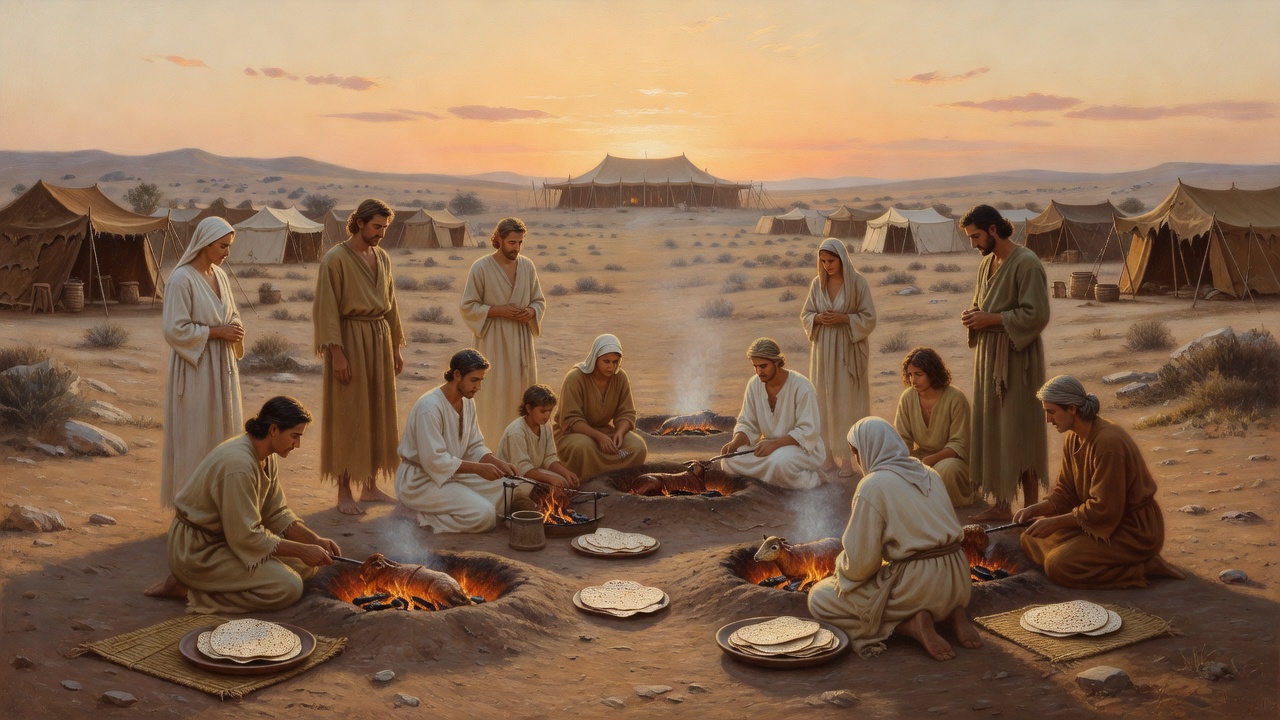
1Observe the month of Abiba, and perform the pascha before the Lord thy God; for in the month of Abiba the Lord thy God brought thee out of Mizraim, and wrought signs for thee in the night. 2And thou shalt sacrifice the pascha before the Lord thy God, with the lambs (young) of thy flock, and with consecrated victims from thy herd, in the place which the Lord will choose to make His Shekinah dwell there. 3Thou shalt not eat leaven with it. Seven days shalt thou eat unleavened bread with it, the bread of humiliation; for in haste didst thou come out of the land of Mizraim: that thou mayest remember the day of thy coming from the land of Mizraim all the days of thy life. 4And there shall not be leaven seen with thee within all thy borders seven days; neither shall any of the flesh of that which thou didst sacrifice in the evening of the first day remain until the morning. 5Thou hast not liberty to sacrifice the pascha in anyone of thy cities which the Lord thy God will give thee; 6But in the place which the Lord thy God will approve to make His Shekinah dwell, there thou shalt sacrifice the pascha, in the evening, at the going away of the sun; the time of thy coming out of Mizraim. 7And thou shalt dress and eat it in the place which the Lord thy God shall favour, and in the morning turn and go to thy tent. 8Six days thou shalt eat unleavened, and on the seventh day gather together before the Lord thy God: thou shalt do no work.
The Feast of Weeks
9Seven weeks number to thee from the beginning (of the harvest); when the omer of the elevation is reaped with the sickle, shalt thou begin to number the seven weeks. 10And thou shalt perform the festival of the weeks before the Lord thy God, with a tribute of the free-will offering of thy hand, which thou shalt give as the Lord thy God will have blessed thee. 11And thou shalt rejoice before the Lord thy God, thou, thy son, thy daughter, thy man-servant, thy handmaid, the Levite who is in thy cities, the sojourner, the orphan, and the widow who are among you, in the place which the Lord thy God will choose to make His Shekinah to dwell there. 12And thou shalt remember that thou wast a servant in Mizraim, and keep and perform these statutes.
The Feast of Tabernacles
13The Feast of Tabernacles thou shalt make to thee seven days, when thou hast gathered in from thy threshing-floor, and from thy wine-press. 14And thou shalt rejoice in thy feast, thou, thy son, thy daughter, thy servant, thy handmaid, the Levite, the stranger, the orphan, and the widow, who are in thy cities. 15Seven days shalt thou hold the festival before the Lord thy God in the place the Lord shall choose, because the Lord thy God will have blessed thee in all thy produce, and in all the work of thy hands, and therefore shalt thou rejoice.
16Three times in the year all thy males are to appear before the Lord thy God in the place that He will choose; at the Feast of the Unleavened, the Feast of Weeks, and the Feast of Tabernacles; and they shall not appear before the Lord empty; 17But every man with the gift of his hand, according to the blessing of the Lord thy God which He hath given thee.
Judges and Justice
18Judges and officers shalt thou appoint to thee in all thy cities which the Lord thy God will give thee throughout thy tribes, and they shall judge the people with true judgment. 19Thou shalt not pervert judgment, nor have respect to persons, nor receive a gift; for a gift blindeth the eyes of the wise, and depraveth right words. 20Thou shalt follow that which is surely true, that thou mayest live and inherit the land which the Lord thy God will give thee.
Forbidden Forms of Worship
21Thou shalt not plant thee a grove, nor any tree beside the altar of the Lord thy God that thou makest thee, 22nor erect a statue which the Lord thy God abhorreth.
Did you know?
Appointed Feasts and Righteous Justice
- Deuteronomy mandates three annual pilgrimage festivals—the Feast of Unleavened Bread (Passover), the Feast of Weeks, and the Feast of Tabernacles. For these occasions, the men of Israel were required to travel and appear before God not in their local towns, but at the specific central location chosen as a dwelling for His Name.Sources: the Bible text itself
- The celebrations of the Feast of Weeks and the Feast of Tabernacles explicitly included vulnerable members of society, such as servants, Levites, foreigners, orphans, and widows. These communal rejoicings were tied to the memory of Israel's liberation from slavery in Egypt.Sources: the Bible text itself
- In addition to religious assemblies, the text commands the appointment of local judges and officials across every town. They were forbidden from taking bribes or showing partiality, establishing the standard to pursue justice alone throughout the land.Sources: the Bible text itself
Notes written with AI assistance from open sources (Theographic Bible Metadata, CC BY-SA 4.0; Easton’s Bible Dictionary, public domain) and reviewed before publishing.
Places in this chapter
Only places identified with high confidence are shown (90% or more according to the scholarly sources compiled by OpenBible). Period map: DARE (Digital Atlas of the Roman Empire), CC BY 4.0; modern map: © OpenStreetMap contributors; places: OpenBible.info (CC BY 4.0).
Credits and license for this translation
Targum Onkelos Etheridge
The Targums of Onkelos and Jonathan Ben Uzziel On the Pentateuch With The Fragments of the Jerusalem Targum From the Chaldee by J. W. Etheridge, M.A. First Published 1862-65.
Public Domain
Language: English
2020-12-20
Section headings adapted from the Berean Standard Bible (public domain); they are not part of this translation’s text.
Source: http://ebible.org/engoke/ · eBible.org