Zephaniah 1
The Orthodox Jewish Bible · Tap a verse to see its cross-references.
About this book
About Zephaniah
- Easton's Bible Dictionary (1897) presents Zephaniah, whose name it explains as "Jehovah has concealed" or "Jehovah of darkness," as the son of Cushi and great-grandson of Hezekiah, and as the ninth of the minor prophets. It dates his prophecy to the reign of Josiah, king of Judah (641–610 B.C.), and says he was contemporary with Jeremiah, with whom he had much in common.Sources: Easton: Zephaniah · Zephaniah · Cushi
- Amon, Josiah's father, restored idolatry in Judah, and Easton reads Zephaniah 1:4 and 3:4, 11 as referring to that reign. The same dictionary links Zephaniah 1:4–6 with the worship of Baal and Zephaniah 1:5 with Malcham, described as the national idol of the Ammonites. Josiah, who came to the throne at eight, is presented as later acting against the idolatry that prevailed.Sources: Amon · Josiah · Baal · Malcham
- Easton's Bible Dictionary outlines the book as an introduction announcing judgment on the world and on Israel because of their transgressions (1:1–6), a description of the judgment (1:7–18), an exhortation to seek God while there is still time (2:1–3), judgment on other peoples (2:4–15), what it calls the hopeless misery of Jerusalem (3:1–7), and a promise of salvation (3:8–20).Sources: Easton: Zephaniah
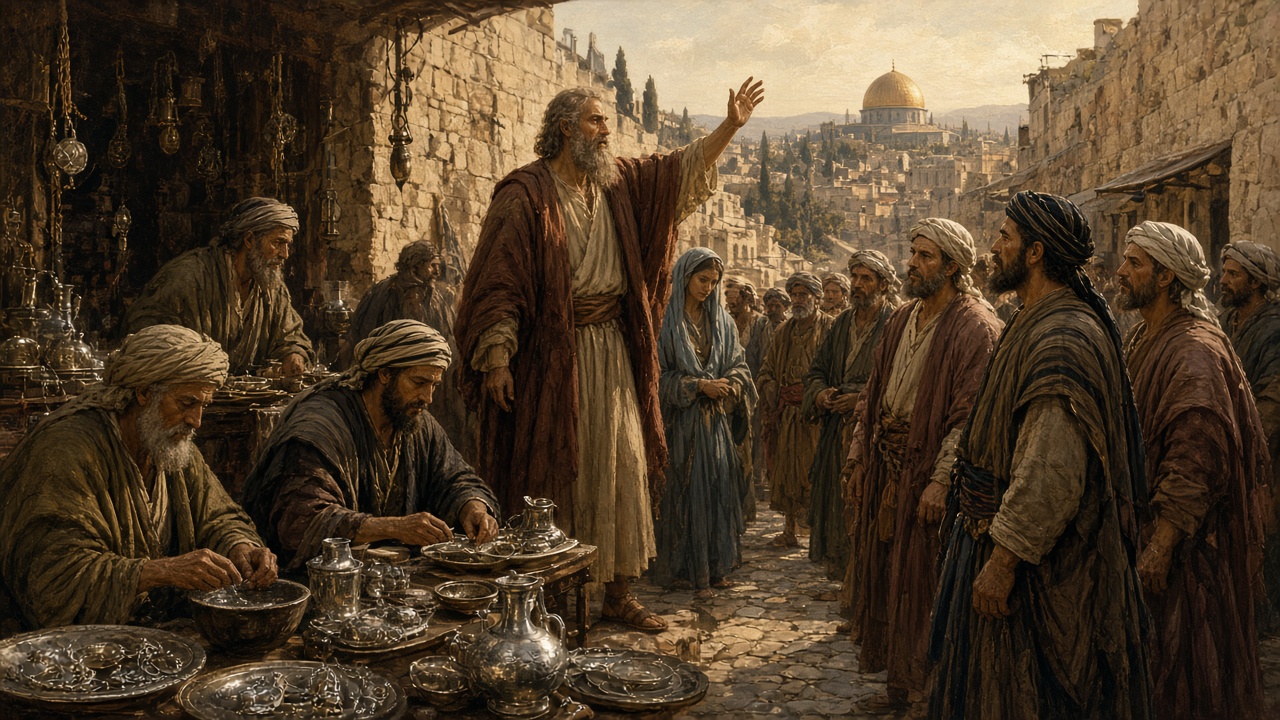
- Zephaniah 1:11 names the Mortar, a place in or near Jerusalem inhabited by silver merchants. It has been conjectured that this was the Phoenician quarter of the city, where traders of that nation lived.Sources: Mortar
Notes written with AI assistance from open sources (Theographic Bible Metadata, CC BY-SA 4.0; Easton’s Bible Dictionary, public domain) and reviewed before publishing.
Zephaniah Prophesies Judgment on Judah
1The Devar Hashem which came unto Tzephanyah ben Cushi, ben Gedalyah, ben Amaryah, ben Chizkiyah, in the yamim of Yoshiyahu (Josiah) ben Amon, Melech Yehudah.
2I will utterly sweep away
all things from off the adamah,
saith Hashem.
3I will sweep away Adam (humankind) and Behemah (beast, animal, cattle);
I will sweep away Oph HaShomayim (Birds of the Air)
and the Dagim of HaYam (Fish of the Sea),
and the michsholim (stumbling blocks, what causes to fall into sin) with the resha'im;
and I will cut off adam from off the adamah,
saith Hashem.
4I will also stretch out Mine hand against Yehudah,
and against all the inhabitants of Yerushalayim;
and I will cut off from this place
the she'ar HaBa'al (remnant of Ba'al),
and the shem (name) of the Kemarim (the idolatrous priests) with the [idolatrous] kohanim;
5And those that worship the Tz'va HaShomayim
(Army of Heaven, star g-ds) upon the rooftops;
and those that worship and that swear [oaths] by Hashem,
but also swear by Milcom;
6And those that turned back from following Hashem;
and those that have not sought Hashem,
nor inquired of Him.
The Day of the LORD
7Hold thy peace (keep silent) at the presence of Adonai Hashem:
for the Yom Hashem is at hand;
for Hashem hath prepared a zevach (sacrifice),
Hashem hath consecrated His guests.
8And it shall come to pass in the Yom Zevach Hashem,
that I will punish the sarim (princes),
and Bnei HaMelech,
and all such as are clothed with malbush nochri (foreign apparel).
9In the same Yom also will I visit to punish
all those that leap over the threshold, which fill their mastersʼ batim (houses)
with chamas (violence) and mirmah (deceit).
10And it shall come to pass in that Yom, saith Hashem,
that there shall be the noise of a cry from Sha'ar HaDagim,
and a wail from the Second Quarter of the city,
and a loud crash from the hills.
11Howl, ye inhabitants of HaMakhtesh,
for all the merchants are cut down;
all they that weigh out kesef are cut off.
12And it shall come to pass at that time,
that I will search Yerushalayim with nerot (lamps),
and visit to punish the [proud] men
that are [complacently] settled on their lees;
that say in their lev: Hashem will not do tov,
neither will Hashem do rah.
13Therefore their goods shall become a booty,
and their batim a desolation;
they shall also build batim, but not inhabit them;
and they shall plant kramim (vineyards), but not drink the yayin thereof.
14The Yom Hashem HaGadol is near,
near and hastening quickly;
the sound of the Yom Hashem is mar (bitter);
there the gibbor (mighty man, warrior) cries aloud.
15That Yom is a Yom Evrah (day of wrath),
a Yom Tzarah and Metzukah (a day of trouble and distress, pressure),
a Yom of Sho'ah (catastrophe) and Meshoah (desolation),
a Yom of Choshech and Afelah (gloom),
a Yom of Anan and Arafel (thick darkness),
16A Yom of the Shofar and Teruah (battle cry)
against the fortified cities,
and against the high battlements.
17And I will bring distress upon adam,
that they shall walk like ivrim,
because they have sinned against Hashem;
and their dahm shall be poured out like dust,
and their bowels like dung.
18Neither their kesef nor their zahav
shall be able to save them in the Yom Evrat Hashem
(Day of Hashem ʼs Wrath);
but kol ha'aretz (the whole earth) shall be devoured
by the eish of Hashemʼs kina (jealousy, zeal, passion);
for He shall make a complete end, a terrible end,
of kol yoshvei ha'aretz (all them that dwell on the earth).
Did you know?
The Day of the LORD and Judgment on Idolatry
- Zephaniah traces his lineage back four generations to Hezekiah, dating his prophetic ministry to the reign of King Josiah of Judah. Josiah came to power after his father, King Amon, had restored idolatry across Judah before being assassinated by his own servants.Sources: the Bible text itself · Josiah · Amon · Hizkiah
- The chapter denounces religious syncretism in Jerusalem, where people bowed on rooftops to the host of heaven and combined their devotion to the LORD with oaths to Baal and Malcham, the national idol of the Ammonites.Sources: the Bible text itself · Baal · Malcham
- The prophecy specifies landmarks in Jerusalem that would experience turmoil, including the Fish Gate and the Mortar (or Hollow), a district inhabited by merchants who weighed out silver.Sources: the Bible text itself · Fish Gate · Mortar
Notes written with AI assistance from open sources (Theographic Bible Metadata, CC BY-SA 4.0; Easton’s Bible Dictionary, public domain) and reviewed before publishing.
Places in this chapter
- Jerusalem · 31.777, 35.234 · verses 4, 12
- Fish Gate · Today: in Jerusalem · 31.777, 35.234 · verse 10
- Second Quarter · Today: in Jerusalem · 31.777, 35.234 · verse 10
- Canaan · 32.767, 35.333 · verse 11
- Mortar · Today: in Jerusalem · 31.777, 35.234 · verse 11
Only places identified with high confidence are shown (90% or more according to the scholarly sources compiled by OpenBible). Period map: DARE (Digital Atlas of the Roman Empire), CC BY 4.0; modern map: © OpenStreetMap contributors; places: OpenBible.info (CC BY 4.0).
Credits and license for this translation
The Orthodox Jewish Bible
The Orthodox Jewish Bible - Tanakh and Orthodox Jewish Brit Chadasha - The Holy Bible
copyright © 2002-2011, 2021, 2024 Artists for Israel International
Language: English
Contributor: Artists for Israel International
THE ORTHODOX JEWISH TANAKH
Artists For Israel Intl Inc.
This version also appears with the Orthodox Yiddish Triglot which presents the Hebrew Yiddish script in Latin script and an English word for word translation, available at afii.org/Torah
To donate PayPal.Me
This translation is made available to you under the terms of the
Creative Commons Attribution license 4.0.
You may share and redistribute this Bible translation or extracts from it in any format, provided that:
You include the above copyright and source information.
If you make any changes to the text, you must indicate that you did so in a way that makes it clear that the original licensor is not necessarily endorsing your changes.
Pictures included with Scriptures and other documents on this site are licensed just for use with those Scriptures and documents.
For other uses, please contact the respective copyright owners.
Note that in addition to the rules above, revising and adapting God's Word involves a great responsibility to be true to God's Word. See Revelation 22:18-19.
2026-01-06
Section headings adapted from the Berean Standard Bible (public domain); they are not part of this translation’s text.
Source: http://ebible.org/engojb/ · eBible.org