Revelation 21
The Orthodox Jewish Bible · Tap a verse to see its cross-references.
A New Heaven and a New Earth
1And I saw Shomayim Chadashim (New Heavens) and Eretz Chadasha (a New Earth), for the shomayim harishonah (the first heaven) and haaretz harishonah (the first earth) were passed away, and there is no longer any Yam (Sea). 2And I saw the Ir Hakodesh, the Yerushalayim HaChadasha coming down and descending out of Shomayim from Hashem, having been made ready as a Kallah adorned for her Ba'al (Husband). 3And I heard a kol gadol (loud voice), a Bat Kol from the Kisse (Throne) saying, “Hinei, The Mishkan of Hashem is with men, and He shall tabernacle with them, and they shall be His people, and Hashem Himself shall dwell among them. 4And He will wipe away every tear from their eyes, and there shall not be any longer Mavet, nor Avelut nor weeping nor pain; the former things have passed away.”
5And said the One sitting on the Kisse (Throne), “Hinei, I make all things chadash.” And He says, “Write, for these devarim are ne'emanim and amittiyim.” 6And He said to me, “It is finished! I am the Alef and the Tav, the Reshit and the Ketz. To the one thirsting I will give of the Ma'ayan (Fountain) of Mayim Chayyim (Water of Life) freely. 7The one who wins the nitzachon (victory), shall inherit these things and I will be his G-d and he will be to Me beni (my son). 8But for those of morech lev (cowardliness) and those without emunah (faith) and the ones having become vile and ratzchaniyot (murderers) and zonim (fornicators) and mekhashfim (sorcerers) and ovdei haelilim (idolaters) and all the shakranit (liars), their chelek will be in the Agam (Lake) burning with Eish (fire) and Gofrit (sulfur), which is HaMavet HaSheyni (the Second Death).”
The New Jerusalem
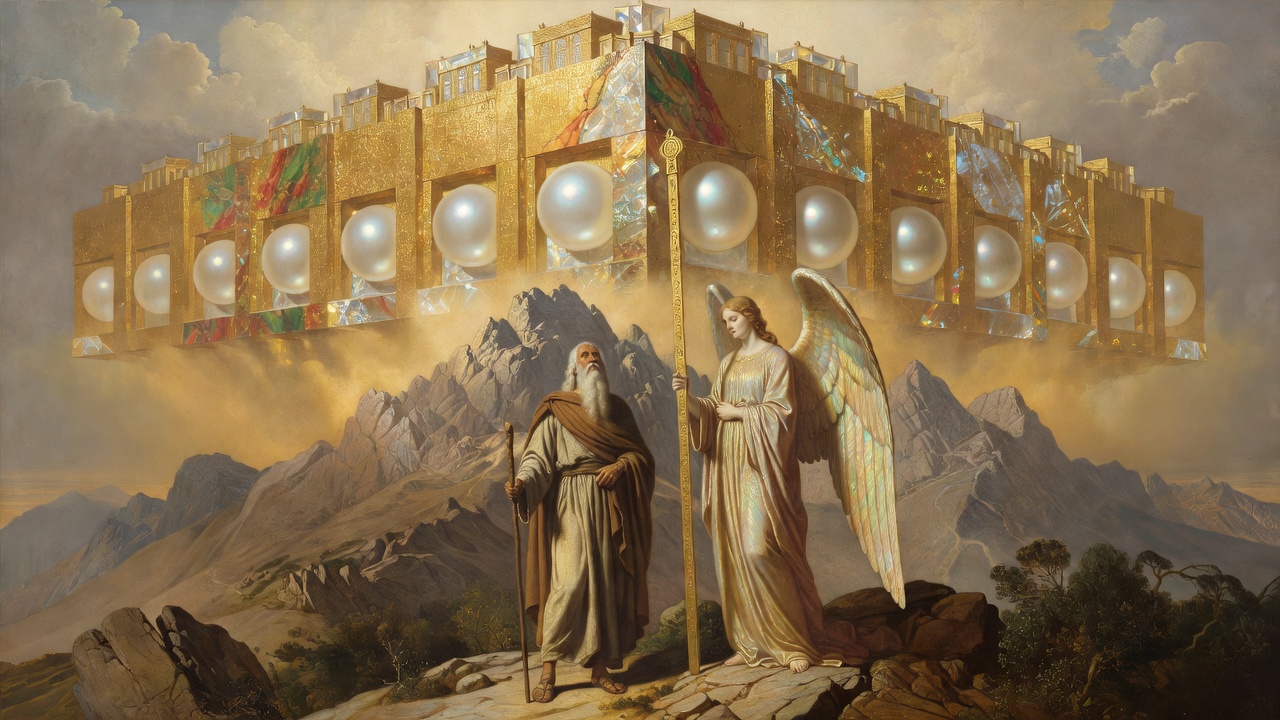
9And one of the shivat hamalachim having the sheva ke'arot (bowls) being full of the last sheva makkot (plagues), came and spoke with me, saying “Bo! I will show you the Kallah of the SEH” (Lamb). 10And he carried me away in the Ruach Hakodesh onto a great and high mountain, and showed me the Ir Hakodesh, Yerushalayim, descending and coming down out of Shomayim from Hashem, 11Having the Shekhinah kavod (glory) of Hashem. Her brilliance, was like a precious stone, even a jasper, clear as crystal, 12Having a great and high wall, having Shneym Asar She'arim (Twelve Gates), and at the She'arim (Gates), Shneym Asar malachim (Twelve angels), and SHEMOT (Names) were inscribed on them, which are the shemot (names) of the Shneym Asar Shivtei HaBnei Yisroel (Twelve Tribes of the Bnei Yisroel). 13There were shloshah she'arim (three gates) on the mizrach (east), there were shloshah she'arim on the tzafon (north), and shloshah she'arim on the darom (south) and shloshah she'arim on the ma'arav (west). 14And the wall of the Ir Hakodesh had Shneym Asar Foundation Stones, and on them were the Shneym Asar shemot (names) of the Shneym Asar Shlichim of the SEH (Lamb).
15And the one speaking with me had a gold measuring rod, that he might measure the Ir Hakodesh and its she'arim (gates) and its wall. 16And the city is laid out foursquare, shaped like a cube, and its length is as great as the width; and he measured the Ir Hakodesh with the rod across and it measured Shneym Asar (Twelve) thousand stadia (fifteen hundred miles); the length and the breadth and the height are equal. 17And he measured its wall a hundred forty-four cubits (seventy-two yards) by manʼs measurement, which is also that of the malachim. 18And the wall was constructed of jasper and the Ir was pure zahav (gold) like clear glass. 19The foundation stones of the wall of the city were adorned with every kind of precious stone, harishon (the first) foundation stone was jasper, hasheni (the second), sapphire, hashlishi (the third), chalcedony, harevi'i (fourth), emerald; 20The fifth, sardonyx, the sixth, carnelian, the seventh, chrysolite, the eighth, beryl, the ninth, topaz, the tenth, chrysoprase, the eleventh, jacinth, the twelfth, amethyst. 21And the Shneym Asar she'arim were Shneym Asar pearls, respectively each one of the she'arim was a single pearl. And the rekhov (street) of the city was pure zahav (gold), like transparent glass.
22And I saw no Heikhal in it, for Adonoi Hashem El Shaddai and the SEH (Lamb), are its Beis HaMikdash. 23And the city has no need of the shemesh (sun) nor of the levanah (moon) that they may shine in it, for the kavod (glory) of Hashem illumined it and its menorah is the SEH (Lamb). 24And the Nations shall walk their derech by its Ohr (Light), and the melachim (kings) of ha'aretz shall bring their glory into it. 25And b'yom (for there will be no Lailah) the she'arim (gates) of it shall never be shut. 26And the melachim will bring the kavod (glory) of the Nations into it. 27And never may enter into it any thing tameh and anyone practicing to'evah (abomination) and sheker (falsehood), but only the ones having been written in the Sefer HaChayyim Shel HaSEH (the Book of Life of the Lamb).
Did you know?
The New Jerusalem
- In this vision the city coming down from heaven is called the holy city, the new Jerusalem. Jerusalem was also known as the holy city and the city of God, and in Arabic it is el-Khuds, meaning the holy. Its name is in a dual form and means possession of peace or foundation of peace.Sources: the Bible text itself · Jerusalem
- The seer is carried in the Spirit to a great and high mountain and shown that holy city descending. Jerusalem is described as a mountain city enthroned on a mountain stronghold, and the dual form of the name probably refers to the two mountains on which it was built, Zion and Moriah, or, as some suppose, to the upper and lower city.Sources: the Bible text itself · Jerusalem
- The city wall has twelve gates, three on each side, inscribed with the names of the twelve tribes of Israel. Israel is another name for Jacob, explained as one who follows on another's heels, or as a supplanter.Sources: the Bible text itself · Jacob (Israel)
Notes written with AI assistance from open sources (Theographic Bible Metadata, CC BY-SA 4.0; Easton’s Bible Dictionary, public domain) and reviewed before publishing.
Places in this chapter
Only places identified with high confidence are shown (90% or more according to the scholarly sources compiled by OpenBible). Period map: DARE (Digital Atlas of the Roman Empire), CC BY 4.0; modern map: © OpenStreetMap contributors; places: OpenBible.info (CC BY 4.0).
Credits and license for this translation
The Orthodox Jewish Bible
The Orthodox Jewish Bible - Tanakh and Orthodox Jewish Brit Chadasha - The Holy Bible
copyright © 2002-2011, 2021, 2024 Artists for Israel International
Language: English
Contributor: Artists for Israel International
THE ORTHODOX JEWISH TANAKH
Artists For Israel Intl Inc.
This version also appears with the Orthodox Yiddish Triglot which presents the Hebrew Yiddish script in Latin script and an English word for word translation, available at afii.org/Torah
To donate PayPal.Me
This translation is made available to you under the terms of the
Creative Commons Attribution license 4.0.
You may share and redistribute this Bible translation or extracts from it in any format, provided that:
You include the above copyright and source information.
If you make any changes to the text, you must indicate that you did so in a way that makes it clear that the original licensor is not necessarily endorsing your changes.
Pictures included with Scriptures and other documents on this site are licensed just for use with those Scriptures and documents.
For other uses, please contact the respective copyright owners.
Note that in addition to the rules above, revising and adapting God's Word involves a great responsibility to be true to God's Word. See Revelation 22:18-19.
2026-01-06
Section headings adapted from the Berean Standard Bible (public domain); they are not part of this translation’s text.
Source: http://ebible.org/engojb/ · eBible.org