Psalms 80
The Orthodox Jewish Bible · Tap a verse to see its cross-references.
Hear Us, O Shepherd of Israel
1(For the one directing. Set to The Lilies of the Edut. Of Asaph. Mizmor.)
2Give ear, O Ro'eh Yisroel,
Thou that leadest Yosef like a tzon;
Thou that art enthroned between the Keruvim, shine forth.
3Before Ephrayim and Binyamin and Menasheh,
Stir up Thy gevurah (might), and come and save us.
4Turn us again, O Elohim,
and cause Thy face to shine that we may be saved.
5Hashem Elohim Tzva'os,
ad mosai (how long) wilt Thou be angry against the tefillat amecha (prayer of Thy people)?
6Thou feedest them with the lechem dimah (bread of tears);
and givest them dima'ot (tears) to drink in great measure.
7Thou makest us a madon (strife, contention) unto shcheneinu (our neighbors),
and oyveinu (our enemies) mock us.
8Turn us again, O Elohim Tzva'os,
and cause Thy face to shine that we may be saved.
9Thou hast brought a gefen (vine) out of Mitzrayim;
Thou hast drove out Goyim, and planted it.
10Thou preparedst room before it,
and didst cause it to take deep root,
and it filled the eretz.
11The harim were covered with the tzel (shadow) of it,
and the branches thereof were like the mighty cedars.
12It sent out its branches unto the yam (sea),
and its shoots unto the Nahar (river).
13Lammah (why) hast Thou then broken down her walls,
so that all they which pass by the derech do pluck her?
14The chazir (wild boar) out of the forest doth lay it waste,
and the beasts of the sadeh doth devour it.
15Shuv nah (return now), we beseech Thee, O Elohim Tzva'os;
look down from Shomayim, and behold, and visit gefen zot (this vine);
16And the stock which Thy Yamin (Right Hand) hath planted,
and the Ben that Thou madest strong for Thyself.
17It is burned with eish, it is cut down;
they perish at the ge'arah (rebuke) of Thy countenance.
18Let Thy Yad be upon the Ish Yeminecha (the Man of your Right Hand),
upon the Ben Adam whom Thou madest strong for Thyself.
19So will we never turn back from Thee;
revive us, and we will call upon Thy Shem.
20Turn us again, Hashem Elohim Tzva'os;
cause Thy face to shine that we may be saved.
Did you know?
A Prayer for the Uprooted Vine
- The psalm specifically mentions Ephraim, Benjamin, and Manasseh, tribes closely linked by descent from Rachel through Joseph and Benjamin. During Israel's wilderness wanderings, these three tribes were assigned to camp and march together on the western side of the tabernacle.Sources: Benjamin (patriarch) · Manasseh (son of Joseph) · the Bible text itself
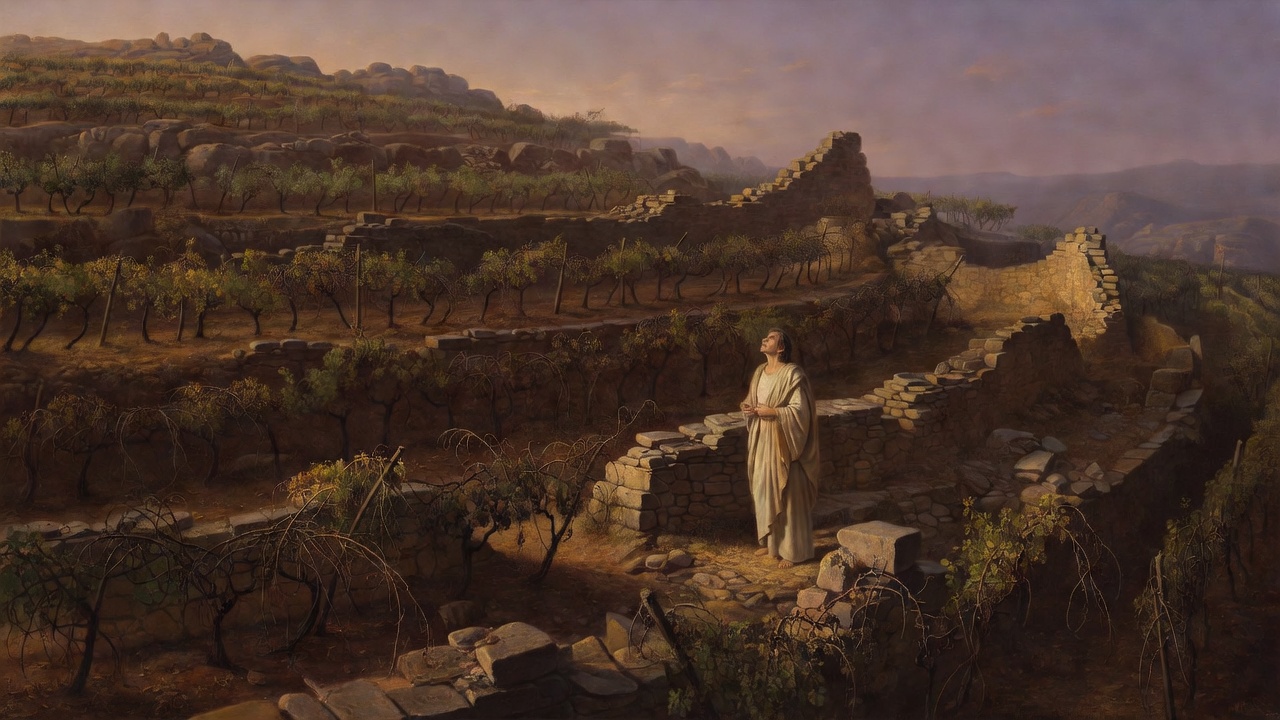
- The author uses an extended allegory comparing the nation of Israel to a grapevine brought out of Egypt and replanted in Canaan. The song laments that God had torn down the protective vineyard walls, leaving the fruitful vine exposed to wild beasts and passersby.Sources: Egypt · the Bible text itself
- This poem is part of a distinct collection spanning Psalms 73 through 83 attributed to Asaph. The biblical record describes Asaph as a leading Levite musician in the time of King David whose musical guild or descendants continued his tradition in temple worship.Sources: Asaph (Levite) · the Bible text itself
Notes written with AI assistance from open sources (Theographic Bible Metadata, CC BY-SA 4.0; Easton’s Bible Dictionary, public domain) and reviewed before publishing.
Places in this chapter
- Egypt · 30.129, 31.308 · verse 8
- Euphrates · Today: Euphrates River · 31.004, 47.442 · verse 11
- Great Sea · Today: Mediterranean Sea · 31.805, 34.170 · verse 11
Only places identified with high confidence are shown (90% or more according to the scholarly sources compiled by OpenBible). Period map: DARE (Digital Atlas of the Roman Empire), CC BY 4.0; modern map: © OpenStreetMap contributors; places: OpenBible.info (CC BY 4.0).
Credits and license for this translation
The Orthodox Jewish Bible
The Orthodox Jewish Bible - Tanakh and Orthodox Jewish Brit Chadasha - The Holy Bible
copyright © 2002-2011, 2021, 2024 Artists for Israel International
Language: English
Contributor: Artists for Israel International
THE ORTHODOX JEWISH TANAKH
Artists For Israel Intl Inc.
This version also appears with the Orthodox Yiddish Triglot which presents the Hebrew Yiddish script in Latin script and an English word for word translation, available at afii.org/Torah
To donate PayPal.Me
This translation is made available to you under the terms of the
Creative Commons Attribution license 4.0.
You may share and redistribute this Bible translation or extracts from it in any format, provided that:
You include the above copyright and source information.
If you make any changes to the text, you must indicate that you did so in a way that makes it clear that the original licensor is not necessarily endorsing your changes.
Pictures included with Scriptures and other documents on this site are licensed just for use with those Scriptures and documents.
For other uses, please contact the respective copyright owners.
Note that in addition to the rules above, revising and adapting God's Word involves a great responsibility to be true to God's Word. See Revelation 22:18-19.
2026-01-06
Section headings adapted from the Berean Standard Bible (public domain); they are not part of this translation’s text.
Source: http://ebible.org/engojb/ · eBible.org