Psalms 74
The Orthodox Jewish Bible · Tap a verse to see its cross-references.
Why Have You Rejected Us Forever?
1(A Maskil of Asaph)
1 O Elohim, why hast Thou cast us off lanetzach?
Why doth Thine anger smoke against the tzon (sheep) of Thy mireh (pasture)?
2Remember Thy Edah (congregation), which Thou hast purchased of old;
the shevet (tribe) of Thine nachalah, which Thou hast redeemed:
this Har Tziyon, wherein Thou hast dwelt.
3Lift up Thy footsteps unto the mashu'ot netzach (perpetual ruins);
even all that the oyev hath done wickedly in the Kodesh.
4Thine enemies roar in the midst of Thy Mo'ed (place of meeting);
they set up their banners for otot (signs).
5It had been as though one lifted up
kardumim (axes) upon the thicket of etz.
6But now they break down the carved panels
at once with hammers and chisels.
7They have set ablaze Thy Mikdash, burning it to the ground;
they have brought chillul to the Mishkan Shemecha (the dwelling place of Thy Name).
8They said in their hearts,
Let us crush them altogether;
they have burned up all the Mo'adei El in HaAretz.
9We see not our otot (signs);
there is no longer any navi;
neither is there among us any that knoweth ad mah (until when).
10O Elohim ad mosai, (how long) shall the adversary revile?
Shall the oyev (enemy) blaspheme Thy Shem lanetzach (forever)?
11Why withdrawest Thou Thy Yad, even Thy Yamin (Right Hand)?
Take it out of Thy Kheyk (bosom) and destroy.
12For Elohim is my Melech mikedem (from of old),
working Yeshu'ah (salvation) in the midst of Ha'Aretz.
13Thou didst divide the yam by Thy oz (power);
Thou didst break the heads of the sea serpents in the waters.
14Thou didst break the head of Leviathan in pieces,
and gavest him to be ma'akhal (food) to the people inhabiting the wilderness.
15Thou didst break open the fountain and the flood;
Thou driedst up mighty naharot (rivers).
16The yom is Thine, the lailah also is Thine;
Thou hast prepared the ma'ohr (luminary, moon) and the shemesh.
17Thou hast set all the boundaries of Eretz;
Thou hast made kayitz (summer) and choref (winter).
18Remember this, that the oyev (enemy) hath reproached Hashem,
and that the am naval (foolish people) have blasphemed Shimcha.
19O deliver not the nefesh of Thy turtledove unto the wild beast;
forget not the life of Thy aniyim (poor) lanetzach (forever).
20Have regard unto the Brit (covenant);
for the dark places of the earth
are full of the habitations of chamas.
21O let not the oppressed return in shame;
let the oni and evyon praise Thy Shem.
22Arise, O Elohim, fight for Thine Own cause;
remember how the naval (foolish man) revileth Thee kol hayom.
23Forget not the kol (voice) of Thine enemies,
the tumult of those against Thee that rises up tamid (continually).
Did you know?
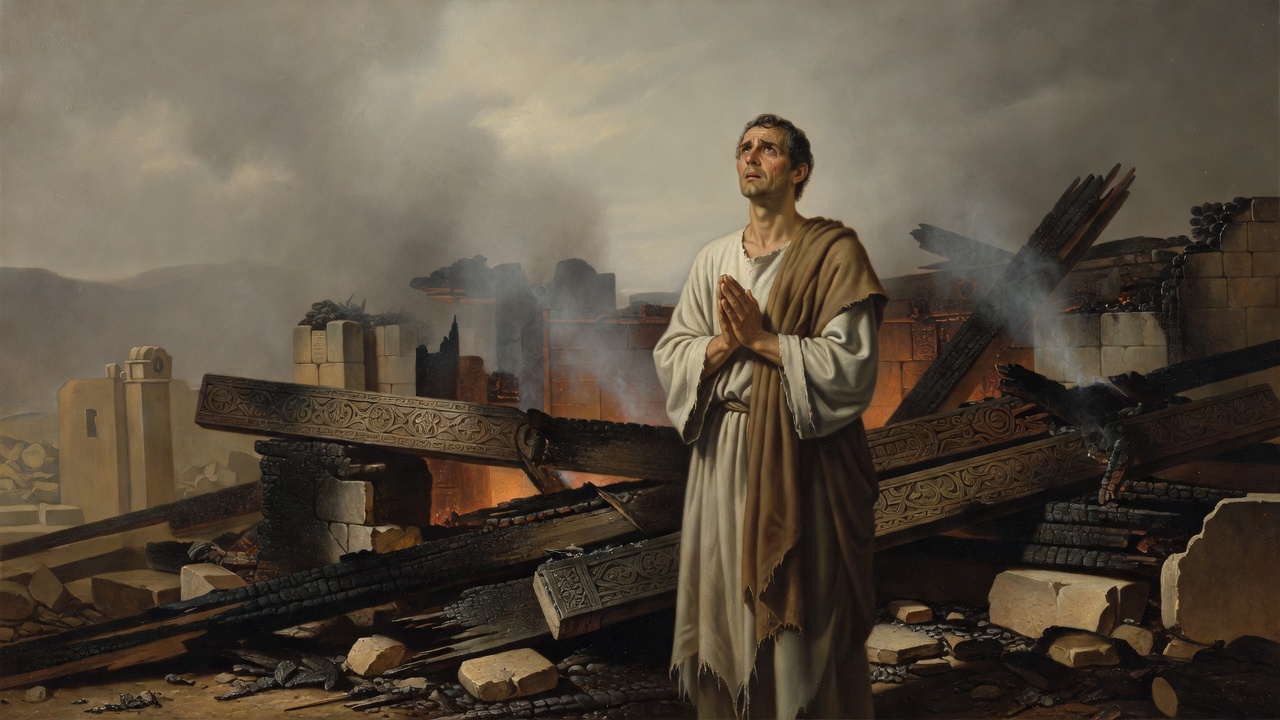
Lament over the Destroyed Sanctuary
- Psalms 73 through 83 are attributed to Asaph, a Levite musician and leader of David's choir. Because Psalm 74 laments the burning and total destruction of the sanctuary, many scholars connect it with the later "sons of Asaph," a guild of poets and singers who preserved his tradition.Sources: Asaph (Levite) · the Bible text itself
- The psalm appeals to God to remember Mount Zion, a prominent hill in Jerusalem where David established his citadel and where the sanctuary stood as the dwelling place of God's name.Sources: Mount Zion · the Bible text itself
- The destruction of the sanctuary is vividly described using the metaphor of woodcutters felling trees, as invaders smashed the intricate carved woodwork with axes and picks before burning the holy place to the ground.Sources: the Bible text itself
Notes written with AI assistance from open sources (Theographic Bible Metadata, CC BY-SA 4.0; Easton’s Bible Dictionary, public domain) and reviewed before publishing.
Places in this chapter
- Mount Zion · 31.772, 35.229 · verse 2
Only places identified with high confidence are shown (90% or more according to the scholarly sources compiled by OpenBible). Period map: DARE (Digital Atlas of the Roman Empire), CC BY 4.0; modern map: © OpenStreetMap contributors; places: OpenBible.info (CC BY 4.0).
Credits and license for this translation
The Orthodox Jewish Bible
The Orthodox Jewish Bible - Tanakh and Orthodox Jewish Brit Chadasha - The Holy Bible
copyright © 2002-2011, 2021, 2024 Artists for Israel International
Language: English
Contributor: Artists for Israel International
THE ORTHODOX JEWISH TANAKH
Artists For Israel Intl Inc.
This version also appears with the Orthodox Yiddish Triglot which presents the Hebrew Yiddish script in Latin script and an English word for word translation, available at afii.org/Torah
To donate PayPal.Me
This translation is made available to you under the terms of the
Creative Commons Attribution license 4.0.
You may share and redistribute this Bible translation or extracts from it in any format, provided that:
You include the above copyright and source information.
If you make any changes to the text, you must indicate that you did so in a way that makes it clear that the original licensor is not necessarily endorsing your changes.
Pictures included with Scriptures and other documents on this site are licensed just for use with those Scriptures and documents.
For other uses, please contact the respective copyright owners.
Note that in addition to the rules above, revising and adapting God's Word involves a great responsibility to be true to God's Word. See Revelation 22:18-19.
2026-01-06
Section headings adapted from the Berean Standard Bible (public domain); they are not part of this translation’s text.
Source: http://ebible.org/engojb/ · eBible.org