Psalms 149
The Orthodox Jewish Bible · Tap a verse to see its cross-references.
Sing to the LORD a New Song
1Praise Hashem.
Shiru l'Adonoi shir chadash (Sing unto Hashem a new song),
and His praise in the Kahal Chasidim.
2Let Yisroel rejoice in Him that made him;
let the Bnei Tziyon be glad in their Melech.
3Let them praise Shmo in the dance;
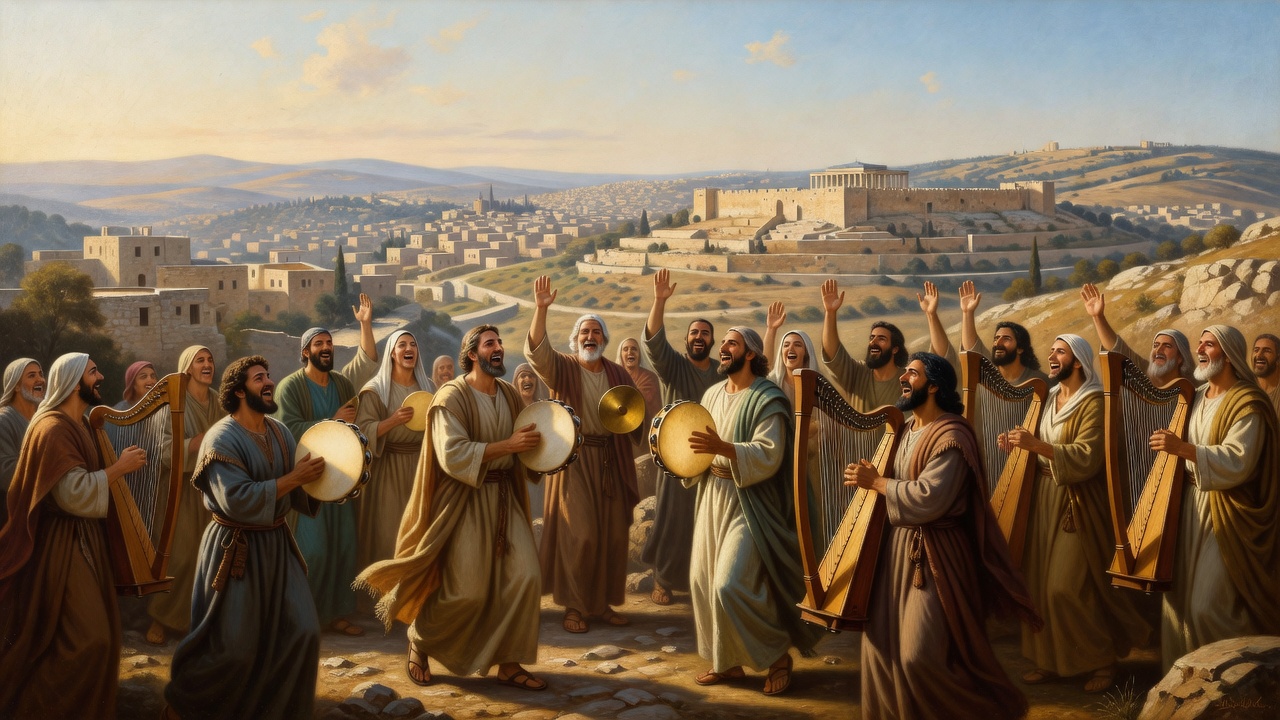
let them sing zemirot unto Him with the tambourine and kinnor.
4For Hashem taketh pleasure in His people;
He will crown the meek with Yeshu'ah (salvation).
5Let the Chasidim be joyful in kavod;
let them sing for joy upon their beds.
6Let the high praises of G-d be in their mouth,
and a two-edged sword in their hand;
7To execute vengeance upon the Goyim,
and punishments upon the people;
8To bind their melachim with chains,
and their nobles with shackles of barzel (iron);
9To execute upon them the mishpat katuv (written judgment);
this honor have all His Chasidim.
Hallelu Hashem.
Did you know?
Praise and Victory in Zion
- The reference to the children of Zion points to the people of Jerusalem. Zion was the fortified hill captured by King David from the Jebusites, where he established his citadel and palace, known as the City of David.Sources: Zion · the Bible text itself
- Psalm 149 pairs exuberant temple-style worship—including dancing, tambourines, and harps—with imagery of battle, depicting the faithful with high praises in their mouths and double-edged swords in their hands.Sources: the Bible text itself
Notes written with AI assistance from open sources (Theographic Bible Metadata, CC BY-SA 4.0; Easton’s Bible Dictionary, public domain) and reviewed before publishing.
Places in this chapter
- Zion · Today: Jerusalem · 31.777, 35.234 · verse 2
Only places identified with high confidence are shown (90% or more according to the scholarly sources compiled by OpenBible). Period map: DARE (Digital Atlas of the Roman Empire), CC BY 4.0; modern map: © OpenStreetMap contributors; places: OpenBible.info (CC BY 4.0).
Credits and license for this translation
The Orthodox Jewish Bible
The Orthodox Jewish Bible - Tanakh and Orthodox Jewish Brit Chadasha - The Holy Bible
copyright © 2002-2011, 2021, 2024 Artists for Israel International
Language: English
Contributor: Artists for Israel International
THE ORTHODOX JEWISH TANAKH
Artists For Israel Intl Inc.
This version also appears with the Orthodox Yiddish Triglot which presents the Hebrew Yiddish script in Latin script and an English word for word translation, available at afii.org/Torah
To donate PayPal.Me
This translation is made available to you under the terms of the
Creative Commons Attribution license 4.0.
You may share and redistribute this Bible translation or extracts from it in any format, provided that:
You include the above copyright and source information.
If you make any changes to the text, you must indicate that you did so in a way that makes it clear that the original licensor is not necessarily endorsing your changes.
Pictures included with Scriptures and other documents on this site are licensed just for use with those Scriptures and documents.
For other uses, please contact the respective copyright owners.
Note that in addition to the rules above, revising and adapting God's Word involves a great responsibility to be true to God's Word. See Revelation 22:18-19.
2026-01-06
Section headings adapted from the Berean Standard Bible (public domain); they are not part of this translation’s text.
Source: http://ebible.org/engojb/ · eBible.org