Psalms 122
The Orthodox Jewish Bible · Tap a verse to see its cross-references.
Pray for the Peace of Jerusalem
1(Shir HaMa'alot [Song of Ascents], of Dovid)
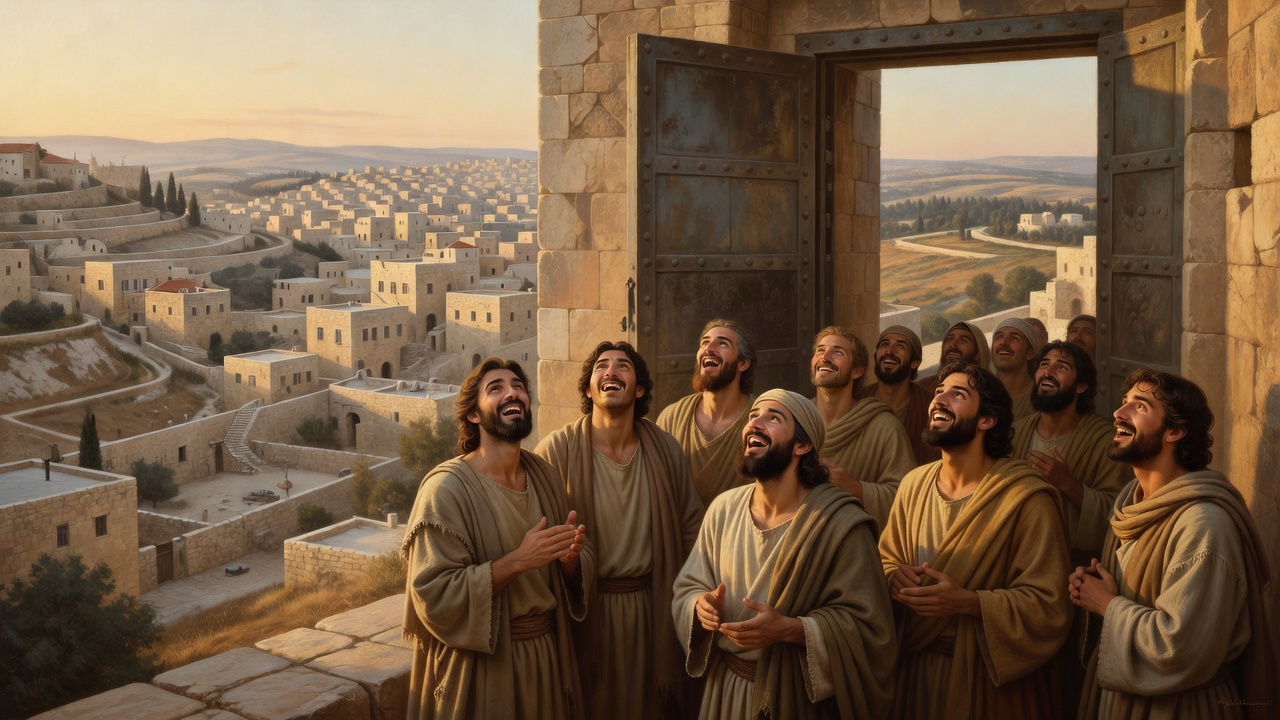
1 I was glad when they said unto me,
Let us go into the Bais Hashem.
2Our feet shall stand within thy she'arim,
O Yerushalayim.
3Yerushalayim is built as an Ir
bound firmly together;
4That is where the Shevatim (tribes) go up,
the Shivtei Hashem,
according to the edut l'Yisroel (the statute to Yisroel),
to give thanks unto the Shem of Hashem.
5For there are set kise'ot l'mishpat (thrones of judgment),
the kise'ot of the Bais Dovid.
6Sha'alu shalom Yerushalayim (pray for the peace of Jerusalem);
they shall prosper that love thee.
7Shalom be within thy wall,
and security within thy citadels.
8L'ma'an (for the sake of) my achim and companions,
I will now say, Shalom be within thee.
9L'ma'an the Bais Hashem Eloheinu
I will seek thy tov.
Did you know?
A Pilgrimage Song for the City of Peace
- The name Jerusalem appears in the original Hebrew in a dual form, often interpreted as meaning 'foundation of peace' or 'possession of peace.' This dual form may refer to the two mountains on which the city sat—Zion and Moriah—or to the upper and lower sections of the city.Sources: Jerusalem
- This psalm is a Song of Ascents associated with David, depicting pilgrims traveling to Jerusalem to give thanks at the house of the LORD and highlighting the city as the seat of the thrones of justice for the royal line of David.Sources: the Bible text itself · David
Notes written with AI assistance from open sources (Theographic Bible Metadata, CC BY-SA 4.0; Easton’s Bible Dictionary, public domain) and reviewed before publishing.
Places in this chapter
Only places identified with high confidence are shown (90% or more according to the scholarly sources compiled by OpenBible). Period map: DARE (Digital Atlas of the Roman Empire), CC BY 4.0; modern map: © OpenStreetMap contributors; places: OpenBible.info (CC BY 4.0).
Credits and license for this translation
The Orthodox Jewish Bible
The Orthodox Jewish Bible - Tanakh and Orthodox Jewish Brit Chadasha - The Holy Bible
copyright © 2002-2011, 2021, 2024 Artists for Israel International
Language: English
Contributor: Artists for Israel International
THE ORTHODOX JEWISH TANAKH
Artists For Israel Intl Inc.
This version also appears with the Orthodox Yiddish Triglot which presents the Hebrew Yiddish script in Latin script and an English word for word translation, available at afii.org/Torah
To donate PayPal.Me
This translation is made available to you under the terms of the
Creative Commons Attribution license 4.0.
You may share and redistribute this Bible translation or extracts from it in any format, provided that:
You include the above copyright and source information.
If you make any changes to the text, you must indicate that you did so in a way that makes it clear that the original licensor is not necessarily endorsing your changes.
Pictures included with Scriptures and other documents on this site are licensed just for use with those Scriptures and documents.
For other uses, please contact the respective copyright owners.
Note that in addition to the rules above, revising and adapting God's Word involves a great responsibility to be true to God's Word. See Revelation 22:18-19.
2026-01-06
Section headings adapted from the Berean Standard Bible (public domain); they are not part of this translation’s text.
Source: http://ebible.org/engojb/ · eBible.org