Psalms 109
The Orthodox Jewish Bible · Tap a verse to see its cross-references.
The Song of the Slandered
1(For the one directing. Of Dovid. Mizmor)
1 Hold not Thy peace, O Elohei tehillati;
2For the mouth of the rasha and the mouth of the mirmah
are opened against me;
they have spoken against me with a leshon sheker (a lying tongue).
3They surrounded me also with divrei sinah (words of hatred);
and attacked me without cause.
4In return for my ahavah they are my adversaries;
but I give myself unto tefillah (prayer).
5Thus they have laid upon me ra'ah for tovah,
and sinah for my ahavah.
6Set Thou a rasha (wicked man) over him;
and let Satan (the Accuser) stand at his yamin (right hand).
7When he shall be tried, let him be in the judgment condemned;
and let his tefillah (prayer) become sin.
8Let his yamim be few;
and let another take his pekuddah.
9Let his banim be yetomim,
and his isha an almanah.
10Let his banim be continually vagabonds, and beg;
let them seek from their ruins.
11Let the nosheh (creditor) seize all that he hath;
and let the zarim (strangers) plunder his labor.
12Let there be none to extend chesed unto him;
neither let there be any to favor his yetomim.
13Let his posterity be cut off;
and in the dor acher (generation following) let their shem be blotted out.
14Let the avon of his avot be remembered before Hashem;
and let not the chattat immo be blotted out.
15Let them be before Hashem tamid,
that He may cut off the memory of them from ha'aretz.
16Because he remembered not to show chesed,
but persecuted the ish oni and the evyon,
that he might even slay the nikheh levav (broken-hearted person).
17As he loved kelalah (cursing),
so it came on him; as he delighted not in brocha (blessing),
so it was far from him.
18As he clothed himself with kelalah as with his garment,
so let it come into his inward parts like mayim,
and like shemen into his atzmot.
19Let it be unto him like a beged which covereth him,
and for a belt wherewith he is girded tamid (continually).
20This is the reward of mine adversaries from Hashem,
and of them that speak rah against my nefesh.
21But Thou O Hashem Adonoi, do with me for the sake of Thy Name;
because Thy chesed is tov, deliver Thou me.
22For I am oni and evyon,
and my lev is wounded within me.
23I am gone like a lengthening tzel (shadow);
I am shaken off like the arbeh.
24My knees are weak from a tzom;
and my basar faileth of fatness.
25I became also a cherpah (reproach) unto them;
when they looked upon me, they shaked their heads.
26Help me, O Hashem Elohai;
O hoshi'eini (save me) according to Thy chesed;
27That they may know that this is Thy Yad;
that Thou, Hashem, hast done it.
28Let them make kelalah (curse), but do Thou make brocha;
when they arise, let them be ashamed;
but let Thy eved rejoice.
29Let mine adversaries be clothed with shame,
and let them cover themselves with their own shame, as with a me'il (cloak).
30I will greatly praise Hashem with my mouth;
and, I will praise Him among the multitude.
31For He shall stand at the yamin (right hand) of the evyon (needy),
to save him from those that judge with condemnation his nefesh.
Did you know?
A Plea Against False Accusers
- The psalm asks for an accuser or adversary to stand at the enemy's right hand in judgment (verse 6). This legal imagery uses the term behind the Hebrew name Satan, which fundamentally denotes an adversary or accuser, contrasting with verse 31 where the Lord Himself stands at the right hand of the needy.Sources: the Bible text itself · Satan
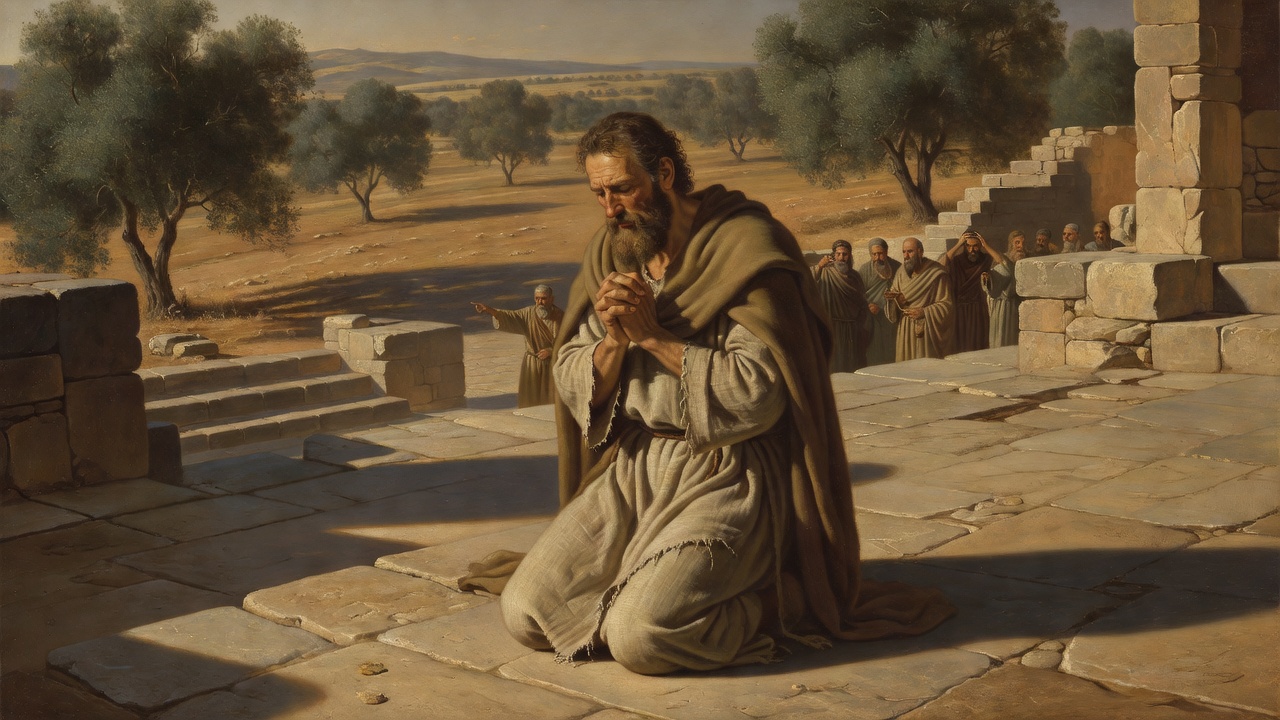
- The author portrays severe personal suffering while enduring malicious slanders, describing knees weakened by fasting, physical emaciation, and feeling shaken off like a locust as life fades like an evening shadow.Sources: the Bible text itself
Notes written with AI assistance from open sources (Theographic Bible Metadata, CC BY-SA 4.0; Easton’s Bible Dictionary, public domain) and reviewed before publishing.
Credits and license for this translation
The Orthodox Jewish Bible
The Orthodox Jewish Bible - Tanakh and Orthodox Jewish Brit Chadasha - The Holy Bible
copyright © 2002-2011, 2021, 2024 Artists for Israel International
Language: English
Contributor: Artists for Israel International
THE ORTHODOX JEWISH TANAKH
Artists For Israel Intl Inc.
This version also appears with the Orthodox Yiddish Triglot which presents the Hebrew Yiddish script in Latin script and an English word for word translation, available at afii.org/Torah
To donate PayPal.Me
This translation is made available to you under the terms of the
Creative Commons Attribution license 4.0.
You may share and redistribute this Bible translation or extracts from it in any format, provided that:
You include the above copyright and source information.
If you make any changes to the text, you must indicate that you did so in a way that makes it clear that the original licensor is not necessarily endorsing your changes.
Pictures included with Scriptures and other documents on this site are licensed just for use with those Scriptures and documents.
For other uses, please contact the respective copyright owners.
Note that in addition to the rules above, revising and adapting God's Word involves a great responsibility to be true to God's Word. See Revelation 22:18-19.
2026-01-06
Section headings adapted from the Berean Standard Bible (public domain); they are not part of this translation’s text.
Source: http://ebible.org/engojb/ · eBible.org