Proverbs 5
The Orthodox Jewish Bible · Tap a verse to see its cross-references.
Avoiding Immorality
1Beni (my son), attend unto my chochmah,
and bow thine ozen to my tevunah (understanding);
2That thou mayest regard mezimah (discretion),
and that thy sfatayim (lips) may keep da'as (knowledge).
3For the sfatayim (lips) of a zarah (strange woman) drip as a honeycomb,
and her mouth is smoother than shemen (olive oil);
4But her end is marah (bitter) as wormwood,
sharp as a two-edged cherev.
5Her raglayim go down to mavet;
her steps lead to Sheol.
6Lest thou shouldest compare [hers] to the orach chayyim,
her ma'agalot (paths) are crooked, that thou canst not know them.
7Hear me now therefore, O ye banim,
and turn not from the words of my peh (mouth).
8Remove thy derech far from her,
and come not near the petach (doorway) of her bais;
9Lest thou give thine hod (strength) unto others,
and thy shanim unto the cruel one;
10Lest zarim (strangers) be filled with thy koach;
and thy toilings be in the bais nochri;
11And thou mourn at the acharit (last, latter end, future),
when thy basar and thy body are consumed,
12And say, How have I hated musar,
and my lev spurned tokhakhat (reproof);
13And have not obeyed the voice of my morim (teachers),
nor inclined mine ear to the ones who were my melamed!
14I was at the brink of all rah (evil, ruin)
in the midst of the kahal (congregation) and edah (assembly).
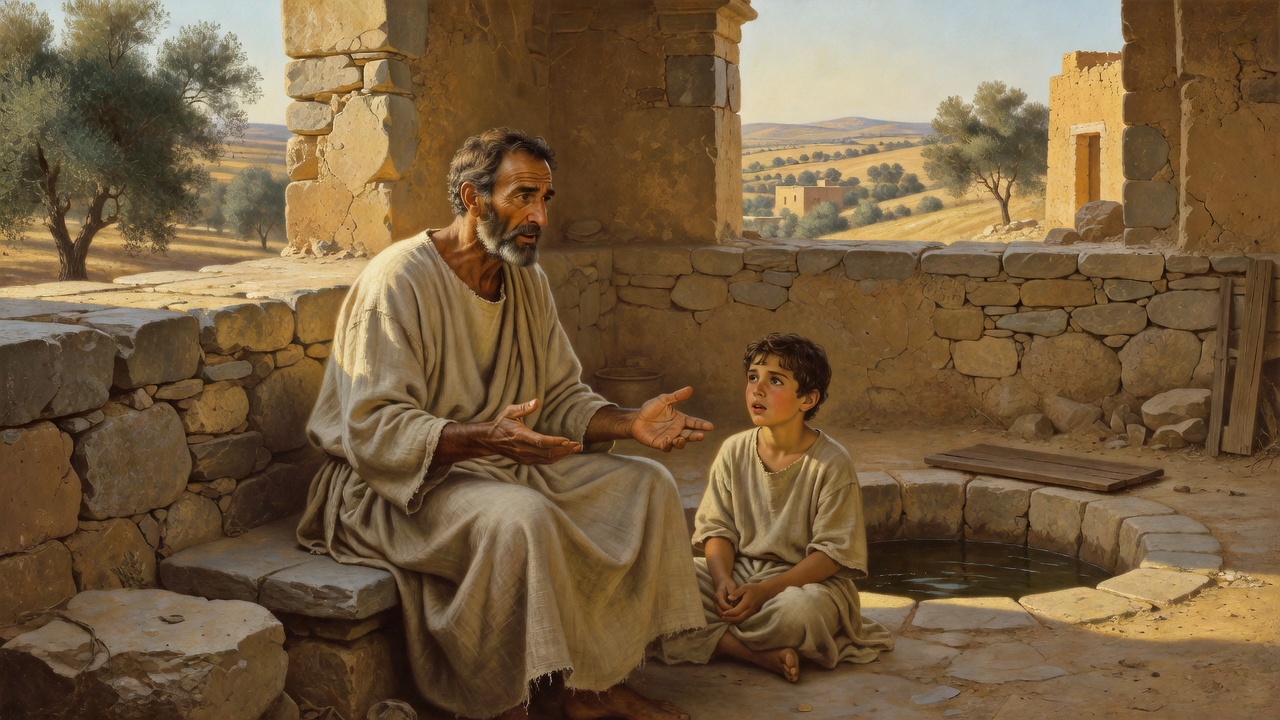
15Drink mayim out of thine own bor (cistern),
and running waters out of thine own well.
16Should thy fountains be dispersed abroad,
and channels of mayim in the rekhovot (town squares)?
17Let them be only thine own,
and never zarim (strangers) with thee.
18Let thy makor (fountain) be blessed;
and rejoice with the isha of thy youth.
19Let her be as the loving deer and graceful doe;
let her breasts satisfy thee at all times;
and be thou enraptured tamid (ever) with ahavat (love of) her.
20And why wilt thou, beni (my son), be intoxicated with a zarah (strange woman),
and embrace the kheyk (bosom) of a nochriyah (foreign [heathen] woman)?
21For the drakhim ish are before the eyes of Hashem,
and He pondereth all his ma'agalot (paths).
22His own avonot shall entrap the rashah himself,
and he shall be held fast by the cords of his chattat.
23He shall die without musar;
and in the greatness of his folly he shall be led astray.
Did you know?
Wisdom, Fidelity, and the Pitfalls of Seduction
- The passage uses domestic water sources, such as a personal cistern and well, as metaphors for marital intimacy and fidelity. The father advises finding satisfaction at home rather than letting one's springs and streams scatter into public streets and squares.Sources: the Bible text itself
- Seductive speech is contrasted with its consequences: while its words are portrayed as sweet like honey and smooth like oil, the ultimate outcome is described as bitter like wormwood, piercing like a double-edged sword, and leading to death and Sheol.Sources: the Bible text itself
- The warning highlights both practical and spiritual costs of infidelity, from the loss of personal wealth and physical vigor to public disgrace before the community assembly, concluding that all human ways are examined by the LORD.Sources: the Bible text itself
Notes written with AI assistance from open sources (Theographic Bible Metadata, CC BY-SA 4.0; Easton’s Bible Dictionary, public domain) and reviewed before publishing.
Credits and license for this translation
The Orthodox Jewish Bible
The Orthodox Jewish Bible - Tanakh and Orthodox Jewish Brit Chadasha - The Holy Bible
copyright © 2002-2011, 2021, 2024 Artists for Israel International
Language: English
Contributor: Artists for Israel International
THE ORTHODOX JEWISH TANAKH
Artists For Israel Intl Inc.
This version also appears with the Orthodox Yiddish Triglot which presents the Hebrew Yiddish script in Latin script and an English word for word translation, available at afii.org/Torah
To donate PayPal.Me
This translation is made available to you under the terms of the
Creative Commons Attribution license 4.0.
You may share and redistribute this Bible translation or extracts from it in any format, provided that:
You include the above copyright and source information.
If you make any changes to the text, you must indicate that you did so in a way that makes it clear that the original licensor is not necessarily endorsing your changes.
Pictures included with Scriptures and other documents on this site are licensed just for use with those Scriptures and documents.
For other uses, please contact the respective copyright owners.
Note that in addition to the rules above, revising and adapting God's Word involves a great responsibility to be true to God's Word. See Revelation 22:18-19.
2026-01-06
Section headings adapted from the Berean Standard Bible (public domain); they are not part of this translation’s text.
Source: http://ebible.org/engojb/ · eBible.org