Numbers 19
The Orthodox Jewish Bible · Tap a verse to see its cross-references.
[CHUKAT]
1And Hashem spoke unto Moshe and unto Aharon, saying,
2This is the chukkat hatorah which Hashem hath commanded, saying, Speak unto the Bnei Yisroel, that they bring thee a completely red female cow, wherein is no blemish, and upon which never came ol (yoke): 3And ye shall give her unto El'azar HaKohen, that he may bring her forth outside the machaneh, and one shall slaughter (shachat) her before his face; 4And El'azar HaKohen shall take of her dahm with his finger, and sprinkle of her dahm directly before the Ohel Mo'ed seven times; 5And one shall burn the heifer in his sight; her hide, and her basar, and her dahm, with her dung, shall he burn; 6And the kohen shall take cedar wood, and hyssop, and crimson thread, and cast it into the midst of the burning heifer. 7Then the kohen shall wash his clothes, and he shall immerse his basar in mayim, and afterward he shall come into the machaneh, and the kohen shall be tamei until the erev. 8And he that burneth her shall wash his clothes in mayim, and immerse his basar in mayim, and shall be tamei until the erev. 9And a man that is tahor shall gather up the ashes of the cow, and lay them up outside the machaneh in a makom tahor, and it shall be in safekeeping for HaEdah Bnei Yisroel for water of sprinkling; it is for sin-purification. 10And he that gathereth the ashes of the heifer shall wash his clothes, and be tamei until the erev; and it shall be unto the Bnei Yisroel, and unto the ger that sojourneth among them, for a chukkat olam.
11He that toucheth the dead body of any man shall be tamei shivat yamim. 12He shall make himself tahor with it on the Yom HaShelishi, and on the seventh day he shall be tahor; but if he does not make himself tahor on the Yom HaShelishi, then the seventh day he shall not be tahor. 13Whosoever toucheth the body of any man that is dead, and maketh not himself tahor, makes tamei the Mishkan Hashem; and that nefesh shall be cut off from Yisroel; because the water of sprinkling was not sprinkled upon him, he shall be tamei; his tumah is yet upon him.
14This is the torah, when a man dieth in an ohel, all that come into the ohel, and all that is in the ohel, shall be tamei seven days. 15And every open vessel, which hath no covering bound upon it, is tamei. 16And whosoever toucheth one that is slain with a cherev in the open fields, or a dead body, or a bone of a man, or a kever, shall be tamei seven days.
17And for one who is tamei they shall take of the ashes of the burning of the purification, and running mayim shall be put thereto in a vessel; 18And an ish tahor shall take hyssop, and dip it in the mayim, and sprinkle it upon the ohel, and upon all the vessels, and upon the nefashot that were there, and upon him that touched a bone, or one slain, or one dead, or a kever;
19And the tahor (clean person) shall sprinkle upon the tamei on the Yom HaShelishi, and on the seventh day; and on the seventh day he shall make himself tahor, and wash his clothes, and immerse himself in mayim, and shall be tahor at erev. 20But the man that shall be tamei, and shall not purify himself, that nefesh shall be cut off from among the Kahal, because he hath contaminated the Mikdash Hashem; the water of sprinkling hath not been sprinkled upon him; he is tamei. 21And it shall be a chukkat olam unto them, that he that sprinkleth the water of sprinkling shall immerse his clothes; and he that toucheth the water of sprinkling shall be tamei until erev. 22And whatsoever the tamei person toucheth shall be tamei; and the nefesh that toucheth it shall be tamei until erev.
Did you know?
The Red Heifer and Purification from Death
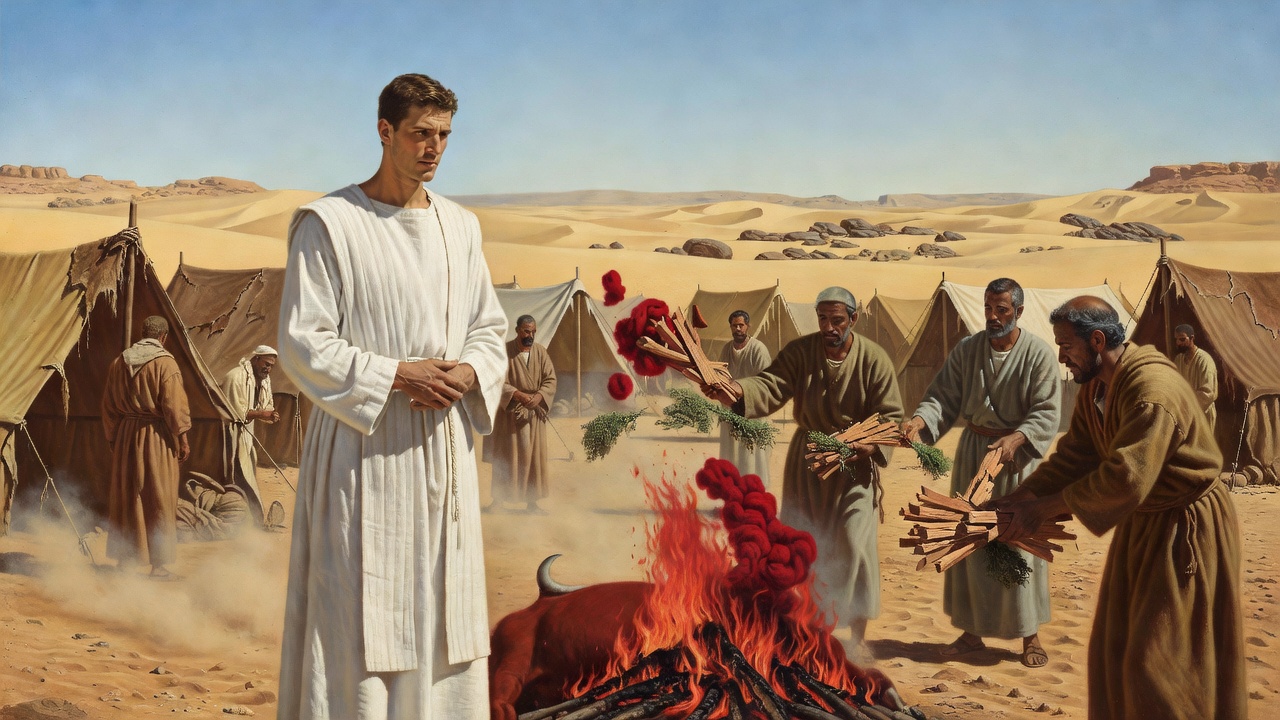
- Unlike typical sacrifices offered at the tabernacle altar, the unblemished red heifer that had never worn a yoke was taken outside the camp. There it was slaughtered in the presence of the priest Eleazar and burned whole along with cedar wood, hyssop, and scarlet wool.Sources: the Bible text itself · Eleazar
- The ashes of the heifer were stored outside the camp to prepare the water of purification. Paradoxically, while this mixture purified individuals who were defiled by death, everyone who handled the burning heifer, gathered its ashes, or sprinkled the water became temporarily unclean until evening.Sources: the Bible text itself
- Contact with a corpse, a human bone, a grave, or merely being inside a tent where someone died caused seven days of ceremonial uncleanness. To be restored, the person had to be sprinkled with the purification water on the third and seventh days and wash their clothes and body.Sources: the Bible text itself
Notes written with AI assistance from open sources (Theographic Bible Metadata, CC BY-SA 4.0; Easton’s Bible Dictionary, public domain) and reviewed before publishing.
Credits and license for this translation
The Orthodox Jewish Bible
The Orthodox Jewish Bible - Tanakh and Orthodox Jewish Brit Chadasha - The Holy Bible
copyright © 2002-2011, 2021, 2024 Artists for Israel International
Language: English
Contributor: Artists for Israel International
THE ORTHODOX JEWISH TANAKH
Artists For Israel Intl Inc.
This version also appears with the Orthodox Yiddish Triglot which presents the Hebrew Yiddish script in Latin script and an English word for word translation, available at afii.org/Torah
To donate PayPal.Me
This translation is made available to you under the terms of the
Creative Commons Attribution license 4.0.
You may share and redistribute this Bible translation or extracts from it in any format, provided that:
You include the above copyright and source information.
If you make any changes to the text, you must indicate that you did so in a way that makes it clear that the original licensor is not necessarily endorsing your changes.
Pictures included with Scriptures and other documents on this site are licensed just for use with those Scriptures and documents.
For other uses, please contact the respective copyright owners.
Note that in addition to the rules above, revising and adapting God's Word involves a great responsibility to be true to God's Word. See Revelation 22:18-19.
2026-01-06
Source: http://ebible.org/engojb/ · eBible.org