Nehemiah 12
The Orthodox Jewish Bible · Tap a verse to see its cross-references.
The Priests and Levites Who Returned
1Now these are the Kohanim and the Levi'im that went up with Zerubavel ben Sh'altiel, and Yeshua; Serayah, Yirmeyah, Ezra, 2Amaryah, Maluch, Chattush, 3Shechanyah, Rechum, Meremot, 4Iddo, Gintoi, Aviyah, 5Miyamin, Ma'adiyah, Bilgah, 6Shema'yah, and Yoyariv, Yedayah, 7Sallu, Amok, Chilkiyah, Yedayah. These were the chief of the Kohanim and of their brethren in the days of Yeshua.
8Moreover the Levi'im; Yeshua, Binnui, Kadmiel, Sherevyah, Yehudah, and Matanyah, which was over the huyedot, he and his brethren. 9Also Bakbukyah and Unni, their brethren, were opposite them in the mishmarot (services). 10And Yeshua fathered Yoyakim, Yoyakim also fathered Elyashiv, and Elyashiv fathered Yoyada, 11And Yoyada fathered Yonatan, and Yonatan fathered Yaddua.
12And in the days of Yoyakim these were Kohanim rashei haAvot; of Serayah, Merayah; of Yirmeyah, Chananyah; 13Of Ezra, Meshullam; of Amaryah, Yehochanan; 14Of Malikhi, Yonatan; of Shevanyah, Yosef; 15Of Charim, Adna; of Merayot, Chelkai; 16Of Iddo, Zecharyah; of Ginton, Meshullam; 17Of Aviyah, Zichri; of Minyamin, of Moadyah, Piltai; 18Of Bilgah, Shammua; of Shema'yah, Yehonatan; 19And of Yoyariv, Matnai; of Yedayah, Uzzi; 20Of Sallai, Kallai; of Amok, Ever; 21Of Chilkiyah, Chashavyah; of Yedayah, Netanel.
22The Levi'im in the days of Elyashiv, Yoyada, and Yochanan, and Yaddua, were recorded rashei haAvot; also the kohanim, to the reign of Daryavesh the Persian. 23The Bnei Levi, the rashei haAvot, were written in the Sefer Divrei Hayamim, even until the days of Yochanan ben Elyashiv. 24And the chiefs of the Levi'im: Chashavyah, Sherevyah, and Yeshua ben Kadmiel, with their brethren over against them, to praise and to give thanks, according to the mitzvat Dovid Ish HaElohim, choir opposite choir. 25Matanyah, and Bakbukyah, Ovadyah, Meshullam, Talmon, Akkuv, were gatekeepers keeping the storerooms of the gates. 26These were in the days of Yoyakim ben Yeshua ben Yotzadak, and in the days of Nechemyah the governor, and of Ezra HaKohen HaSofer.
The Dedication of the Wall
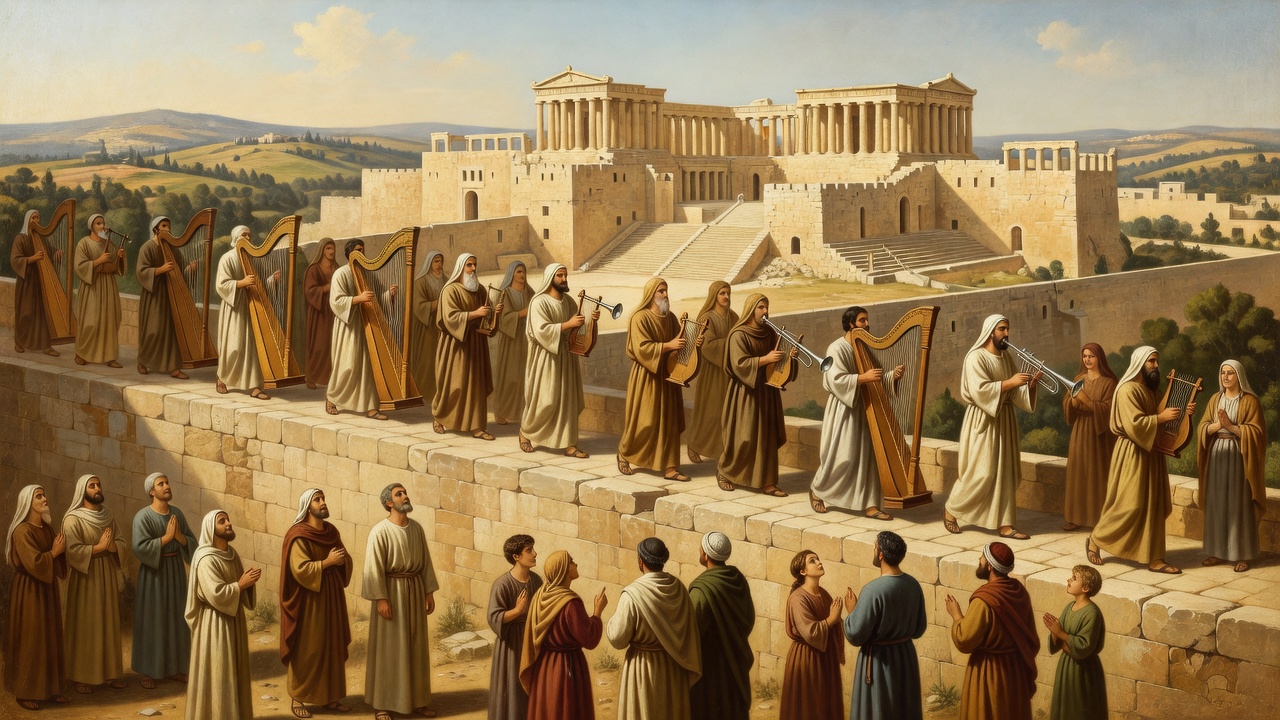
27And at the dedication of the Chomat Yerushalayim they sought the Levi'im from all their places, to bring them to Yerushalayim, to keep the dedication with simchah, both with todot, and with singing, with cymbals, nevalim, and with kinorot. 28And Bnei HaMishorerim gathered themselves together, both out of the region around Yerushalayim, and from the villages of Netophati; 29Also from the Bais Gilgal, and out of the fields of Geva and Azmavet; for the singers had built villages around Yerushalayim. 30Kohanim and Levi'im made themselves tahor, and made the people tahor, the gates, and the chomah.
31Then I brought up the sarim of Yehudah upon the chomah, and appointed two great choirs to give thanks, whereof one went on the right hand upon the wall toward the Dung Gate; 32And after them went Hoshayah, and half of the sarim of Yehudah, 33And Azaryah, Ezra, and Meshullam, 34Yehudah, Binyamin, Shema'yah, and Yirmeyah, 35And certain of the banim of kohanim with trumpets; namely Zecharyah ben Yonatan ben Shema'yah ben Matanyah ben Michayah ben Zakkur ben Asaph; 36And his brethren, Shema'yah, and Azare'el, Milalai, Gilalai, Ma'ai, Netanel, and Yehudah, Chanani, with the musical instruments of Dovid the Ish HaElohim, and Ezra the Sofer before them. 37And at the Fountain Gate they went up by the steps of Ir Dovid, at the going up of the wall, above the Bais Dovid, even the Water Gate eastward.
38The other company of them that gave thanks went opposite them, I after them, and half the people upon the wall, from beyond the Migdal of the Ovens even unto the Broad Wall; 39And from above the Ephrayim Gate, and above the Old Gate, and above the Fish Gate, and the Migdal of Chanan'el, and the Migdal of the Hundred, even unto the Sheep Gate; and they stood still in the Prison Gate. 40So stood the two companies of them that gave thanks in the Beis HaElohim, and I, and the half of the officials with me; 41And the Kohanim: Elyakim, Ma'aseiyah, Minyamin, Michayah, Elyo'einai, Zecharyah, and Chananyah, with trumpets; 42And Ma'aseiyah, Shema'yah, El'azar, Uzzi, Yehochanan, Malkiyah, Eilam, and Ezer. And the singers sang loud, with Yizrachyah their overseer. 43Also that day they offered zevakhim gedolim, and rejoiced, for HaElohim had made them rejoice with great joy; the wives also and the children rejoiced, so that the joy of Yerushalayim was heard even afar off.
Provisions for Temple Worship
44And at that time were some appointed over the storerooms for the Otzarot, for terumot, for the reshit, and for ma'aserot (tithes), to gather into them out of the fields of the cities the portions required by the Torah for the Kohanim and Levi'im: for Yehudah rejoiced for the Kohanim and for the Levi'im stationed [in Beis Hashem]. 45They performed the Mishmeret Eloheihem and the Mishmeret HaTahorah according to the commandment of Dovid, and of Sh'lomo bno. 46For in the days of Dovid and Asaph of old there were chiefs of the singers, and shir tehillah and hodot unto Elohim. 47And kol Yisroel in the days of Zerubavel, and in the days of Nechemyah, gave the portions for the singers and the gatekeepers, every day its portion; and they set aside as kodesh the portion for the Levi'im; and the Levi'im set aside as kodesh the portion for the Bnei Aharon.
Did you know?
Dedication of the Wall and Priestly Registers
- For the dedication of Jerusalem's rebuilt wall, Levites and singers were brought from surrounding settlements where they had built villages, including Beth-gilgal and the fields of Geba and Azmaveth. Musical worship was organized in alternating groups using instruments patterned after the instructions of King David.Sources: the Bible text itself · Beth-gilgal · Geba · Azmaveth
- The dedication ceremony featured two large thanksgiving choirs marching directly along the top of the newly repaired city walls in opposite directions. One procession was led by Ezra the scribe toward the Dung Gate, while Nehemiah followed the second group, until both choirs met at the house of God.Sources: the Bible text itself · Dung Gate · Gate of the Fountain
- The chapter preserves ancestral records of priests and Levites spanning from the first return under Zerubbabel and the high priest Jeshua through several generations into the Persian period. These records documented the lineage of high priests and family heads responsible for temple services and gatekeeping.Sources: the Bible text itself · Zerubbabel · Joshua · Eliashib
Notes written with AI assistance from open sources (Theographic Bible Metadata, CC BY-SA 4.0; Easton’s Bible Dictionary, public domain) and reviewed before publishing.
Places in this chapter
- Jerusalem · 31.777, 35.234 · verses 27, 28, 29, 43
- Dung Gate · Today: in Jerusalem · 31.777, 35.234 · verse 31
- City of David · 31.774, 35.236 · verse 37
- Fountain Gate · Today: in Jerusalem · 31.777, 35.234 · verse 37
- Water Gate · Today: in Jerusalem · 31.777, 35.234 · verse 37
- Broad Wall · 31.776, 35.232 · verse 38
- Tower of the Ovens · Today: in Jerusalem · 31.777, 35.234 · verse 38
- Ephraim Gate · Today: in Jerusalem · 31.777, 35.234 · verse 39
- Fish Gate · Today: in Jerusalem · 31.777, 35.234 · verse 39
- Gate of the Guard · Today: in Jerusalem · 31.777, 35.234 · verse 39
- Gate of Yeshanah · Today: in Jerusalem · 31.777, 35.234 · verse 39
- Sheep Gate · Today: in Jerusalem · 31.777, 35.234 · verse 39
- Tower of Hananel · Today: Antonia Fortress · 31.780, 35.234 · verse 39
- Tower of the Hundred · Today: within 500 m of the Antonia Fortress · 31.780, 35.234 · verse 39
Only places identified with high confidence are shown (90% or more according to the scholarly sources compiled by OpenBible). Period map: DARE (Digital Atlas of the Roman Empire), CC BY 4.0; modern map: © OpenStreetMap contributors; places: OpenBible.info (CC BY 4.0).
Credits and license for this translation
The Orthodox Jewish Bible
The Orthodox Jewish Bible - Tanakh and Orthodox Jewish Brit Chadasha - The Holy Bible
copyright © 2002-2011, 2021, 2024 Artists for Israel International
Language: English
Contributor: Artists for Israel International
THE ORTHODOX JEWISH TANAKH
Artists For Israel Intl Inc.
This version also appears with the Orthodox Yiddish Triglot which presents the Hebrew Yiddish script in Latin script and an English word for word translation, available at afii.org/Torah
To donate PayPal.Me
This translation is made available to you under the terms of the
Creative Commons Attribution license 4.0.
You may share and redistribute this Bible translation or extracts from it in any format, provided that:
You include the above copyright and source information.
If you make any changes to the text, you must indicate that you did so in a way that makes it clear that the original licensor is not necessarily endorsing your changes.
Pictures included with Scriptures and other documents on this site are licensed just for use with those Scriptures and documents.
For other uses, please contact the respective copyright owners.
Note that in addition to the rules above, revising and adapting God's Word involves a great responsibility to be true to God's Word. See Revelation 22:18-19.
2026-01-06
Section headings adapted from the Berean Standard Bible (public domain); they are not part of this translation’s text.
Source: http://ebible.org/engojb/ · eBible.org