Mark 12
The Orthodox Jewish Bible · Tap a verse to see its cross-references.
The Parable of the Wicked Tenants
1And Rebbe, Melech HaMoshiach began to speak to them in meshalim (parables). A man, a Baal Bayit, planted a kerem (vineyard), and he put around [it] a fence and dug a pit for the yekev (winepress) and built a migdal (tower), and he leased it to koremim (vine keepers) and then the man went on a journey. 2And the Baal Bayit sent an eved to the tenants, the koremim, in the season [of katzir (harvest)] in order that from the koremim he might receive from the perot (fruit) of the kerem (vineyard). 3But they seized the eved and they beat him and sent him away empty. 4And again the Baal Bayit sent to the tenants, the koremim, another eved; and that one they struck on the rosh and insulted. 5And the Baal Bayit sent another; and that one they killed, and many others, some beating, and others killing. 6Still he had one BEN AHUV. Lemaskana (finally), the Baal Bayit sent him to them saying, They will respect BENI. 7But those koremim said to themselves, This one is the Yoresh (Heir) the Bechor. Come, let us kill him, and the nachalah, the bechorah, will be ours. 8And having seized [him], they killed him and threw him out of the kerem. 9What then will the Baal Bayit of the kerem do? He will come and destroy the koremim and will give the kerem to others. 10Have you not read the Kitvei Hakodesh? EVEN MAASU HABONIM HAYTAH LEROSH PINAH (The stone which the ones building rejected, this one has come to be for [the] chief cornerstone). 11MEIET HASHEM HAYTAH ZOT, HI NIFLAT BEINEINU (From Adonoi this came to be and it is wonderful in our eyes).
12And they were seeking to seize him, and they were afraid of the multitude, for they knew that against them he told the mashal. And leaving him, they went away.
Paying Taxes to Caesar
13And they send to him some of the Perushim (Pharisees) and the Herodians in order that they might catch him in a dvar. 14And having come, they say to him: Rabbi, we have daas that you are an ish Emes and you do not show deference toward anyone. Ki ein masso panim (For there is no partiality) with you but rather on the Derech Hashem you give Divrei Torah in Emes. Is it mutar to give a poll tax to Caesar or not? Should we give or should we not give? 15But Rebbe, Melech HaMoshiach, having seen their tzeviut (hypocrisy), said to them, Why are you testing me? Bring me a denarius that I may look [at it]. 16And they brought [one]. And Rebbe, Melech HaMoshiach says to them, Whose demut is this and whose inscription? And they said to him, Caesarʼs. 17And he said to them, The things of Caesar, give to Caesar, and the things of Hashem [give] to Hashem. And they were amazed at Rebbe, Melech HaMoshiach.
The Sadducees and the Resurrection
18And [the] Tzedukim come to Rebbe, Melech HaMoshiach, the ones who say that there is not to be a Techiyas HaMesim, and they were questioning him, saying, 19Rabbi, Moshe (Rabbeinu) wrote to us that if an ACH of someone should die and leave behind an isha UVEN EIN LO (and there is no son to him) YEVAMAH YAVO ALEIHA ULEKAKHAH LO LISHA VHAYAH HABECHOR ASHER TELED YAKUM AL SHEM ACHIV HAMET (the brother of her husband must come to her and he must take her to him as wife and the Bechor she bears shall raise up the name of the dead brother). 20Now there were shiva achim. And the first took a wife and, dying, did not leave a descendant. 21And the second took her and he died, not having left behind a descendant. And the third likewise. 22And the seven did not leave a descendant. 23In the Techiyas HaMesim, when they are made to stand up alive, of which of them will she be [the] isha? For seven had her as wife.
24Rebbe, Melech HaMoshiach, said to them, Is not this the reason you are in error, having daas neither of the Kitvei Hakodesh nor of the gevurat Hashem? 25But concerning the Mesim that are made to stand up alive, they do not marry nor are they given in nisuim, but are like the malachim in Shomayim. 26But concerning the Mesim, that they are made to stand up alive, have you not read in the sefer Moshe at the bush, how Hashem spoke to him, saying, ANOCHI ELOHEI AVRAHAM ELOHEI YITZCHAK VELOHEI Ya'akov, ( Ex 3:6). 27Hashem is not the G-d of the Mesim (Dead ones) but of the Chayyim (Living ones). You are greatly mistaken.
The Greatest Commandment
28And one of the Sofrim approached and heard them debating, and seeing that Rebbe, Melech HaMoshiach answered them well, asked him, Which mitzvah is rishonah of all the mitzvot? 29Rebbe, Melech HaMoshiach answered, SHEMA YISROEL ADONOI ELOHEINU ADONOI ECHAD is harishonah. 30V'AHAVTA ES ADONOI ELOHEICHA B'CHOL LEVAVCHA UVECHOL NAFSHECHA UVECHOL MODECHA. 31And the shneyah is this, VAHAVTA LREACHA KAMOCHA. There is not another mitzvah greater than these. 32And the Baal Torah said to him, Well spoken, Rabbi, beemes you have said that Hashem is ECHAD (one), and EIN OD and there is no other except him. 33and to have ahavah for him B'CHOL LEVAVCHA (with all your heart) and with all your binah UVECHOL MODECHA (with all your strength) and L'REACHA KAMOCHA (your neighbor as yourself) is greater [than] all of the burnt offerings and sacrifices. 34And Rebbe, Melech HaMoshiach, when he saw that this torah teacher answered with chochmah (wisdom), said to him, You are not far from the Malchut Hashem. And no one was daring to put a she'elah (question) in front of Rebbe, Melech HaMoshiach again.
Whose Son Is the Christ?
35While Rebbe, Melech HaMoshiach was saying shiurim (Torah talks) in the Beis Hamikdash, he was saying: How is it that the Sofrim say that Moshiach is [merely] ben Dovid? 36Dovid himself said by the Ruach Hakodesh, NEUM HASHEM LADONI: SHEV LIMINI, AD ASHIT OYVECHA HADOM LRAGLECHA. 37Dovid himself calls Moshiach Adon; how then is Moshiach [merely] ben Dovid? And the large multitude found it a huge oneg (pleasure) to listen to him.
Beware of the Scribes
38And in his torah, Rebbe, Melech HaMoshiach was saying, Beware of the Sofrim (Scribes, Torah teachers, rabbonim), the ones enamored of strutting about in extremely long kaftans and with equally lengthy Birkat Shalom greetings in the marketplaces, 39And places of honor in the shuls and places of honor at the seudot (banquet dinners). 40Beware particularly of the ones devouring the batim (houses) of the almanot (widows) and making a grand show of davening long tefillos. Mishpat (Judgment) will fall more heavily on these.
The Widow’s Offering
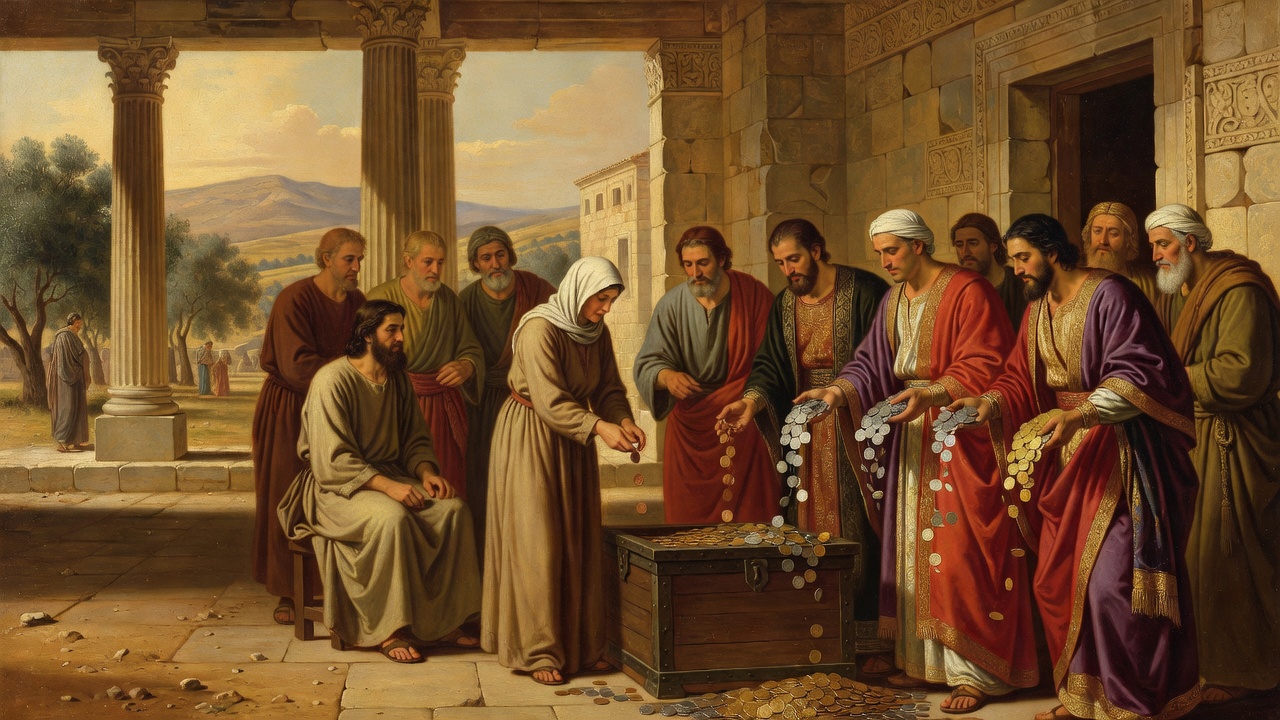
41And having sat [down] opposite the Beis Hamikdash Otzar (Treasury), Rebbe, Melech HaMoshiach was observing how the multitude throws copper [coins] into the Otzar. And many ashirim (rich people) were throwing [in] much. 42And a poor almanah (widow) came and threw [in] two leptas, which is a kodrantes. 43And having summoned his talmidim, Rebbe, Melech HaMoshiach said to them: Omein, I say to you that this poor almanah has put in more tzedakah (charity contribution) than all those contributing to the Otzar, 44For everyone threw in from their abundance, but this almanah from her need has put in everything she had, all her michyah (subsistence).
Did you know?
Debates in the Temple
- The Sadducees, who say there is no resurrection, question Jesus about seven brothers and one widow, appealing to what Moses wrote. He points them to the burning bush in the Book of Moses, where God says, “I am the God of Abraham, the God of Isaac, and the God of Jacob.” Abraham, “father of a multitude,” was Terah’s son; Isaac was Abraham’s only son by Sarah; and Jacob was the second-born of the twin sons of Isaac and Rebekah.Sources: the Bible text itself · Abraham · Isaac · Jacob (Israel)
- Asked which commandment is the most important, Jesus begins, “Hear, O Israel, the Lord our God, the Lord is One,” and adds, “Love your neighbor as yourself.” Israel is another name for Jacob, the second-born twin son of Isaac and Rebekah; Jacob’s name is explained as one who follows on another’s heels, or supplanter.Sources: the Bible text itself · Jacob (Israel)
- Teaching in the temple courts, Jesus asks how the scribes can say that the Christ is the Son of David if David himself calls him “Lord.” David, whose name means “Beloved,” was the eighth and youngest son of Jesse, a citizen of Bethlehem, and his early occupation was tending his father’s sheep on the uplands of Judah.Sources: the Bible text itself · David
Notes written with AI assistance from open sources (Theographic Bible Metadata, CC BY-SA 4.0; Easton’s Bible Dictionary, public domain) and reviewed before publishing.
Credits and license for this translation
The Orthodox Jewish Bible
The Orthodox Jewish Bible - Tanakh and Orthodox Jewish Brit Chadasha - The Holy Bible
copyright © 2002-2011, 2021, 2024 Artists for Israel International
Language: English
Contributor: Artists for Israel International
THE ORTHODOX JEWISH TANAKH
Artists For Israel Intl Inc.
This version also appears with the Orthodox Yiddish Triglot which presents the Hebrew Yiddish script in Latin script and an English word for word translation, available at afii.org/Torah
To donate PayPal.Me
This translation is made available to you under the terms of the
Creative Commons Attribution license 4.0.
You may share and redistribute this Bible translation or extracts from it in any format, provided that:
You include the above copyright and source information.
If you make any changes to the text, you must indicate that you did so in a way that makes it clear that the original licensor is not necessarily endorsing your changes.
Pictures included with Scriptures and other documents on this site are licensed just for use with those Scriptures and documents.
For other uses, please contact the respective copyright owners.
Note that in addition to the rules above, revising and adapting God's Word involves a great responsibility to be true to God's Word. See Revelation 22:18-19.
2026-01-06
Section headings adapted from the Berean Standard Bible (public domain); they are not part of this translation’s text.
Source: http://ebible.org/engojb/ · eBible.org