Matthew 11
The Orthodox Jewish Bible · Tap a verse to see its cross-references.
John’s Inquiry
1And it came about when he finished giving directives to his Shneym Asar Talmidim, he moved on from there, exercising the ministry of moreh (teacher) and darshan (preacher, maggid) in their shtetlach.
2Now when Yochanan, in the beit hasohor (prison), heard of the maasei haMoshiach (works of Moshiach), he sent his talmidim to Rebbe, Melech HaMoshiach. 3They asked him, Tell us. Are you Hu Habah (He who comes) or is our chikiah (wait) to be for the Bias (Coming) of another? 4And Rebbe, Melech HaMoshiach answered them, saying, Go give the report of what you see and hear to Yochanan: 5The ivrim (blind people) see, the pisechim (lame people) walk, the metzoraim (lepers) are cleansed, the chereshim (deaf people) hear, the mesim are made to stand up alive, and the aniyim (poor) have the Besuras HaGeulah preached to them. 6Ashrey (Happy) is the one who does not find a cause of michshol (falling, stumbling) in me.
Jesus Testifies about John
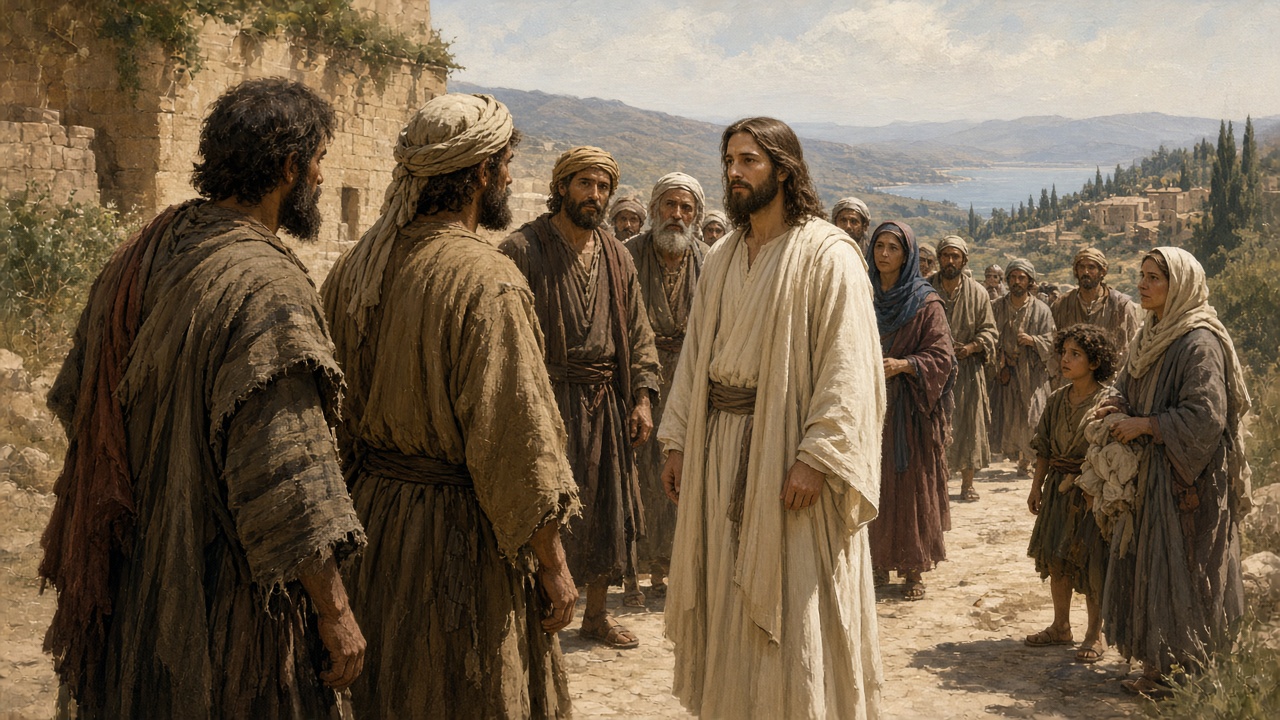
7As they were leaving, he began to speak to the multitudes about Yochanan, What did you go out into the midbar (wilderness) to see? A reed being shaken by the wind? 8What did you go out to see? Someone shtats (imposing, impressive) in appearance, attired in soft raiment? Hinei, the ones wearing soft raiment are in houses of melachim (kings). 9But what did you go out to see? A Navi? Ken, I tell you. And one greater than a Navi. 10This is he about whom it has been written, HINNENI SHOLEIACH MALACHI (Behold, I will send my messenger) before your face, UPINNAH DERECH LEFANAI (and he will prepare the way before me). 11Omein, I say to you, of those born of women, there has not appeared one greater than Yochanan of the tevilah of teshuva, yet the person with the least chashivut in the Malchut HaShomayim is greater than he. 12From the days of Yochanan of the tevilah of teshuva until now, the Malchut HaShomayim has been under violent attack and the violent seize it with coercion. 13For all the Neviim and the Torah prophesied until Yochanan. 14And, if you are willing it to be mekabel (accept, receive), he is the “Eliyahu,” who is to come. 15The one having ears, let him hear. 16But to what will I compare this generation? It is like yeladim sitting in the marketplaces, calling out to one another, 17We played the chalil (flute) for you, but you did not dance; we sang a kina (lament, funeral dirge) for you, and you did not mourn. 18For Yochanan came neither eating nor drinking, and they say, He has a shed. 19The Bar Enosh came eating and drinking, and they say, Hinei! A zolel (glutton) and a shikkor (drunkard), a friend of mochesim (tax collectors) and chote'im (sinners). Yet, Chochmah (Wisdom) is vindicated by her ma'asim.
Woe to the Unrepentant
20Then he began to reproach the shtetlach (villages) in which were accomplished most of his gevurot (mighty deeds), because they did not make teshuva. 21Oy l'chah (Woe to you), Korazin! Oy l'chah, Beit-Tzaidah! For if in Tzor and Tzidon were accomplished the gevurot that were accomplished among you, they would have made teshuva long ago in sackcloth and ashes. 22Nevertheless, I say to you, it will be more bearable for Tzor and Tzidon than for you on Yom HaDin. 23And you, K'far-Nachum, were you lifted up as far as Shomayim? You shall be brought down as far as Sheol. For if in S'dom were accomplished the gevurot that were accomplished among you, S'dom would have a sheerit (remnant) today! 24Nevertheless, I say to you, it will be more bearable for the land of S'dom on Yom HaDin than for you.
Rest for the Weary
25At that time, Rebbe, Melech HaMoshiach said, Modeh Ani, Avi, Adon HaShomayim v'HaAretz, (I thank you, Father, L-rd of Heaven and Earth), because you hid these things from the chachamim (wise) and those with seichel, and to them they are nistar (hidden, esoteric), and you made a hisgalus (revelation) of them unto ollelim (infants). 26Ken, Avi, for thus it was pleasing in your sight. 27All things were given to me by Avi, and no one has daas (knowledge) of HaBen except HaAv, nor does anyone have daas of HaAv, except HaBen, and anyone to whom HaBen chooses to unveil him. 28Come to me, all you who are burden-weary and heavy laden, and I will give you Shabbos menuchah. 29Take my ol (yoke) upon you and learn from me, for I am anav (humble) and have shiflut (lowliness) in lev (heart), and you will find menuchah (rest, security) for your nefashot (souls). 30For my ol (yoke) is easy and my burden is light.
Did you know?
John's question and the cities that did not repent
- From prison, John sent his disciples to ask whether Jesus was the one who was to come. Jesus told the crowds that John was more than a prophet—the messenger sent ahead to prepare the way—and, if they were willing to accept it, the Elijah who was to come. A Bible dictionary calls John the forerunner and says his mission was already the subject of prophecy, citing Isaiah 40:3 and Malachi 3:1; it also introduces Elijah as the Elias of the New Testament.Sources: the Bible text itself · John the Baptist · Elijah
- Jesus then denounced Chorazin, Bethsaida, and Capernaum, where most of his miracles had been performed, because they did not repent. A dictionary identifies Chorazin with modern Kerazeh, about two and a half miles up the Wady Kerazeh from Capernaum, and says that Capernaum, absent from the Old Testament, became Jesus' own city after he left Nazareth. It places Bethsaida on the east side of the lake, two miles up the Jordan in Gaulonitis, enlarged by Philip the tetrarch and named Julias after the emperor's daughter, though some have supposed there was only one Bethsaida, near where the Jordan enters the lake.Sources: the Bible text itself · Chorazin · Capernaum · Bethsaida
- He set those cities against Tyre and Sidon, which he said would have repented long ago in sackcloth and ashes, and against Sodom, which he said would have remained to this day. Sidon, on the Mediterranean coast about twenty-five miles north of Tyre, was the oldest Phoenician city there and the mother city of Tyre. A dictionary says the commerce of the whole world was gathered into Tyre's warehouses, and that Sodom, in the vale of Siddim, was destroyed by fire from heaven so completely that no trace of it has been found.Sources: the Bible text itself · Sidon · Tyre · Sodom
Notes written with AI assistance from open sources (Theographic Bible Metadata, CC BY-SA 4.0; Easton’s Bible Dictionary, public domain) and reviewed before publishing.
Places in this chapter
- Galilee · 32.760, 35.527 · verse 1
- Sidon · Today: Sandikli archaeological site in Sidon · 33.561, 35.372 · verses 21, 22
- Tyre · 33.271, 35.196 · verses 21, 22
Only places identified with high confidence are shown (90% or more according to the scholarly sources compiled by OpenBible). Period map: DARE (Digital Atlas of the Roman Empire), CC BY 4.0; modern map: © OpenStreetMap contributors; places: OpenBible.info (CC BY 4.0).
Credits and license for this translation
The Orthodox Jewish Bible
The Orthodox Jewish Bible - Tanakh and Orthodox Jewish Brit Chadasha - The Holy Bible
copyright © 2002-2011, 2021, 2024 Artists for Israel International
Language: English
Contributor: Artists for Israel International
THE ORTHODOX JEWISH TANAKH
Artists For Israel Intl Inc.
This version also appears with the Orthodox Yiddish Triglot which presents the Hebrew Yiddish script in Latin script and an English word for word translation, available at afii.org/Torah
To donate PayPal.Me
This translation is made available to you under the terms of the
Creative Commons Attribution license 4.0.
You may share and redistribute this Bible translation or extracts from it in any format, provided that:
You include the above copyright and source information.
If you make any changes to the text, you must indicate that you did so in a way that makes it clear that the original licensor is not necessarily endorsing your changes.
Pictures included with Scriptures and other documents on this site are licensed just for use with those Scriptures and documents.
For other uses, please contact the respective copyright owners.
Note that in addition to the rules above, revising and adapting God's Word involves a great responsibility to be true to God's Word. See Revelation 22:18-19.
2026-01-06
Section headings adapted from the Berean Standard Bible (public domain); they are not part of this translation’s text.
Source: http://ebible.org/engojb/ · eBible.org