Luke 23
The Orthodox Jewish Bible · Tap a verse to see its cross-references.
Jesus before Pilate
1And the whole multitude of them got up and led Rebbe, Melech HaMoshiach before Pilate. 2And they began to accuse him saying, This one we found misleading our nation and making it asur to pay taxes to Caesar and calling himself Moshiach and that he is to be a Melech. 3And Pilate cross-examined him, saying, Are you the Melech HaYehudim? And in reply, he said to him, You say so? 4And Pilate said to the Rashei Hakohanim and the multitudes, I find no ashmah (guilt) in this man. 5But they were insisting, saying, He incites the people, from where he began with his torah (teaching), throughout all of Yehudah, from the Galil even to this place.
Jesus before Herod
6And when Pilate heard this, he asked whether the man was a Gelili (an inhabitant of the Galil). 7And having learned that he is under the jurisdiction of Herod, he sent him to Herod, who was also in Yerushalayim during those days. 8And Herod, having laid eyes on Rebbe Melech HaMoshiach, had great simcha. For he was for a long time wanting to see him, because he keeps hearing things about him and was hoping to watch some ot (miraculous sign) being performed by him. 9And Herod was questioning him with many words, but he answered him nothing. 10And the Rashei Hakohenim and the Sofrim had stood by vehemently accusing Rebbe, Melech HaMoshiach. 11And having treated him with contempt, Herod with his chaiyalim also ridiculed him, having clothed him in an elegant royal robe. So they thus sent back him to Pilate. 12And Herod and Pilate became fast friends with one another on that very day, for they were previously at enmity toward each other.
The Crowd Chooses Barabbas
13And Pilate, when he had assembled the Rashei Hakohanim and the manhigim and the people, 14Said to them, You brought to me this man causing the people to rise up in mered (revolt), and, hinei, I have cross-examined him before you and I found nothing in this man of the crime of which you make accusations against him. 15And neither did Herod, for he sent him back to us, and, hinei, nothing worthy of mishpat mavet has been done by him. 16Therefore, having disciplined him, I will release him. [ 17Now he was obliged to release to them one at the Chag (Festival).]
18But they cried out with one kol, saying, Away with this one! And release to us Bar-Abba! 19(Bar-Abba was a man who was thrown into the beis hasohar, because of some insurrection which occurred in HaIr as well as a retzach.) 20And again Pilate addressed them, wishing to release Rebbe Melech HaMoshiach. 21But they were crying out saying, Let him be talui al HaEtz! Let him be hanged on HaEtz! 22And a paam shlishit (third time), Pilate said to them, But what raah did this one do? No crime worthy of mavet did I find in him. Therefore, having disciplined him, I will release him. 23But they insisted with a kol gadol demanding him to be hanged on HaEtz and their voices were roiv (the larger portion) prevailing. 24And Pilate decided that their demand be accomplished. 25And Pilate released the one they were requesting, the one who had been thrown into the beis hasohar on account of an insurrection and retzach, but Rebbe Melech HaMoshiach he delivered over to their ratzon.
The Crucifixion
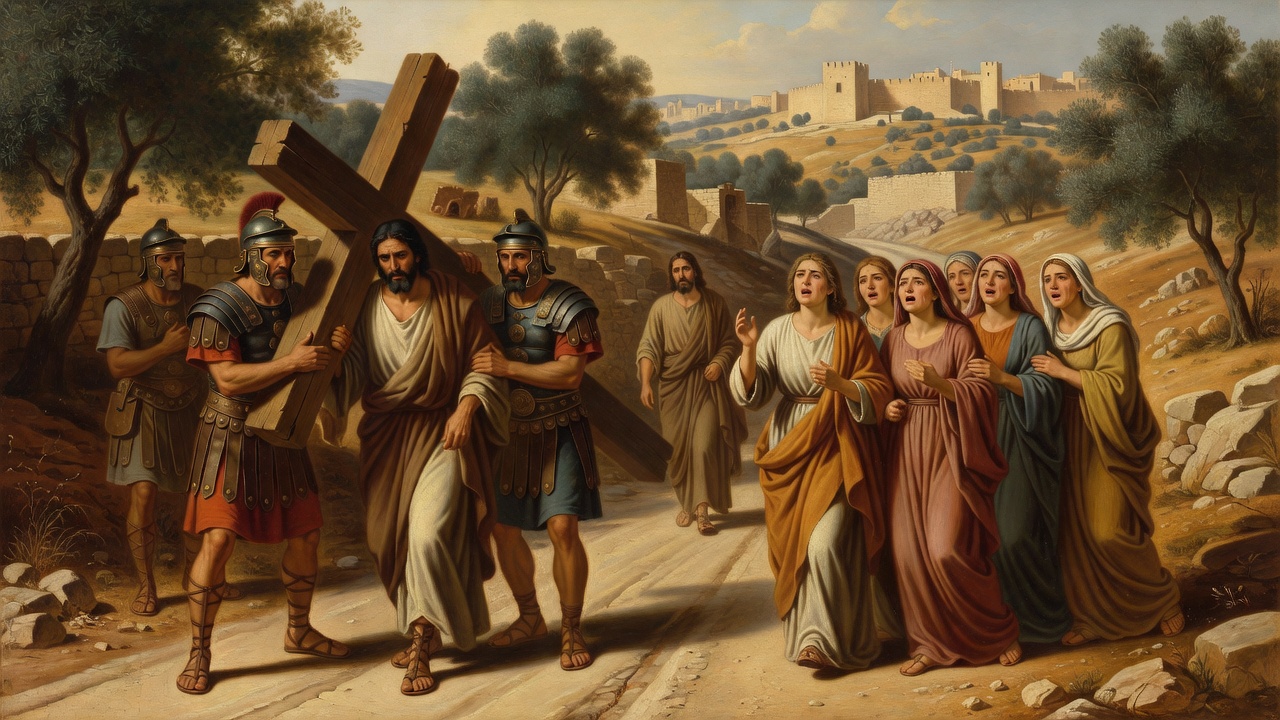
26And as they led him away, having seized a certain Shim'on, a Cyrenian, coming in from the country, they put upon him Moshiachʼs Etz to carry, following Rebbe Melech HaMoshiach. 27And a great multitude of HaAm were following him and nashim, who were acting as avelim, lamenting for him. 28And having turned to them, Rebbe Melech HaMoshiach said, Benot HaYerushalayim (Daughters of Yerushalayim), stop weeping for me; weep for yourselves and for your yeladim, 29Because, hinei, yamim are coming in which they will say, Ashrey are the barren and the wombs which did not bear and the breasts which did not nurse. 30Then they will begin to say to the mountain, Fall on us! And to the hills, Bury us. 31Because if while an etz (tree) is green they do these things, what may happen when it is dry?
32And two POSHA'IM (criminals, resha'im) were also being led away with Rebbe, Melech HaMoshiach to be executed. 33And when they came upon the place being called The Skull, there they hanged each on his etz, Rebbe, Melech HaMoshiach and the POSHA'IM (criminals), one on the right, and one on the left. 34But Rebbe Melech HaMoshiach was saying, Abba, grant selicha to them, for they have no daas of what they are doing. And dividing up his garments, VAPPILU GORAL (they cast lots). 35And HaAm had stood watching. And the manhigim were mocking him also, saying, Others he saved, let him save himself, if this one is the Rebbe Melech HaMoshiach of Hashem, the Bechir Hashem. 36And the chaiyalim also ridiculed him as they approached, offering CHOMETZ (wine vinegar) to him, 37and saying, If you are HaMelech HaYehudim, save yourself. 38And there was also an inscription over him, this is hamelech hayehudim.
39And one of the POSHA'IM (criminals) having been hanged with him was speaking Chillul Hashem gadfanut against him, saying, Are you not the Rebbe Melech HaMoshiach? 40Save yourself and us. And in reply the other, rebuking him, said, Do you not have yirat Shomayim? For you are under the same gezar din (verdict) of harshaah (condemnation as guilty). 41And this is a just gezar din against us, for we deserve what we are getting for our ma'asim (deeds). But this one did nothing rah. 42And he was saying, Adoni, remember me when you come into your Malchut. 43And Rebbe, Melech HaMoshiach said to him, Omein, I say to you, hayom (today) you will be with me in Gan Eden.
The Death of Jesus
44It was already the sixth hour and choshech was over the whole land until the ninth hour. 45The shemesh being obscured; and the Parochet in the Beis Hamikdash was torn in two. 46And having cried out with a kol gadol, he said, Abba, BYADCHA AFKID RUCHI (into your hands I commit my ruach). And this having said, he breathed out his last. 47And the centurion who saw the thing that happened was saying, Baruch Hashem, surely this man was a Tzaddik. 48And when all the hamon (crowd) that had assembled at this spectacle had observed the things that had happened, they went away beating their chests. 49And all his acquaintances stood at a distance and the nashim, the ones following him from the Galil, observed these things.
The Burial of Jesus
50And, hinei, a man by name Yosef being a member of the Sanhedrin, and an ish tov and a tzaddik, 51(This one had not consented to their cheshbon and action) came from Ramatayim, a shtetl of Yehudah. He was waiting expectantly for the Malchut Hashem. 52He approached Pilate, and asked for the gufat Yehoshua. 53And, having taken down geviyyato (his body), he wrapped it in a linen and placed it in a hewn kever (tomb) where not anyone had yet been laid. 54And it was nearly Erev Shabbat, Shabbos was drawing near. 55And following along after, the nashim who had come out of the Galil with him, saw the kever (tomb) and how his NEVELAH (body) was laid. 56And having returned, they prepared spices and ointments.
And on Shabbos they rested according to the mitzvah (commandment).
Did you know?
Trial, Cross, and Burial
- Pontius Pilate, identified by Easton's Bible Dictionary (1897) as the sixth Roman procurator of Judea (A.D. 26–36), kept his headquarters at Caesarea but often went up to Jerusalem. The council’s accusations in this chapter are political: that Jesus was subverting the nation, forbidding the payment of taxes to Caesar, and proclaiming himself Christ, a king.Sources: Pontius Pilate · the Bible text itself
- When Pilate learned that Jesus was a Galilean and under Herod’s jurisdiction, he sent him to Herod Antipas, a son of Herod by Malthace, who was then in Jerusalem. Herod had long wanted to see Jesus and hoped for a miracle, but Jesus did not answer his questions. After Herod and his soldiers mocked Jesus and dressed him in a fine robe, they sent him back, and that day Herod and Pilate, who had been enemies, became friends.Sources: Herod Antipas · the Bible text itself
- The place of crucifixion is called The Skull; a Latin form, Calvaria, translated the Greek Kranion, which rendered the Hebrew Gulgoleth. It probably took this name from its shape, a low, rounded, bare rise somewhat like a human skull, and Scripture nowhere calls it a hill. The crucifixion took place outside the city walls and near a public road.Sources: Skull · the Bible text itself
Notes written with AI assistance from open sources (Theographic Bible Metadata, CC BY-SA 4.0; Easton’s Bible Dictionary, public domain) and reviewed before publishing.
Places in this chapter
- Galilee · 32.760, 35.527 · verses 5, 6, 7, 49, 55
- Jerusalem · 31.777, 35.234 · verses 5, 7, 19, 28
- Judea · Today: Judea 1 · 31.777, 35.234 · verses 5, 51
- Cyrene · 32.821, 21.851 · verse 26
Only places identified with high confidence are shown (90% or more according to the scholarly sources compiled by OpenBible). Period map: DARE (Digital Atlas of the Roman Empire), CC BY 4.0; modern map: © OpenStreetMap contributors; places: OpenBible.info (CC BY 4.0).
Credits and license for this translation
The Orthodox Jewish Bible
The Orthodox Jewish Bible - Tanakh and Orthodox Jewish Brit Chadasha - The Holy Bible
copyright © 2002-2011, 2021, 2024 Artists for Israel International
Language: English
Contributor: Artists for Israel International
THE ORTHODOX JEWISH TANAKH
Artists For Israel Intl Inc.
This version also appears with the Orthodox Yiddish Triglot which presents the Hebrew Yiddish script in Latin script and an English word for word translation, available at afii.org/Torah
To donate PayPal.Me
This translation is made available to you under the terms of the
Creative Commons Attribution license 4.0.
You may share and redistribute this Bible translation or extracts from it in any format, provided that:
You include the above copyright and source information.
If you make any changes to the text, you must indicate that you did so in a way that makes it clear that the original licensor is not necessarily endorsing your changes.
Pictures included with Scriptures and other documents on this site are licensed just for use with those Scriptures and documents.
For other uses, please contact the respective copyright owners.
Note that in addition to the rules above, revising and adapting God's Word involves a great responsibility to be true to God's Word. See Revelation 22:18-19.
2026-01-06
Section headings adapted from the Berean Standard Bible (public domain); they are not part of this translation’s text.
Source: http://ebible.org/engojb/ · eBible.org