Job 30
The Orthodox Jewish Bible · Tap a verse to see its cross-references.
Job’s Honor Turned to Contempt
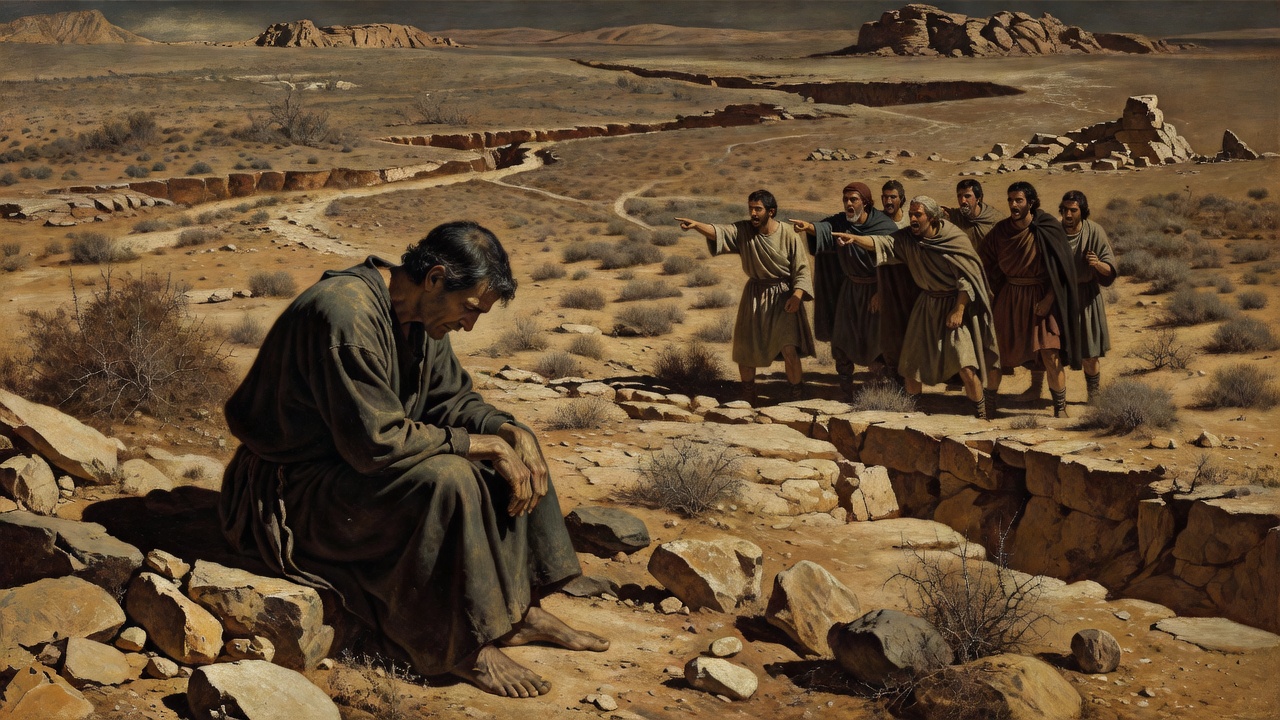
1But now they that are younger than I have me in derision,
whose avot I would have disdained to have set
with the dogs of my tzon.
2Yea, what use was the koach of their hands to me,
since their vigor hath perished?
3For choser (want, lack) and hunger
they gnawed the parched ground desolate and waste.
4They cut up mallow plants by the bushes,
and juniper roots for their lechem.
5They were banished from among men,
(they shouted after them as after a ganav);
6To dwell in the clefts of the wadis,
in holes of aphar, and in the rocks.
7Among the bushes they brayed;
tachat (under) the underbrush they were huddled together.
8They were bnei naval, yea, sons of base men;
they were driven forth out of ha'aretz.
9And atah (now) am I their mocking song,
yea, I am their byword.
10They abhor me, they flee far from me,
and spare not rok (spit) in my face.
11Because He hath loosed my bowstring, and afflicted me,
they have also let loose the resen (bridle) before me.
12Upon my yamin (right hand) rise up the rabble;
they push away my feet,
and they raise up against me the ways of their destruction.
13They break up my road,
they set forward my overthrow, they have no ozer (helper).
14They approach me as through a wide breach;
in the shoah (desolation, Holocaust), they rolled themselves upon me.
Job’s Prosperity Becomes Calamity
15Ballahot (terrors) are turned upon me;
they pursue my dignity like the ruach,
and my safety passeth away like a cloud.
16And now my nefesh ebbs away from me;
the yemei oni have taken hold upon me.
17My atzmot are pierced in me in the night,
and my gnawing pains take no rest.
18By great koach is my garment disfigured;
it bindeth me about like the collar of my kuttonet (chiton, robe).
19He hath cast me into the chomer,
and I am become like aphar and ashes.
20I cry unto Thee, and Thou dost answer me lo (not);
I stand up, and Thou regardest me not.
21Thou art become cruel to me;
with Thy strong yad Thou opposest Thyself against me.
22Thou liftest me up to the ruach;
Thou causest me to drive along, and vanish in the roaring of the storm.
23For I know that Thou wilt bring me down to mavet,
to the bais mo'ed l'khol chai.
24Yet will not one stretch out his yad in a heap of ruin,
or cry out for help in his disaster.
25Did not I weep for him that was in trouble?
Was not my nefesh grieved for the evyon (needy)?
26When I looked for tov,
then rah came unto me;
and when I waited for ohr,
there came ofel (darkness).
27My bowels boiled, and rested not;
yemei oni met me.
28I went mourning without the sun;
I stood up, and I cried out in the kahal.
29I am an ach to jackals,
and a re'a to owls.
30My ohr (skin) grows black upon me,
and my atzmot are burned with fever.
31My kinnor (harp) also is turned to evel (mourning),
and my flute into the voice of them that weep.
Did you know?
Humiliation, Physical Suffering, and Desert Outcasts
- In this chapter, Job contrasts his previous social standing with his current humiliation at the hands of impoverished outcasts. He describes these men as surviving on the margins of society, foraging for wild mallow and broom tree roots in desolate wadis and rock hollows.Sources: the Bible text itself
- Job uses vivid siege metaphors, picturing his attackers as an advancing army laying ramps and breaking through breaches against him, while he endures severe physical afflictions such as fever, gnawing pain, and blackened, peeling skin.Sources: the Bible text itself
- To convey the isolation and intensity of his grief, Job identifies with the mournful sounds of wilderness creatures, calling himself a companion to jackals and ostriches, while his musical instruments—the harp and flute—are turned entirely to weeping.Sources: the Bible text itself
Notes written with AI assistance from open sources (Theographic Bible Metadata, CC BY-SA 4.0; Easton’s Bible Dictionary, public domain) and reviewed before publishing.
Credits and license for this translation
The Orthodox Jewish Bible
The Orthodox Jewish Bible - Tanakh and Orthodox Jewish Brit Chadasha - The Holy Bible
copyright © 2002-2011, 2021, 2024 Artists for Israel International
Language: English
Contributor: Artists for Israel International
THE ORTHODOX JEWISH TANAKH
Artists For Israel Intl Inc.
This version also appears with the Orthodox Yiddish Triglot which presents the Hebrew Yiddish script in Latin script and an English word for word translation, available at afii.org/Torah
To donate PayPal.Me
This translation is made available to you under the terms of the
Creative Commons Attribution license 4.0.
You may share and redistribute this Bible translation or extracts from it in any format, provided that:
You include the above copyright and source information.
If you make any changes to the text, you must indicate that you did so in a way that makes it clear that the original licensor is not necessarily endorsing your changes.
Pictures included with Scriptures and other documents on this site are licensed just for use with those Scriptures and documents.
For other uses, please contact the respective copyright owners.
Note that in addition to the rules above, revising and adapting God's Word involves a great responsibility to be true to God's Word. See Revelation 22:18-19.
2026-01-06
Section headings adapted from the Berean Standard Bible (public domain); they are not part of this translation’s text.
Source: http://ebible.org/engojb/ · eBible.org