Job 17
The Orthodox Jewish Bible · Tap a verse to see its cross-references.
Job Prepares for Death
1My ruach is broken,
my yamim are extinct,
the kevarim are ready for me.
2Does not hatulim (mockery) surround me?
And doth not mine eye continue in their provocation?
3Lay down an eravon (pledge) with Thee;
who is he that will put up security for me?
4For Thou hast hid their lev from seichel;
therefore shalt Thou not exalt them.
5He that informs on re'im for chelek,
even the eyes of his banim shall fail.
6He hath made me also a mashal (byword) of the peoples;
and I am one in whose face they spit.
7Mine eye also is dim by reason of ka'as,
and all my members are like a tzel (shadow).
8Yesharim shall be appalled at this
and the naki (pure, innocent) shall stir up himself against the chanef (profane, irreligious).
9The tzaddik also shall hold to his derech,
and he whose yadayim are tahor shall grow stronger and stronger.
10But as for all you, do ye return, and come back now;
for I cannot find one chacham among you.
11My yamim are past,
my plans are broken,
even the morashot (possessions, desires) of my lev.
12They change the lailah into yom;
the ohr is near to choshech, say they.
13If I wait, Sheol is mine bais;
I have made my bed in the choshech.
14I have said to Shachat, thou art avi;
to the worm, thou art immi, and achoti.
15And where is now my tikveh?
As for my tikveh, who regards it?
16Will it go down to the gates of Sheol?
Shall we go down together into the dust?
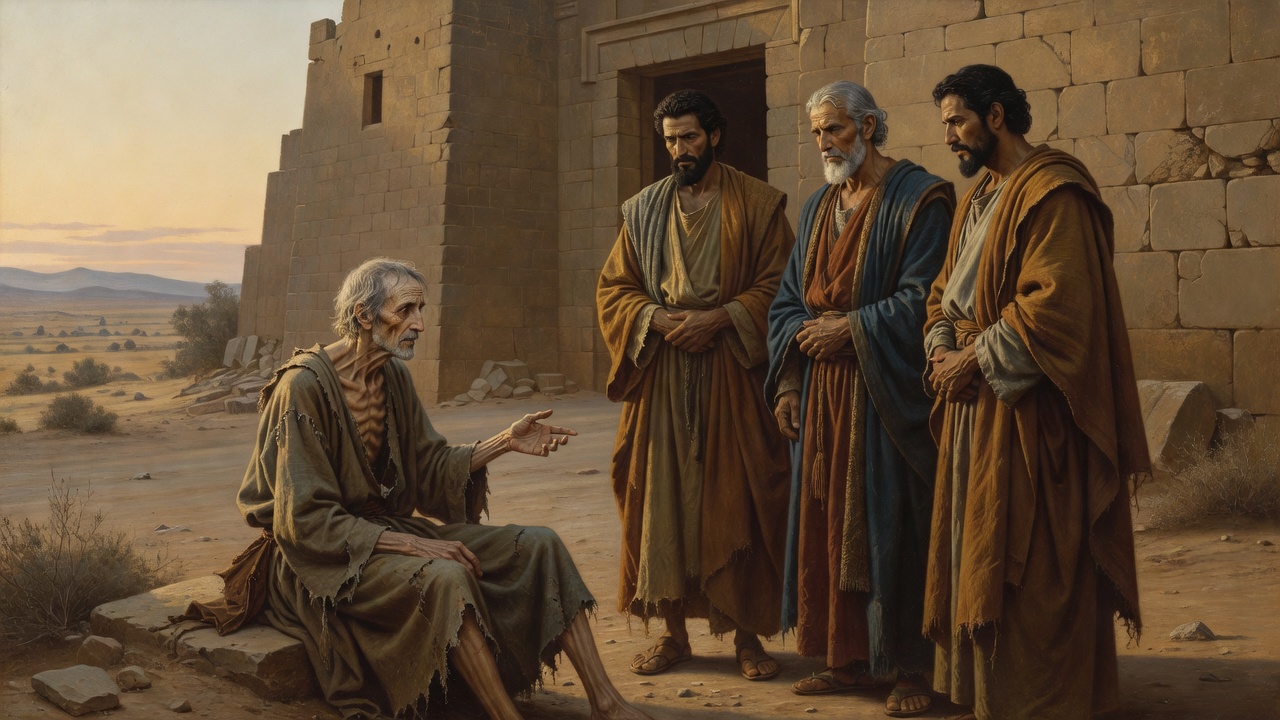
Did you know?
Job's Despair and the Prospect of the Grave
- Job appeals directly to God to act as his pledge or guarantor. In ancient legal practice, a guarantor assumed responsibility for someone accused or indebted, and Job found no human ally willing or able to defend him.Sources: the Bible text itself
- Job describes himself as becoming a byword among the people, a status where an individual's suffering turns into an object of public mockery, contempt, and proverb-like warning.Sources: the Bible text itself
- In his grief, Job speaks of the realm of the dead (Sheol) and the grave as his only remaining home, metaphorically adopting the pit and worms as his closest family members.Sources: the Bible text itself
Notes written with AI assistance from open sources (Theographic Bible Metadata, CC BY-SA 4.0; Easton’s Bible Dictionary, public domain) and reviewed before publishing.
Credits and license for this translation
The Orthodox Jewish Bible
The Orthodox Jewish Bible - Tanakh and Orthodox Jewish Brit Chadasha - The Holy Bible
copyright © 2002-2011, 2021, 2024 Artists for Israel International
Language: English
Contributor: Artists for Israel International
THE ORTHODOX JEWISH TANAKH
Artists For Israel Intl Inc.
This version also appears with the Orthodox Yiddish Triglot which presents the Hebrew Yiddish script in Latin script and an English word for word translation, available at afii.org/Torah
To donate PayPal.Me
This translation is made available to you under the terms of the
Creative Commons Attribution license 4.0.
You may share and redistribute this Bible translation or extracts from it in any format, provided that:
You include the above copyright and source information.
If you make any changes to the text, you must indicate that you did so in a way that makes it clear that the original licensor is not necessarily endorsing your changes.
Pictures included with Scriptures and other documents on this site are licensed just for use with those Scriptures and documents.
For other uses, please contact the respective copyright owners.
Note that in addition to the rules above, revising and adapting God's Word involves a great responsibility to be true to God's Word. See Revelation 22:18-19.
2026-01-06
Section headings adapted from the Berean Standard Bible (public domain); they are not part of this translation’s text.
Source: http://ebible.org/engojb/ · eBible.org