John 10
The Orthodox Jewish Bible · Tap a verse to see its cross-references.
Jesus the Good Shepherd
1Omein, omein, I say to you, the one not entering through the derech hasha'ar (way of the entrance) into the mikhla haTzon (fold [enclosure] of the sheep) but going up another derech, that one is a ganav and a shoded (robber). 2But the one entering through the derech hasha'ar is Ro'eh haTzon (Shepherd of the flock [of sheep]). 3To this one the doorkeeper opens, and the tzon hears the Ro'ehʼs voice and the Ro'eh calls b'shem (by name) each of his own tzon and leads them out. 4When the Ro'eh has brought out all his own, he goes ahead of them, and the tzon follow the Ro'eh, because they have da'as of the Ro'ehʼs voice. 5But a zar (stranger, foreigner) they will never follow, but will flee from him, because they do not have da'as of the voice of zarim (strangers, foreigners). 6This figure of speech Rebbe, Melech HaMoshiach told them. But those ones did not have binah (understanding) of what he was saying to them.
7Rebbe, Melech HaMoshiach said, therefore, again, Omein, omein, I say to you, Ani Hu the derech hasha'ar (way of the entrance) of the tzon. 8All who came before me are ganavim (thieves) and shodedim (robbers), but the tzon did not listen to them. 9I am the derech hasha'ar. Through me, if anyone enters, he will come to yeshu'at Eloheinu and will go in and will go out and will find mir'eh (pasture). 10The ganav does not come except in order that he may steal and kill and destroy. I came that they may have Chayyim (Life) and that they may have it more abundantly. 11I am the Ro'eh HaTov (the Good Shepherd). The Ro'eh HaTov lays down his neshamah for the tzon. 12The gedungener, the one who is not the Ro'eh — the hireling, the one to whom the tzon does not belong — this hireling sees the ze'ev (wolf) coming and abandons the tzon and runs for his life and the ze'ev seizes them and scatters them. 13This happens because he is a hireling and the tzon means nothing to him. 14Ani Hu the Ro'eh HaTov, and I have da'as of my tzon and my tzon has da'as of me. 15Just as HaAv has da'as of me and I have da'as of HaAv, so I lay down my neshamah for the tzon. 16And another tzon I have which is not of this mikhla (fold); those also it is necessary for me to bring, and my voice they will hear, and they will become eder echad with Ro'eh echad (One flock with one Shepherd). 17Therefore, HaAv has ahavah for me, because I lay down my neshamah that I may take it up again. 18No one takes it from me, but I lay it down of my own accord. I have samchut (authority) to lay it down, and I have samchut to receive it again. This mitzvah I received from HaAv of me.
19There was a machloket (division of dissension) again among those of Yehudah, because of these devarim of Rebbe, Melech HaMoshiach. 20And many of them were saying, He has a shed (demon), and He is meshuga — why do you listen to him? 21Others said, These devarim are not of one being possessed of shedim. Surely a shed (demon) is not able to open the eyes of an ivver (blind man)?
Jesus at the Feast of Dedication
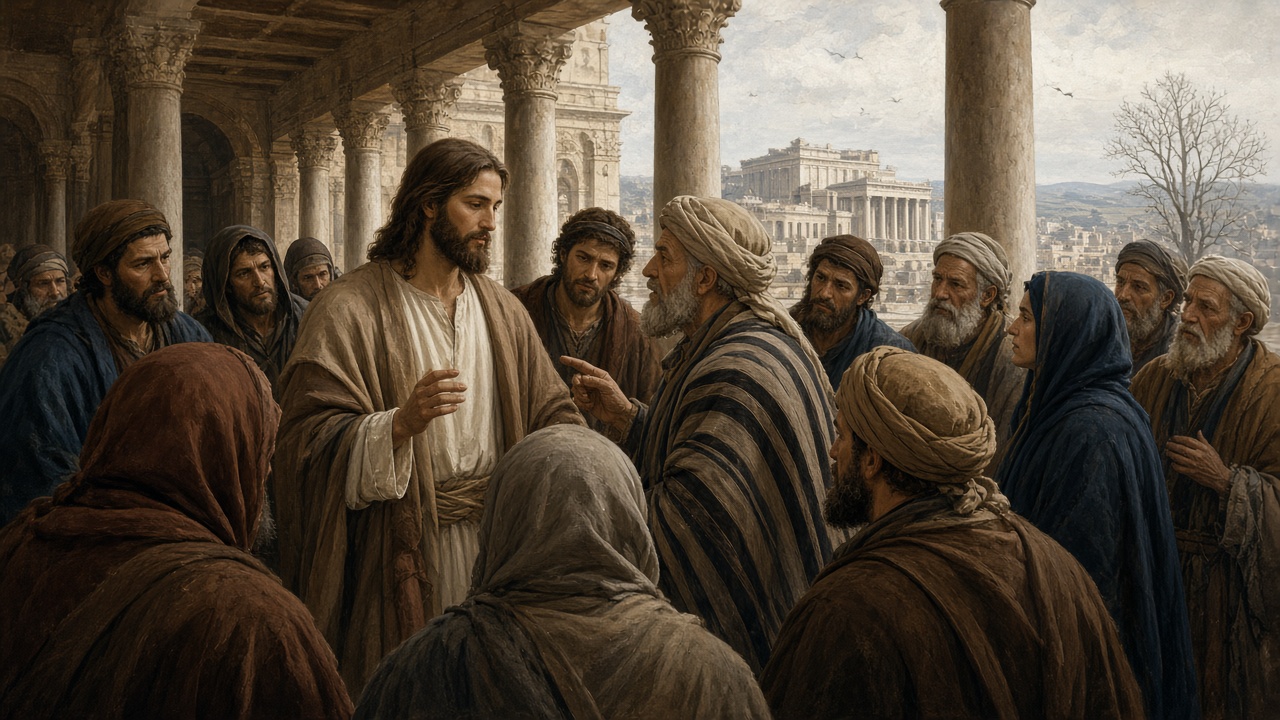
22Then the Chag (Festival) of Chanukah took place in Yerushalayim. It was winter. 23And Rebbe, Melech HaMoshiach was walking around in the Beis Hamikdash in the area called Ulam Sh'lomo (Solomonʼs Colonnade). 24Then those of Yehudah encircled Rebbe, Melech HaMoshiach and were saying to him, How much longer are you going to hold our neshamot in suspense? If you are the Rebbe, Melech HaMoshiach, tell us openly. 25In reply, Rebbe, Melech HaMoshiach said, I did tell you and you do not have emunah. The pe'ulot which I do b'Shem Avi, these pe'ulot give solemn edut (testimony) about me. 26But you do not have emunah (faith), because you do not belong to my Tzon. 27My Tzon hear my voice, and I have da'as of them, and they follow me. 28And I give to them Chayyei Olam, and they will never perish, and no one will snatch them out of my hand. 29That which Avi has given me is greater than all, and no one is able to snatch out of the hand of HaAv. 30I and HaAv are echad.
31Again those of Yehudah took up stones that they might stone him. 32In reply, Rebbe, Melech HaMoshiach said to them, Many ma'asim tovim I showed you from HaAv. Because of which ma'aseh do you stone me? 33In reply, those of Yehudah said to him, For a ma'aseh tov we do not stone you, but for Chillul Hashem and because you, being a man, make yourself G-d. 34In reply, Rebbe, Melech HaMoshiach answered them, Has it not been written in your Torah, ANI AMARTI ELOHIM ATEM (I said you are g-ds). 35If those ones he called g-ds, to whom the Dvar Hashem came and LO YUFAR KITVEI HAKODESH (and the Kitvei Hakodesh cannot be broken), 36Can you say of the One whom HaAv set apart as HaKadosh and sent into the Olam Hazeh that he commits Chillul Hashem because I said, Ben HaElohim Ani Hu? 37If I do not accomplish the pe'ulot of Avi, do not regard me with bitachon. 38But if I do, even if you do not have emunah in me, chotsh have emunah in the pe'ulot, so that you may continue to have da'as and binah that HaAv is in me and I am in HaAv. 39They were seeking, therefore, again to seize him, and he eluded their hand.
John’s Testimony Confirmed
40And he went away again beyond the Yarden to the place where Yochanan was in the beginning giving the mikveh mayimʼs tevilah of teshuvah, and he remained there. 41And many came to him and were saying, Yochanan indeed did no ot (miraculous sign), but everything Yochanan said about this man was HaEmes. 42And many put their emunah (faith) in him there.
Did you know?
The Good Shepherd
- During the Feast of Dedication in Jerusalem it was winter, and Jesus was walking in the temple courts in Solomon's Colonnade. The name Jerusalem, in a dual form, means "possession of peace" or "foundation of peace"; that form probably refers to the mountains of Zion and Moriah, or, as some suppose, to the upper and lower city. Solomon's Hebrew name, Shelomoh, means "peaceful."Sources: the Bible text itself · Jerusalem · Solomon
- A chronology of Gospel events dates the Good Shepherd teaching to AD 29, and dates a time of teaching and healing from Perea to Jerusalem to AD 30.Sources: The Good Shepherd Teaching · Teaching and Healing in Perea to Jerusalem
- Jesus then went back across the Jordan to the place where John had first been baptizing, and many people there believed in him. John was of priestly descent: his father, Zacharias, was a priest of the course of Abia, and his mother, Elisabeth, was of the daughters of Aaron. His birth, six months before that of Jesus, was foretold by an angel; those who came said that John never performed a sign, yet everything he had said about Jesus was true.Sources: the Bible text itself · John the Baptist
Notes written with AI assistance from open sources (Theographic Bible Metadata, CC BY-SA 4.0; Easton’s Bible Dictionary, public domain) and reviewed before publishing.
Places in this chapter
- Jerusalem · 31.777, 35.234 · verse 22
- Solomon’s Portico · Today: in Jerusalem · 31.777, 35.234 · verse 23
- Jordan · Today: Jordan River · 31.761, 35.558 · verse 40
Only places identified with high confidence are shown (90% or more according to the scholarly sources compiled by OpenBible). Period map: DARE (Digital Atlas of the Roman Empire), CC BY 4.0; modern map: © OpenStreetMap contributors; places: OpenBible.info (CC BY 4.0).
Credits and license for this translation
The Orthodox Jewish Bible
The Orthodox Jewish Bible - Tanakh and Orthodox Jewish Brit Chadasha - The Holy Bible
copyright © 2002-2011, 2021, 2024 Artists for Israel International
Language: English
Contributor: Artists for Israel International
THE ORTHODOX JEWISH TANAKH
Artists For Israel Intl Inc.
This version also appears with the Orthodox Yiddish Triglot which presents the Hebrew Yiddish script in Latin script and an English word for word translation, available at afii.org/Torah
To donate PayPal.Me
This translation is made available to you under the terms of the
Creative Commons Attribution license 4.0.
You may share and redistribute this Bible translation or extracts from it in any format, provided that:
You include the above copyright and source information.
If you make any changes to the text, you must indicate that you did so in a way that makes it clear that the original licensor is not necessarily endorsing your changes.
Pictures included with Scriptures and other documents on this site are licensed just for use with those Scriptures and documents.
For other uses, please contact the respective copyright owners.
Note that in addition to the rules above, revising and adapting God's Word involves a great responsibility to be true to God's Word. See Revelation 22:18-19.
2026-01-06
Section headings adapted from the Berean Standard Bible (public domain); they are not part of this translation’s text.
Source: http://ebible.org/engojb/ · eBible.org