James 2
The Orthodox Jewish Bible · Tap a verse to see its cross-references.
A Warning against Favoritism
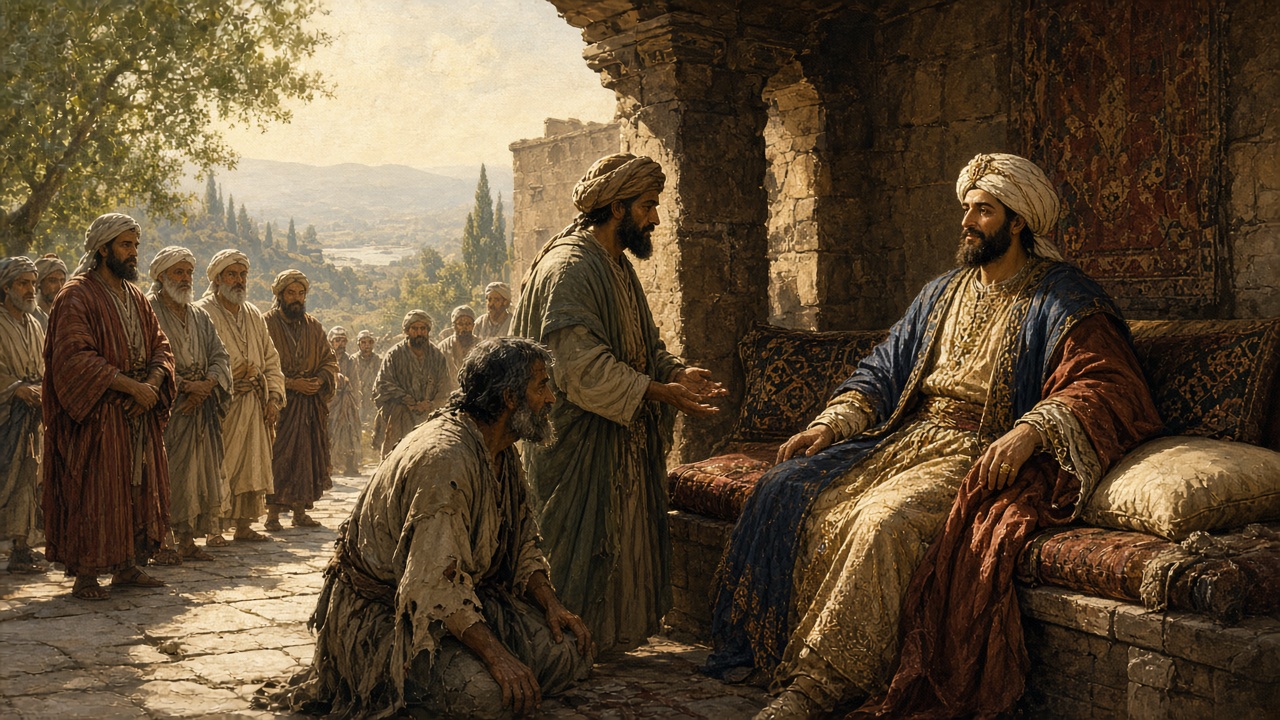
1My Achim b'Moshiach, you do not with your acts of maso panim (favoritism) hold to the emunah of the glorious Adoneinu Rebbe, Melech HaMoshiach Yehoshua. 2For if there enter into your Beit HaKnesset (House of Assembly, shul, synagogue, shtibel) a man with gold rings on his fingers in expensive bekeshe (kaftan) and shtreimel, and there enters also an underpriviledged nebach, a kabtzen (poor person) in shmattes (rags), 3and you pay special attention to the takif [influential man] wearing the bekeshe and shtreimel and say, “You sit here in the seat of kibbud” (respect, honor), and to the kabtzen (pauper) you say, “You stand there.” Or “You sit at my feet,” 4did you not among yourselves differentiate with prejudice and became shofetim (judges) with machshavot re'sha (evil thoughts)? 5Hinei! My beloved Achim b'Moshiach, did not Der Oybershter make the Aniyim of the Olam Hazeh in fact Bechirim of Hashem to be rich in emunah and also yoreshim of the Malchut Hashem, which Adoshem gave as a havtachah (promise) to those with Ahavas Hashem? 6But you dishonored the ish evyon (poor man, pauper). Do not the oishirim (rich ones) oppress you and they drag you into the Batei Din (Bet Din courts)? 7Do they not commit Chillul Hashem gidduf (blasphemy) against the Rebbe, Melech HaMoshiachʼs Shem Tov that has been named upon you?
8If indeed you are shomer regarding the Dat HaMalkhut (Royal Decree), as it is written in the Kitvei Hakodesh, V'AHAVTAH L'REI'ACHA KAMOCHA (And thou shalt love thy neighbor as thyself) you do well. 9But if you show maso panim (favoritism), you are chote'im (sinners) committing averos (transgressions) against the Torah. 10For whoever is shomer over kol haTorah but stumbles in one mitzvah, such is condemned as ashem (guilty) of averoh (transgression) of kol mitzvot. 11For the One having said, LO TINAF (You shall not commit adultery) said also LO TIRTZACH (You shall not murder). Now if you do not commit adultery but you do murder, you have become a Poshei'a al mitzvot HaTorah (Transgressor of the Torah). 12So let your devarim (words) be and so let your ma'asim (deeds) be as those who are about to come under the judgment of the Torah HaCherut. 13For the Din (Judgment) will be without rachamim (mercy) to the one not having shown rachamim. Rachamim wins the nitzachon (victory) over HaDin.
Faith and Works
14What is the revach (gain, profit), my Achim b'Moshiach, if anyone claims to have emunah but does not have ma'asim (deeds)? Surely not such “emunah” is able to bring him to Yeshu'at Eloheinu? 15If an Ach b'Moshiach or an Achot b'Moshiach is dressed in shmattes (tatters) and lacking “lechem chukeinu” (our daily bread), 16and anyone of you says to them, “Go in shalom! Be warmed and fed!” but you do not give to them the physical necessities, what is the revach (profit)? 17So also Emunah, if alongside it there is not in its company Ma'asim, is by itself niftar (deceased, dead).
18But someone will say, “You have emunah and I have ma'asim.” You make known to me the Hisgalus haSod (the revelation of the mystery) of your emunah without your ma'asim, and I'll show you, Chaver, from my ma'asim, the Emunah. 19So you're impressed with yourselves that with your emunah you can recite the kri'at Shema, nu? O you do so well… why, even the shedim have your da'as and emunah! But they shudder! 20Are you willing to have da'as, O hollow man, that “Emunah” unharnessed to Ma'asim, stands idle? 21Avraham Avinu, was he not YITZDAK IM HASHEM (justified with G-d) by his ma'asim when he performed the akedah (binding) and offered up Yitzchak Bno (Isaac his son) upon the mizbe'ach? 22Hinei! While Avraham Avinuʼs Emunah was working, working right alongside was Avraham Avinuʼs Ma'asim, and by Ma'asim the emunah was made shleimah! 23And the Kitvei Hakodesh was fulfilled, Avraham Avinu V'HE'EMIN B'HASHEM V'YACHSHEVEHA LO TZEDAKAH (believed Hashem and it was accounted to him for righteousness). He was even called “Ohev Hashem” (“Friend of G-d”). 24You see that from Ma'asim a man is YITZDAK IM HASHEM and not from “Emunah” alone. 25And likewise also Rachav the Zonah — was she not made YITZDAK IM HASHEM from Ma'asim, having received the messengers and having sent them out a different way? 26For just as the guf (body) without the neshamah is niftar (deceased, dead), so also is Emunah without Ma'asim.
Did you know?
Impartiality and Living Faith
- James recalls that Abraham was justified by offering his son Isaac on the altar, his faith working with his actions and perfected by what he did. Isaac, the only son of Abraham by Sarah, was the one God commanded Abraham to offer as a sacrifice on a mountain in the land of Moriah.Sources: the Bible text itself · Isaac
- James also cites Rahab the prostitute, justified by welcoming the spies and sending them off on another route. The two spies, sent by Joshua while the Hebrews were encamped at Shittim opposite Jericho, had gone to her house, faced danger in the city, and were saved by her fidelity.Sources: the Bible text itself · Rahab
Notes written with AI assistance from open sources (Theographic Bible Metadata, CC BY-SA 4.0; Easton’s Bible Dictionary, public domain) and reviewed before publishing.
Credits and license for this translation
The Orthodox Jewish Bible
The Orthodox Jewish Bible - Tanakh and Orthodox Jewish Brit Chadasha - The Holy Bible
copyright © 2002-2011, 2021, 2024 Artists for Israel International
Language: English
Contributor: Artists for Israel International
THE ORTHODOX JEWISH TANAKH
Artists For Israel Intl Inc.
This version also appears with the Orthodox Yiddish Triglot which presents the Hebrew Yiddish script in Latin script and an English word for word translation, available at afii.org/Torah
To donate PayPal.Me
This translation is made available to you under the terms of the
Creative Commons Attribution license 4.0.
You may share and redistribute this Bible translation or extracts from it in any format, provided that:
You include the above copyright and source information.
If you make any changes to the text, you must indicate that you did so in a way that makes it clear that the original licensor is not necessarily endorsing your changes.
Pictures included with Scriptures and other documents on this site are licensed just for use with those Scriptures and documents.
For other uses, please contact the respective copyright owners.
Note that in addition to the rules above, revising and adapting God's Word involves a great responsibility to be true to God's Word. See Revelation 22:18-19.
2026-01-06
Section headings adapted from the Berean Standard Bible (public domain); they are not part of this translation’s text.
Source: http://ebible.org/engojb/ · eBible.org