Isaiah 62
The Orthodox Jewish Bible · Tap a verse to see its cross-references.
Zion’s Salvation and New Name
1For the sake of Tziyon will I not hold my peace
and for the sake of Yerushalayim I will not remain quiet,
until her tzedek go forth like nogah (brightness),
and her Yeshu'ah (Salvation) like a blazing lapid (torch),
2And the Goyim shall see thy tzedek,
and kol melachim thy kavod;
and thou shalt be called by a shem chadash,
which the mouth of Hashem shall designate.
3Thou shalt also be an ateret tiferet
in the Yad Hashem,
and a tzanif melukhah (royal turban, diadem)
in the palm of thy G-d.
4Of thee it shalt no more be said, Azuvah (Forsaken);
neither of thy land shall it any more be said, Shemameh (Desolate);
but thou shalt be called Cheftzi-Vah, (My Delight is in her)
and thy land Beulah (Married):
for Hashem delighteth in thee,
and thy land shall be married.
5For as a bochur marrieth a betulah,
so shall thy banim marry thee;
and as the choson rejoiceth over the kallah,
so shall thy G-d rejoice over thee.
6I have set shomrim upon thy chomot, O Yerushalayim,
which shall never hold their peace yom nor lailah;
ye that remind Hashem, keep not silence,
7And give Him no rest,
until He establish, and until He make
Yerushalayim a tehillah (praise) in Ha'Aretz.
8Hashem hath sworn by His yamin,
and by the zero'a of His oz (might),
Surely I will no more give thy dagan
(grain) to be food for thine oyevim;
and the bnei nekhar shall not drink thy tirosh,
for the which thou hast toiled;
9But they that have harvested it shall eat it,
and praise Hashem;
and they that have gathered it in shall drink it
in the khatzerot (courtyards) of My Kodesh (Holy Place).
10Pass through, pass through the She'arim;
prepare ye the Derech HaAm;
Build up, build up the mesilah (highway);
gather out the even (stones);
lift up a nes (banner) [visible] over HaAmim (the Nations).
11Hinei, Hashem hath proclaimed
unto the ketzeh HaAretz (end of the Earth):
Say ye to Bat Tziyon, Hinei, thy Salvation cometh;
hinei, His sachar (reward) is with Him,
and His recompense before Him.
12And they shall call them, The Am HaKodesh,
the Geulei Hashem;
and thou shalt be called, Derushah (one being sought),
Ir Lo Ne'ezavah (City Not Deserted).
Did you know?
The Restoration and Renaming of Jerusalem
- In this chapter, Jerusalem and Zion are promised new symbolic names that reflect a dramatic change in status. Rather than being known as Forsaken or Desolate, the city and its land are given names such as Hephzibah (meaning delight is in her) and Beulah (signifying a married land), portraying restoration through the imagery of a joyous wedding feast.Sources: the Bible text itself · Jerusalem · Zion
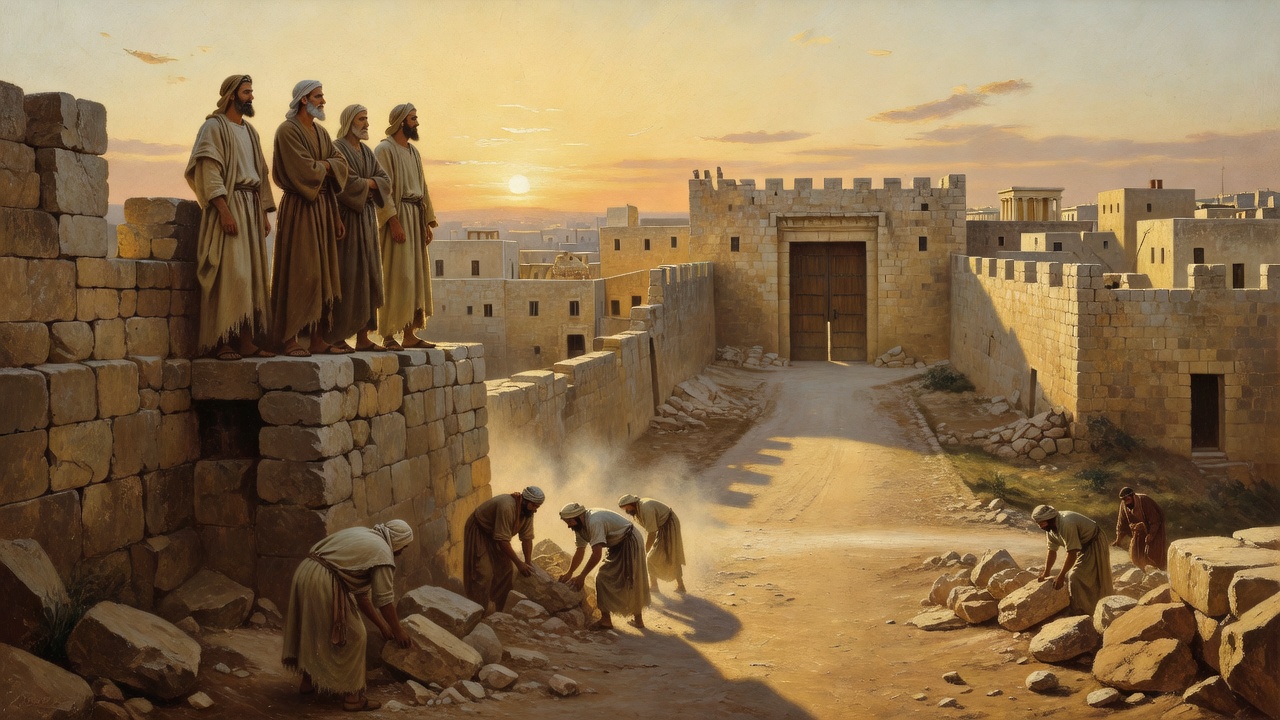
- The poem depicts continuous watchmen stationed atop the stone walls of Jerusalem who keep unceasing vigil day and night. Their role goes beyond standard military sentry duty, as they are instructed to persistently remind the LORD to establish the mountain city and make it the praise of the earth.Sources: the Bible text itself · Jerusalem
- The command to go through the city gates, clear stones, and build up a raised highway uses the ancient imagery of preparing a royal processional route to welcome returning people and signal salvation to surrounding nations.Sources: the Bible text itself
Notes written with AI assistance from open sources (Theographic Bible Metadata, CC BY-SA 4.0; Easton’s Bible Dictionary, public domain) and reviewed before publishing.
Places in this chapter
- Jerusalem · 31.777, 35.234 · verses 1, 5, 6, 7, 8, 12
- Zion · Today: Jerusalem · 31.777, 35.234 · verses 1, 11
Only places identified with high confidence are shown (90% or more according to the scholarly sources compiled by OpenBible). Period map: DARE (Digital Atlas of the Roman Empire), CC BY 4.0; modern map: © OpenStreetMap contributors; places: OpenBible.info (CC BY 4.0).
Credits and license for this translation
The Orthodox Jewish Bible
The Orthodox Jewish Bible - Tanakh and Orthodox Jewish Brit Chadasha - The Holy Bible
copyright © 2002-2011, 2021, 2024 Artists for Israel International
Language: English
Contributor: Artists for Israel International
THE ORTHODOX JEWISH TANAKH
Artists For Israel Intl Inc.
This version also appears with the Orthodox Yiddish Triglot which presents the Hebrew Yiddish script in Latin script and an English word for word translation, available at afii.org/Torah
To donate PayPal.Me
This translation is made available to you under the terms of the
Creative Commons Attribution license 4.0.
You may share and redistribute this Bible translation or extracts from it in any format, provided that:
You include the above copyright and source information.
If you make any changes to the text, you must indicate that you did so in a way that makes it clear that the original licensor is not necessarily endorsing your changes.
Pictures included with Scriptures and other documents on this site are licensed just for use with those Scriptures and documents.
For other uses, please contact the respective copyright owners.
Note that in addition to the rules above, revising and adapting God's Word involves a great responsibility to be true to God's Word. See Revelation 22:18-19.
2026-01-06
Section headings adapted from the Berean Standard Bible (public domain); they are not part of this translation’s text.
Source: http://ebible.org/engojb/ · eBible.org