Isaiah 59
The Orthodox Jewish Bible · Tap a verse to see its cross-references.
Sin Separates Us from God
1Behold, the Yad Hashem is not too short, that it cannot save;
neither His ozen (ear) too kaved (hard, insensitive, heavy, dull) that it cannot hear;
2But your avonot (iniquities) have separated you and Eloheichem,
and your chattot (sins) have concealed His face from you,
that He will not hear.
3For your hands are defiled and polluted with dahm,
and your fingers with avon (iniquity);
your lips have spoken sheker,
your leshon (tongue) hath muttered avlah (perverseness, wickedness, iniquity, lashon hora).
4None calleth b'tzedek (in righteousness),
nor any pleadeth b'emunah (in faithfulness, in truth);
they trust in tohu (nothingness), and speak shav (vanity);
they conceive amal (trouble), and give birth to aven (wickedness).
5They hatch the beytzim (eggs) of the tzifoni (viper, poisonous snake),
and weave the webs of the akavish (spider);
he that eateth of their beytzim (eggs) dieth,
and of that which is cracked open, an efeh (kind of poisonous snake) is hatched.
6Their webs shall not become beged (garments),
neither shall they cover themselves with their ma'asim;
their ma'asim are ma'asei aven (works of wickedness),
and the po'al chamas (act of violence) is in their hands.
7Their raglayim (feet) run to rah,
and they make haste for shefach dahm naki (blood shed of the innocent);
their machsh'vot (thoughts) are machsh'vot of aven (wickedness);
shod (desolation) and shever (destruction) are on their highways.
8Of the Derech Shalom they have no da'as;
and there is no mishpat (justice) in their circuits;
they have made themselves crooked roads;
whosoever walketh thereon shall not know shalom.
9Therefore is mishpat (justice) far from us,
neither doth tzedakah overtake us;
we wait for ohr, but, hinei, choshech;
for negohot (brightness), but we walk in gloom.
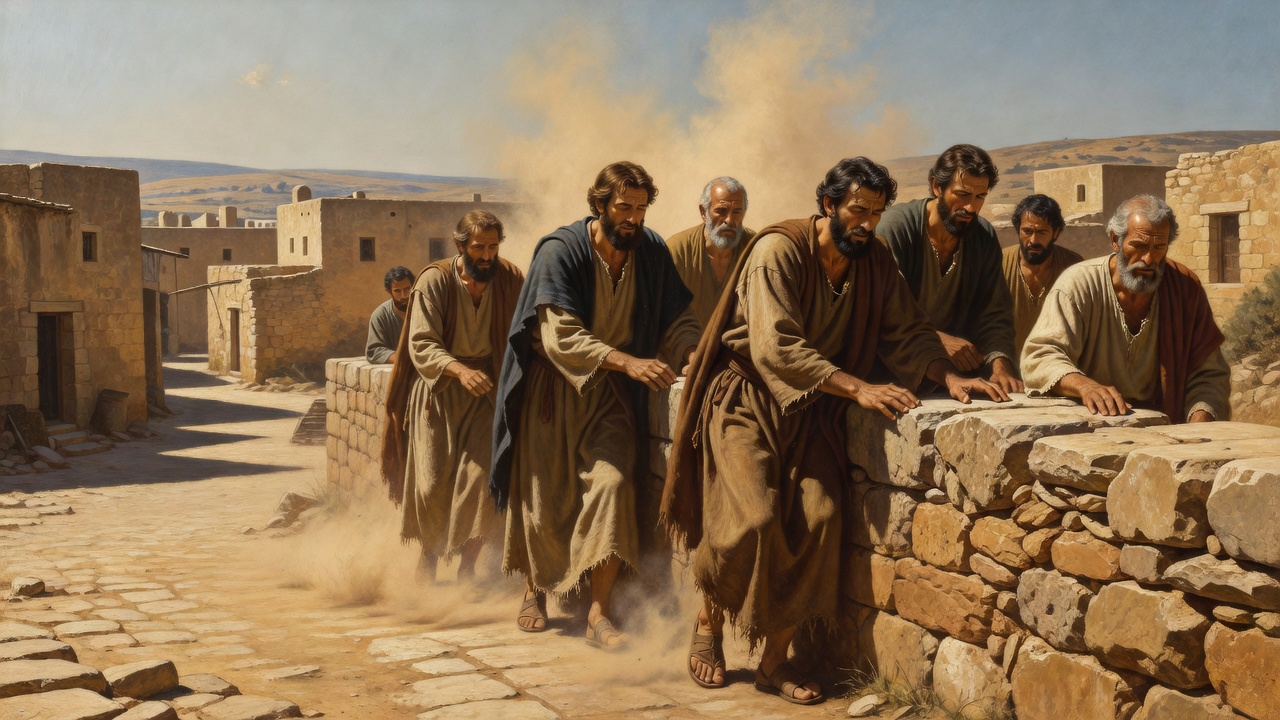
10We grope by the wall like the ivrim (blind),
and we grope as if we had no einayim (eyes);
we stumble at tzohorayim (noon) as in twilight;
we are in full vigor and stout, yet we are as mesim (dead ones).
11We all growl like dubim (bears),
and moan continually like yonim (doves);
we look for mishpat, but there is none;
for Yeshu'ah (Salvation), but it is far off from us.
12Because peysha'einu (our rebellions) have multiplied before Thee,
and chattoteinu (our sins) testify against us;
for peysha'einu are still with us;
and as for avonoteinu (our iniquities), we acknowledge them:
13In rebelling against and kachash (denying) Hashem,
and nasog (turning away) from Eloheinu,
speaking oshek (oppression) and sarah (revolt),
conceiving and uttering from the lev (heart) divrei sheker (words of falsehood).
14And mishpat (justice) is turned back,
and tzedakah (righteousness) standeth afar off;
for emes (truth) is fallen in the rechov (street),
and nacho'ach (honesty) cannot enter.
15Indeed, emes (truth) faileth;
and he that departeth from rah (evil)
maketh himself a prey;
And Hashem saw it,
and it was displeasing in His sight
that there was no mishpat (justice).
16And He saw that there was no ish (man),
and was appalled that there was no Mafgi'a (Intercessor);
therefore His own Zero'a (Arm) wrought Salvation unto Him;
and His own tzedakah (righteousness) He relied on.
17For He put on tzedakah as breastplate armor,
and a helmet of Yeshu'ah (Salvation, Saving Power) upon His rosh;
and He put on the bigdei nakam (garments of vengeance) for a uniform,
and was clad with kinah (zeal) as a me'il (mantle, cloak).
The Covenant of the Redeemer
18According to their gemulot (deeds, dealings), so He will repay,
chemah (fury, wrath) to His adversaries, gemul (recompence) to His oyevim (enemies);
to the iyim (islands) He will repay gemul (recompence, due).
19So shall they fear the Shem Hashem from the ma'arav (west),
and His kavod from the rising of the shemesh.
When the enemy shall come in like a nahar (flood, river),
the Ruach of Hashem shall lift up a standard against him.
20And the Go'el (Redeemer, Moshiach) shall come to Tziyon,
and unto them that make teshuva and turn from peysha (rebellion) in Ya'akov,
saith Hashem.
21As for Me, this is My Brit (Covenant) with them, saith Hashem; My Ruach that is upon thee, and My words which I have put in thy mouth, shall not depart out of thy mouth, nor out of the mouth of thy zera, nor out of the mouth of the zera of thy zera, saith Hashem, from henceforth and ad olam (forever).
Did you know?
Divine Justice and the Redeemer of Zion
- To illustrate profound moral breakdown and the collapse of civic justice, the passage uses vivid metaphors, describing truth stumbling in the public square and people groping along walls like the blind at midday.Sources: the Bible text itself
- When no human champion or intercessor is found to uphold justice, the passage depicts God arming Himself for intervention, putting on righteousness as a breastplate, the helmet of salvation, and a cloak of zeal.Sources: the Bible text itself
- The chapter promises that a Redeemer will arrive in Zion—the fortified southeastern hill of Jerusalem where David built his citadel—to deliver those among Jacob's descendants who turn away from transgression.Sources: the Bible text itself · Zion · Jacob (Israel)
Notes written with AI assistance from open sources (Theographic Bible Metadata, CC BY-SA 4.0; Easton’s Bible Dictionary, public domain) and reviewed before publishing.
Places in this chapter
- Zion · Today: Jerusalem · 31.777, 35.234 · verse 20
Only places identified with high confidence are shown (90% or more according to the scholarly sources compiled by OpenBible). Period map: DARE (Digital Atlas of the Roman Empire), CC BY 4.0; modern map: © OpenStreetMap contributors; places: OpenBible.info (CC BY 4.0).
Credits and license for this translation
The Orthodox Jewish Bible
The Orthodox Jewish Bible - Tanakh and Orthodox Jewish Brit Chadasha - The Holy Bible
copyright © 2002-2011, 2021, 2024 Artists for Israel International
Language: English
Contributor: Artists for Israel International
THE ORTHODOX JEWISH TANAKH
Artists For Israel Intl Inc.
This version also appears with the Orthodox Yiddish Triglot which presents the Hebrew Yiddish script in Latin script and an English word for word translation, available at afii.org/Torah
To donate PayPal.Me
This translation is made available to you under the terms of the
Creative Commons Attribution license 4.0.
You may share and redistribute this Bible translation or extracts from it in any format, provided that:
You include the above copyright and source information.
If you make any changes to the text, you must indicate that you did so in a way that makes it clear that the original licensor is not necessarily endorsing your changes.
Pictures included with Scriptures and other documents on this site are licensed just for use with those Scriptures and documents.
For other uses, please contact the respective copyright owners.
Note that in addition to the rules above, revising and adapting God's Word involves a great responsibility to be true to God's Word. See Revelation 22:18-19.
2026-01-06
Section headings adapted from the Berean Standard Bible (public domain); they are not part of this translation’s text.
Source: http://ebible.org/engojb/ · eBible.org