Isaiah 53
The Orthodox Jewish Bible · Tap a verse to see its cross-references.
The Suffering Servant
1Who hath believed our report?
And to whom is the Zero'a Hashem revealed?
2For he shall grow up before him as a tender plant,
and as a Shoresh (Root, Shoresh Yishai, Moshiach Ben Dovid) out of a dry ground;
he hath no form nor comeliness;
and when we shall see him,
there is no beauty that we should desire him.
3He is despised and chadal ishim (rejected by men);
a man of sorrows, and acquainted with suffering;
and we hid as it were our faces from him;
he was despised, and we esteemed him not.
4Surely he hath borne our sufferings,
and nasah (carried) our sorrows;
yet we did esteem him stricken,
smitten of G-d, and afflicted.
5But he was pierced for our transgressions,
he was bruised mei'avonoteinu (for our iniquities);
the musar (chastisement) that brought us shalom was upon him [Moshiach];
and at the cost of his [Moshiachʼs] chaburah (stripes, lacerations) we are healed.
6All we like sheep have gone astray;
we have turned every one to his own derech (way);
and Hashem hath laid on him
the avon (iniquity, the guilt that separates from G-d) of us all.
7He was oppressed, and he was afflicted,
yet he opened not his mouth;
he is brought as a seh (lamb) to the slaughter,
and as a sheep before her shearers is dumb,
so he openeth not his mouth.
8He was taken from prison and from judgment;
and who of his generation declared?
For he was cut off out of Eretz Chayyim
mipesha ami (for the transgression of my people [Yisroel]),
nega (plague) lamo ([fell] on him).
A Grave Assigned
9And he made his kever (grave) with the resha'im,
and with the oisher (rich man) bemotayv (in his deaths, intensive plural should be translated singular, death);
because he had done no chamas (violence),
neither was any mirmah (deceit) in his mouth.
10Yet it pleased Hashem to bruise him;
He hath put him to suffering;
when Thou shalt make his nefesh an asham offering for sin,
he (Moshiach) shall see zera,
He shall prolong his yamim (days)
and the chefetz Hashem (pleasure, will of Hashem ) shall prosper in his hand.
11He shall see of the travail of his nefesh, and shall be satisfied;
by knowledge of him
shall Tzadik Avdi (My Righteous Servant) justify many;
for he shall bear their avon (iniquities).
12Therefore will I divide him a portion with the great,
and he shall divide the spoil with the strong;
because he hath poured out his nefesh unto mavet (death);
and he was numbered with the transgressors;
and he nasah (bore) [like the Yom Kippur scapegoat] the sin of many,
and made intercession for the transgressors.
Did you know?
The Suffering Servant
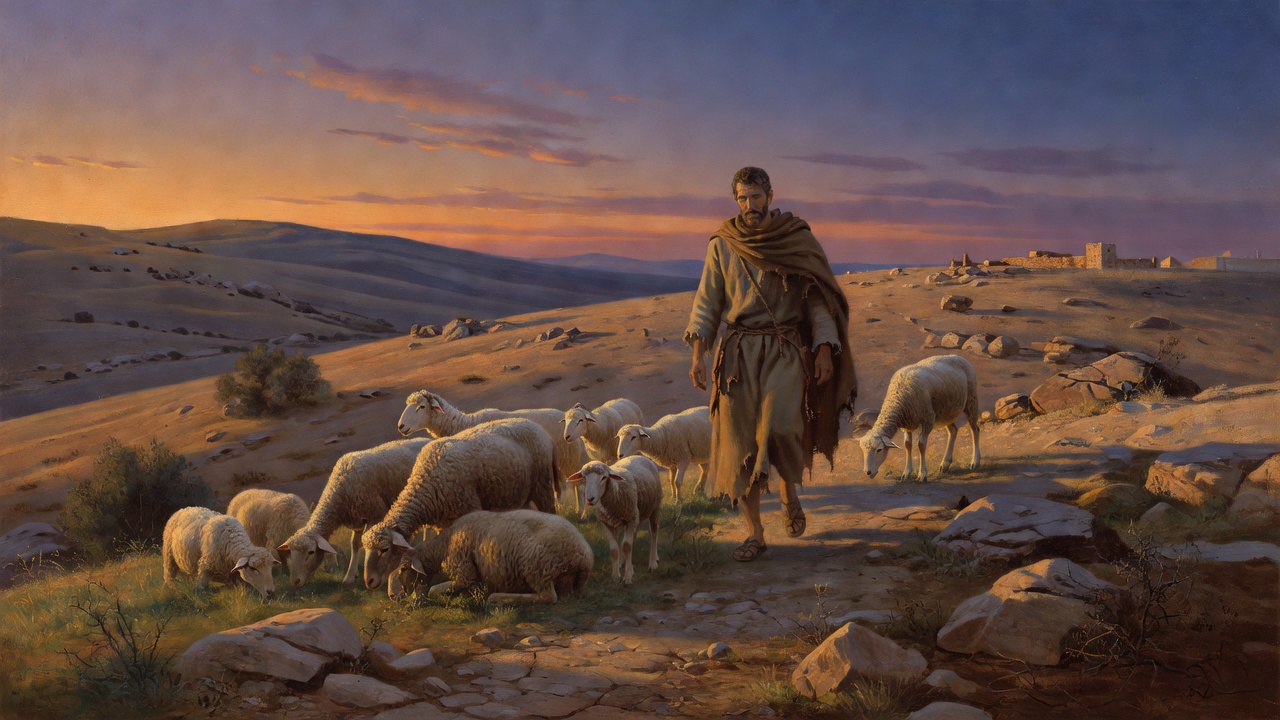
- The poem depicts an unassuming figure described as a tender shoot from dry ground who endures suffering, rejection, and affliction without protest, likened to a silent sheep before its shearers.Sources: the Bible text itself
- The passage portrays the Servant's life as a guilt offering that bears the transgressions of others, promising that after his anguish he will see life, prolong his days, and share spoils with the great.Sources: the Bible text itself
- Chronological traditions place the beginning of the prophetic ministry of Isaiah around 758 BC, spanning a period of more than sixty years.Sources: Prophecies of Isaiah
Notes written with AI assistance from open sources (Theographic Bible Metadata, CC BY-SA 4.0; Easton’s Bible Dictionary, public domain) and reviewed before publishing.
Credits and license for this translation
The Orthodox Jewish Bible
The Orthodox Jewish Bible - Tanakh and Orthodox Jewish Brit Chadasha - The Holy Bible
copyright © 2002-2011, 2021, 2024 Artists for Israel International
Language: English
Contributor: Artists for Israel International
THE ORTHODOX JEWISH TANAKH
Artists For Israel Intl Inc.
This version also appears with the Orthodox Yiddish Triglot which presents the Hebrew Yiddish script in Latin script and an English word for word translation, available at afii.org/Torah
To donate PayPal.Me
This translation is made available to you under the terms of the
Creative Commons Attribution license 4.0.
You may share and redistribute this Bible translation or extracts from it in any format, provided that:
You include the above copyright and source information.
If you make any changes to the text, you must indicate that you did so in a way that makes it clear that the original licensor is not necessarily endorsing your changes.
Pictures included with Scriptures and other documents on this site are licensed just for use with those Scriptures and documents.
For other uses, please contact the respective copyright owners.
Note that in addition to the rules above, revising and adapting God's Word involves a great responsibility to be true to God's Word. See Revelation 22:18-19.
2026-01-06
Section headings adapted from the Berean Standard Bible (public domain); they are not part of this translation’s text.
Source: http://ebible.org/engojb/ · eBible.org