Isaiah 32
The Orthodox Jewish Bible · Tap a verse to see its cross-references.
A Righteous King
1See, a Melech shall reign in tzedek,
and sarim shall rule in mishpat (justice).
2And an ish shall be
as a sheltering hiding place from the ruach (wind),
and a seter (refuge) from the tempest;
as streams of mayim in a dry place,
as the tzel (shadow) of a great rock
in a weary land.
3And the eynayim of them that see shall no longer be closed,
and the oznayim of them that hear shall pay heed.
4The levav also of the rash shall understand da'as,
and the lashon of the stammerers shall be ready to speak plainly.
5The naval (foolish person) shall be no more called noble,
nor the scoundrel said to be honorable.
6For the naval will speak foolishness,
and his lev will work evil, to practise khonef (hypocrisy),
and to utter to'ah (error, perversity) against Hashem,
to leave unsatisfied the nefesh of the ra'av (hungry),
and he will cause the drink of the tzameh (thirsty) to fail.
7The schemes also of the schemer are ra'im (evil ones);
he deviseth zimmot (wicked schemes)
to destroy the poor with words of sheker,
even when the evyon (needy) speaketh mishpat (justly).
8But the noble maketh plans that are noble;
and by noble things shall he stand.
The Women of Jerusalem
9Rise up, ye nashim that are complacently at ease;
hear my voice, ye banot at ease;
give ozen unto my speech.
10Days and a shanah, then shall ye tremble,
ye careless nashim;
for the grape harvest shall fail,
the harvest of fruit shall not come.
11Tremble, ye nashim that are complacently at ease;
shake, ye complacent ones;
strip you, and make you bare,
and gird sackcloth upon your loins.
12They shall mournfully beat upon their breasts,
for the pleasant fields,
for the fruitful gefen (vine).
13Upon the admat Ami (land of My People)
shall come up kotz (thorns) and briers;
indeed, upon all the batim (houses) of joy
in the city of merriment;
14Because the palaces shall be forsaken;
the multitude of the Ir shall be abandoned;
the citadel and stronghold shall be ruins ad olam,
a delight of wild donkeys,
a pasture of adarim (flocks);
15Until the Ruach be poured
upon us from on high,
and the midbar become a carmel (fruitful field),
and the carmel become a ya'ar (forest).
16Then mishpat shall dwell in the midbar,
and tzedakah live in the carmel.
17And the ma'aseh (work) of tzedakah (righteousness) shall be shalom;
and the effect of tzedakah
quietness and assurance ad olam (forever).
18And my people shall dwell in a naveh shalom (a habitation of peace)
and in secure mishkenot (dwellings),
and in quiet menuchot (resting places);
19When it shall hail,
coming down on the ya'ar (forest);
and the Ir shall be utterly brought down in a low place.
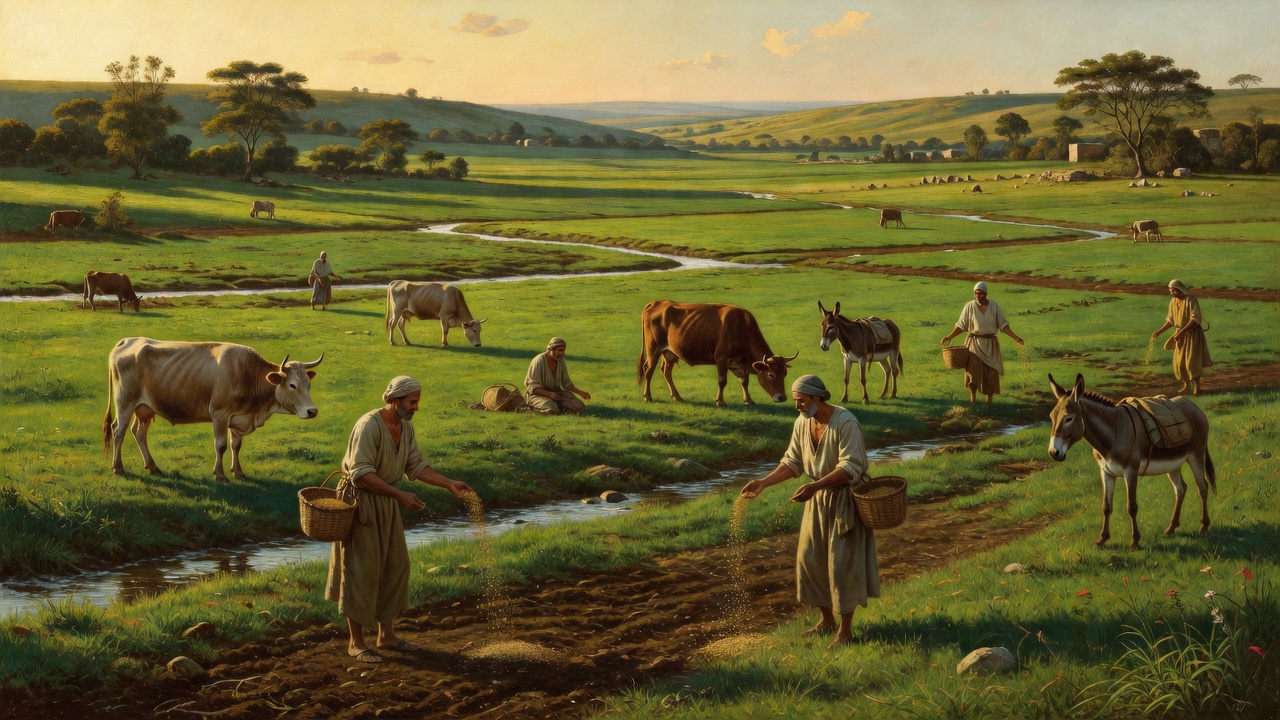
20Blessed are ye that sow beside all mayim,
that send forth there the regel of the shor (ox) and the chamor (donkey).
Did you know?
A Righteous King and the Outpouring of the Spirit
- The chapter opens with the promise of a king and princes who rule with righteousness and justice, acting as shelters from the storm and shade in a parched land. In contrast to oppressive scoundrels and fools who exploit the hungry and poor, noble leaders devise honorable plans.Sources: the Bible text itself
- Isaiah issues a sharp warning to complacent women in Jerusalem, predicting agricultural failure and the desolation of pleasant fields, palaces, and watchtowers within a year.Sources: the Bible text itself
- The period of abandonment is described as lasting until the Spirit is poured out from on high, which transforms the barren wilderness into a fertile orchard and produces enduring peace, security, and quiet confidence.Sources: the Bible text itself
Notes written with AI assistance from open sources (Theographic Bible Metadata, CC BY-SA 4.0; Easton’s Bible Dictionary, public domain) and reviewed before publishing.
Credits and license for this translation
The Orthodox Jewish Bible
The Orthodox Jewish Bible - Tanakh and Orthodox Jewish Brit Chadasha - The Holy Bible
copyright © 2002-2011, 2021, 2024 Artists for Israel International
Language: English
Contributor: Artists for Israel International
THE ORTHODOX JEWISH TANAKH
Artists For Israel Intl Inc.
This version also appears with the Orthodox Yiddish Triglot which presents the Hebrew Yiddish script in Latin script and an English word for word translation, available at afii.org/Torah
To donate PayPal.Me
This translation is made available to you under the terms of the
Creative Commons Attribution license 4.0.
You may share and redistribute this Bible translation or extracts from it in any format, provided that:
You include the above copyright and source information.
If you make any changes to the text, you must indicate that you did so in a way that makes it clear that the original licensor is not necessarily endorsing your changes.
Pictures included with Scriptures and other documents on this site are licensed just for use with those Scriptures and documents.
For other uses, please contact the respective copyright owners.
Note that in addition to the rules above, revising and adapting God's Word involves a great responsibility to be true to God's Word. See Revelation 22:18-19.
2026-01-06
Section headings adapted from the Berean Standard Bible (public domain); they are not part of this translation’s text.
Source: http://ebible.org/engojb/ · eBible.org