Isaiah 27
The Orthodox Jewish Bible · Tap a verse to see its cross-references.
The LORD’s Vineyard
1In Yom Hahu Hashem
with His cherev hakashah v'hagedolah v'hachazakah (terrible and great and strong sword)
shall punish Leviathan the Nachash bari'ach (fleeing serpent),
even Leviathan that Nachash akallaton (crooked serpent);
and He shall slay the Tanin (serpent, devouring sea monster) that is in the sea.
2In Yom Hahu sing ye about her,
A kerem (vineyard) of fruitfulness.
3I Hashem do watch over it;
I will water it continually;
lest any harm it,
I will guard it lailah va'yom.
4Chemah (wrath, fury) is not in Me;
but if there were briers and thorns set against Me in milchamah,
I would march through it,
I would burn it together.
5Or let him take hold of My ma'oz (stronghold, protection)
that he may make shalom with Me;
yes, he shall make shalom with Me.
6He shall cause them that come of Ya'akov to take root;
Yisroel shall blossom and bud,
and fill with fruit the face of the tevel.
7Hath He struck it, as He struck down those that struck it?
Or is it slain like the slaying of them that are slain by Him?
8In measure, in the sending away, Thou dost contend with her.
By His hard wind He removes her
in the Yom Kadim (day of the east wind).
9By this therefore shall kapporah be made for the avon Ya'akov;
and this is full fruitage to take away chattat;
when He maketh all the stones of the [heathen] mizbe'ach
like chalk stones crushed to pieces,
the Asherim poles and pagan incense altars
shall arise no more.
10Yet the Ir Betzurah (fortified city) shall be desolate,
and the habitation forsaken, and left like a midbar;
there shall the egel graze, and there shall it lie down,
and strip bare the branches thereof.
11When the boughs thereof are dry,
they shall be broken off;
the nashim come, and set them on fire;
for it is a people of no understanding;
therefore He that made them will not have compassion on them,
and He that formed them will show them no favor.
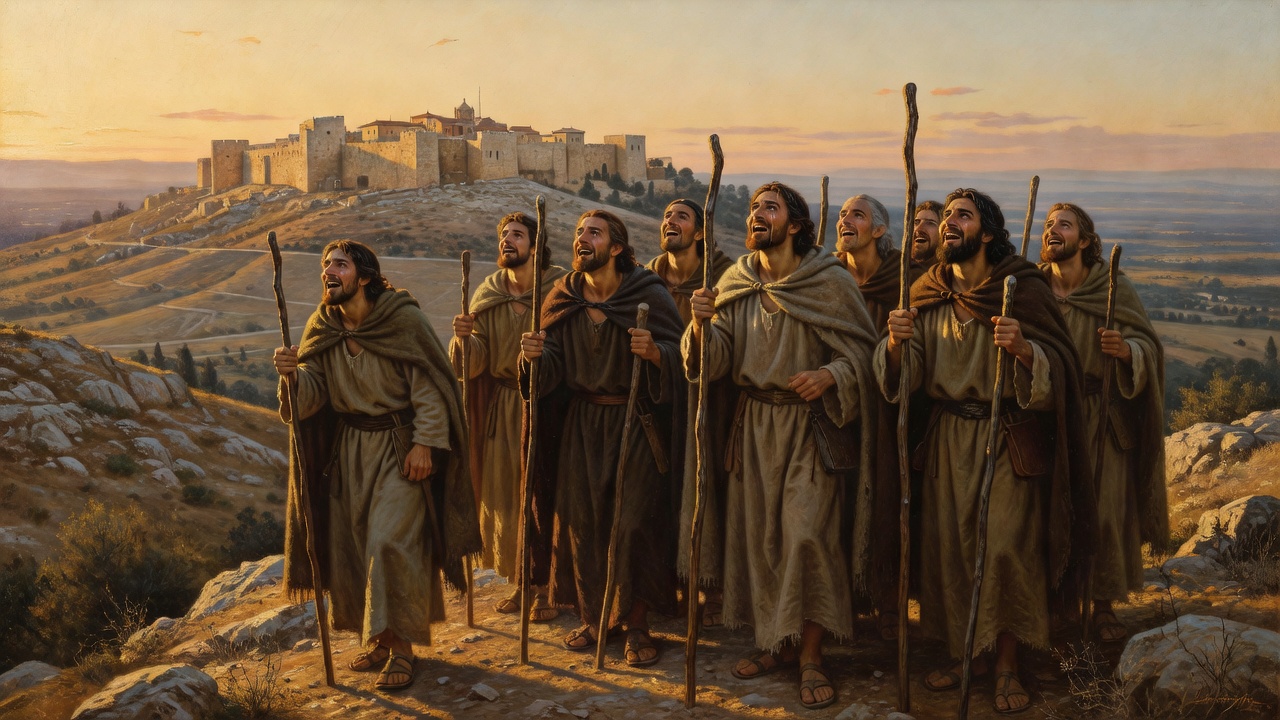
12And it shall come to pass in Yom Hahu, that Hashem shall thresh from the flowing Nahar (i.e. [Euphrates] River) unto the Wadi Mitzrayim, and ye shall be gathered one by one, O ye Bnei Yisroel. 13And it shall come to pass in Yom Hahu, that the shofar gadol shall be blown, and they shall come which were ready to perish in Eretz Ashur (Assyria), and those of the Golus of Eretz Mitzrayim, and shall worship Hashem in the Har HaKodesh in Yerushalayim.
Did you know?
The Fruitful Vineyard and the Return of the Exiles
- In Isaiah 27, Israel is portrayed as a fruitful vineyard carefully guarded and continually watered by the Lord so that it will take root and fill the world with fruit. This picture of divine protection and flourishing stands in contrast to the earlier depiction of an unfruitful vineyard in the book.Sources: the Bible text itself
- The prophecy describes the gathering of Israelites between the flowing Euphrates River and the Brook of Egypt. In biblical tradition, these two geographical landmarks defined the expansive borders of the land promised to Abraham's descendants.Sources: the Bible text itself · Euphrates · Brook of Egypt
- The sounding of a great ram's horn is foretold to call back exiles who were dispersed in the powerful empires of Assyria and Egypt. The returning survivors are summoned to worship the Lord together upon the holy mountain in Jerusalem.Sources: the Bible text itself · Assyria · Egypt · Jerusalem
Notes written with AI assistance from open sources (Theographic Bible Metadata, CC BY-SA 4.0; Easton’s Bible Dictionary, public domain) and reviewed before publishing.
Places in this chapter
- Euphrates · Today: Euphrates River · 31.004, 47.442 · verse 12
- Assyria · 36.359, 43.153 · verse 13
- Egypt · 30.129, 31.308 · verse 13
- Jerusalem · 31.777, 35.234 · verse 13
Only places identified with high confidence are shown (90% or more according to the scholarly sources compiled by OpenBible). Period map: DARE (Digital Atlas of the Roman Empire), CC BY 4.0; modern map: © OpenStreetMap contributors; places: OpenBible.info (CC BY 4.0).
Credits and license for this translation
The Orthodox Jewish Bible
The Orthodox Jewish Bible - Tanakh and Orthodox Jewish Brit Chadasha - The Holy Bible
copyright © 2002-2011, 2021, 2024 Artists for Israel International
Language: English
Contributor: Artists for Israel International
THE ORTHODOX JEWISH TANAKH
Artists For Israel Intl Inc.
This version also appears with the Orthodox Yiddish Triglot which presents the Hebrew Yiddish script in Latin script and an English word for word translation, available at afii.org/Torah
To donate PayPal.Me
This translation is made available to you under the terms of the
Creative Commons Attribution license 4.0.
You may share and redistribute this Bible translation or extracts from it in any format, provided that:
You include the above copyright and source information.
If you make any changes to the text, you must indicate that you did so in a way that makes it clear that the original licensor is not necessarily endorsing your changes.
Pictures included with Scriptures and other documents on this site are licensed just for use with those Scriptures and documents.
For other uses, please contact the respective copyright owners.
Note that in addition to the rules above, revising and adapting God's Word involves a great responsibility to be true to God's Word. See Revelation 22:18-19.
2026-01-06
Section headings adapted from the Berean Standard Bible (public domain); they are not part of this translation’s text.
Source: http://ebible.org/engojb/ · eBible.org