Hosea 3
The Orthodox Jewish Bible · Tap a verse to see its cross-references.
Hosea Redeems His Wife
1Then said Hashem unto me, Go again, love an isha (woman, wife) beloved of her re'a (friend, companion), yet a noefet (adulteress), just like the ahavat Hashem toward the Bnei Yisroel, who look to elohim acharim, and love heathen religion raisin cakes.
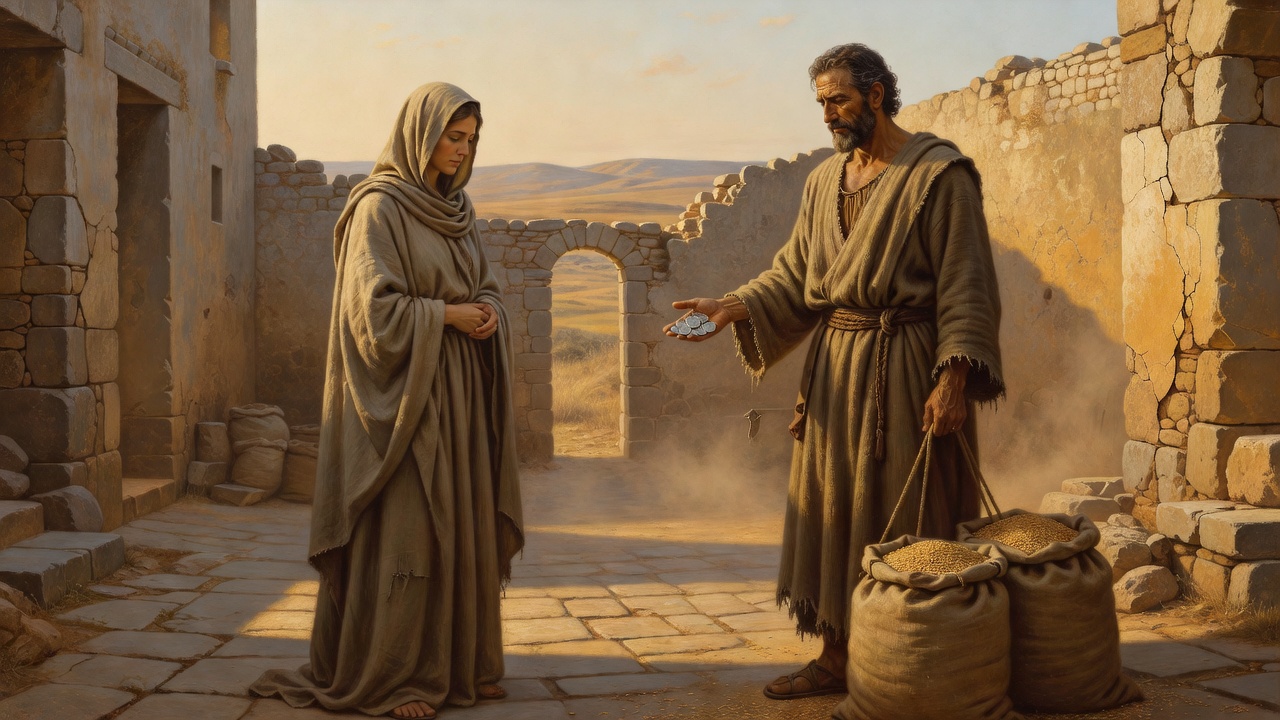
2So I bought her to me for fifteen pieces of kesef, and for a chomer and a half of se'orim; 3And I said unto her, Thou shalt abide with me yamim rabbim and shalt not play the zonah, and thou shalt not be for another ish; and thus will I also towards thee. 1 4For the Bnei Yisroel shall abide yamim rabbim without a melech, and without a sar, and without a zevach, and without a matzevah (stone pillar, monument) and without an ephod (sacred vest used for consulting a deity), and without teraphim (household idols); 5Afterward shall the Bnei Yisroel return, and seek Hashem Eloheihem, and Dovid their melech; and shall fear Hashem and His goodness in the acharit hayamim (last days).
Did you know?
A Symbolic Redemption
- In Hosea 3, the prophet is commanded to buy back his unfaithful wife, paying fifteen shekels of silver along with a homer and a lethech of barley. This personal act serves as a living illustration of God's enduring love for Israel despite the nation's unfaithfulness and devotion to other gods.Sources: the Bible text itself
- The chapter foretells a long period during which the Israelites would live without king, prince, sacrifice, sacred pillar, ephod, or idol. Afterward, they are prophesied to return in reverence to seek the LORD and David their king in the last days.Sources: the Bible text itself
Notes written with AI assistance from open sources (Theographic Bible Metadata, CC BY-SA 4.0; Easton’s Bible Dictionary, public domain) and reviewed before publishing.
Credits and license for this translation
The Orthodox Jewish Bible
The Orthodox Jewish Bible - Tanakh and Orthodox Jewish Brit Chadasha - The Holy Bible
copyright © 2002-2011, 2021, 2024 Artists for Israel International
Language: English
Contributor: Artists for Israel International
THE ORTHODOX JEWISH TANAKH
Artists For Israel Intl Inc.
This version also appears with the Orthodox Yiddish Triglot which presents the Hebrew Yiddish script in Latin script and an English word for word translation, available at afii.org/Torah
To donate PayPal.Me
This translation is made available to you under the terms of the
Creative Commons Attribution license 4.0.
You may share and redistribute this Bible translation or extracts from it in any format, provided that:
You include the above copyright and source information.
If you make any changes to the text, you must indicate that you did so in a way that makes it clear that the original licensor is not necessarily endorsing your changes.
Pictures included with Scriptures and other documents on this site are licensed just for use with those Scriptures and documents.
For other uses, please contact the respective copyright owners.
Note that in addition to the rules above, revising and adapting God's Word involves a great responsibility to be true to God's Word. See Revelation 22:18-19.
2026-01-06
Section headings adapted from the Berean Standard Bible (public domain); they are not part of this translation’s text.
Source: http://ebible.org/engojb/ · eBible.org