Hebrews 3
The Orthodox Jewish Bible · Tap a verse to see its cross-references.
Jesus Our Apostle and High Priest
1For this reason, Achai Hakedoshim b'Moshiach, Chaverim and Chavrusa partners in a Kri'at Marom (High [Himel] Calling), consider carefully the Shliach and Kohen Gadol of the Hachrazah (Proclamation) of our Emunah, Yehoshua, Yeshua. 2He being ne'eman (faithful) to the One having given him s'michah as also Moshe Rabbeinu was ne'eman (faithful) in kol Beis Hashem. 3Yet Rebbe, Melech HaMoshiach is considered worthy of more kavod than Moshe Rabbeinu, because more kavod has the Boneh (Builder) of the Beis than the Beis itself. 4For every Beis is built by someone, but the One having built everything is Hashem. 5Now Moshe Rabbeinu was ne'eman in kol Beis Hashem as an eved, for a solemn edut of the things which were to be spoken afterward. 6But Rebbe, Melech HaMoshiach was ne'eman as HaBen over the Beis Hashem, whose Beis we are, if indeed the bitachon and the tikvah in which we glory we keep hold of to HaKetz.
Do Not Harden Your Hearts
7Therefore, just as the Ruach Hakodesh says, HAYOM IM BEKOLO TISHMAU (Today, if you hear His voice); 8AL TAKSHU LEVAVCHEM KIMRIVAH K'YOM MASSAH BAMIDBAR (Do not harden your heart as you did at Meribah, as you did that day at Massah in the desert), 9ASHER NISSUNI AVOTEICHEM BEKHANUNI GAM RA'U PO'OLI ARBA'IM SHANAH (Where your Fathers tested me and tried me though they saw my deeds forty years). 10Therefore AKUT BEDOR VAOMAR AM TO'EY LEVAV HEM V'HEM LO YAD'U DERAKHAI (I was angry with that generation and I said they are a straying-of-heart people and they have not had da'as of my ways); 11ASHER NISHBA'ETI V'APEY IM YEVO'UN EL MENUKHATI (Therefore I declared on oath in my anger, Never shall they enter into my Rest, Home, Abode, Place of Tranquility.)
The Peril of Unbelief
12Beware, Achim b'Moshiach, lest there will be in any one of you a lev rah (evil heart) without Emunah, that turns away shmad from Elohim Chayyim. 13Instead, give one another chozek (strength) each and every day, as long as it is still called “HAYOM,” (today) lest some of you may fall into KESHI (stubbornness, hardness) and be stubbornly hardened by the nechalim (deceitfulness) of Chet. 14We have become chavrusa partners of Moshiach if only our bitachon (confidence) we had initially we hold firm until HaKetz; 15As it is said, HAYOM IM BEKOLO TISHMAU AL TAKSHU LEVAVCHEM (Today, if you hear his voice, do not harden your heart) as in the Meribah Mered (Rebellion). 16Now who were they who heard and yet rebelled? Was it not all the ones having had litzi'at Mitzrayim (going out from Egypt) under Moshe Rabbeinu? 17And with whom was Hashem angry ARBA'IM SHANAH? Was it not with the ones having sinned, whose “PEGARIM” (corpses) lay where they had “fallen BAMIDBAR” (in the desert)? 18And to whom did He swear that they would not enter into the menuchah (resting place) of Him? Was it not to the ones without mishma'at (obedience)? 19And so we see that they were not able to enter because of lack of Emunah.
Did you know?
Greater Glory Than Moses
- Hebrews asks its readers to fix their attention on Jesus, the apostle and high priest they confess. He was faithful to the one who appointed him, just as Moses was faithful in all God's house, but Jesus is counted worthy of greater glory than Moses, as the builder of a house has greater honor than the house. Moses was faithful as a servant; Christ is faithful as the Son over God's house.Sources: the Bible text itself
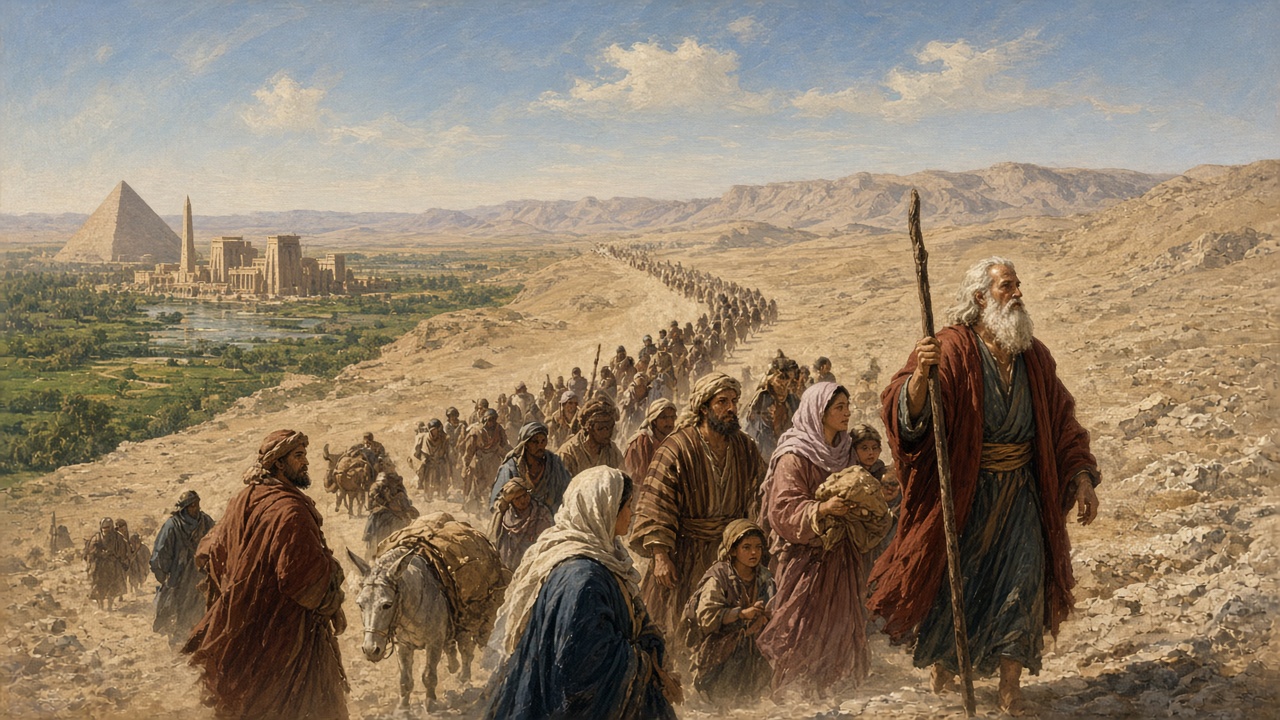
- The warning looks back to the people Moses led out of Egypt. For forty years in the wilderness they tested God, who was angry with that generation and swore they would never enter his rest; their bodies fell in the wilderness. The chapter says that unbelief kept them from entering.Sources: the Bible text itself
- Egypt, the land they left with Moses, is the land of the Nile and the pyramids. Easton's Bible Dictionary (1897) explains the name Moses as Drawn, or links it with the Egyptian word mesu, meaning son.Sources: the Bible text itself · Egypt · Moses
Notes written with AI assistance from open sources (Theographic Bible Metadata, CC BY-SA 4.0; Easton’s Bible Dictionary, public domain) and reviewed before publishing.
Places in this chapter
- Egypt · 30.129, 31.308 · verse 16
Only places identified with high confidence are shown (90% or more according to the scholarly sources compiled by OpenBible). Period map: DARE (Digital Atlas of the Roman Empire), CC BY 4.0; modern map: © OpenStreetMap contributors; places: OpenBible.info (CC BY 4.0).
Credits and license for this translation
The Orthodox Jewish Bible
The Orthodox Jewish Bible - Tanakh and Orthodox Jewish Brit Chadasha - The Holy Bible
copyright © 2002-2011, 2021, 2024 Artists for Israel International
Language: English
Contributor: Artists for Israel International
THE ORTHODOX JEWISH TANAKH
Artists For Israel Intl Inc.
This version also appears with the Orthodox Yiddish Triglot which presents the Hebrew Yiddish script in Latin script and an English word for word translation, available at afii.org/Torah
To donate PayPal.Me
This translation is made available to you under the terms of the
Creative Commons Attribution license 4.0.
You may share and redistribute this Bible translation or extracts from it in any format, provided that:
You include the above copyright and source information.
If you make any changes to the text, you must indicate that you did so in a way that makes it clear that the original licensor is not necessarily endorsing your changes.
Pictures included with Scriptures and other documents on this site are licensed just for use with those Scriptures and documents.
For other uses, please contact the respective copyright owners.
Note that in addition to the rules above, revising and adapting God's Word involves a great responsibility to be true to God's Word. See Revelation 22:18-19.
2026-01-06
Section headings adapted from the Berean Standard Bible (public domain); they are not part of this translation’s text.
Source: http://ebible.org/engojb/ · eBible.org