Galatians 6
The Orthodox Jewish Bible · Tap a verse to see its cross-references.
Carry One Another’s Burdens
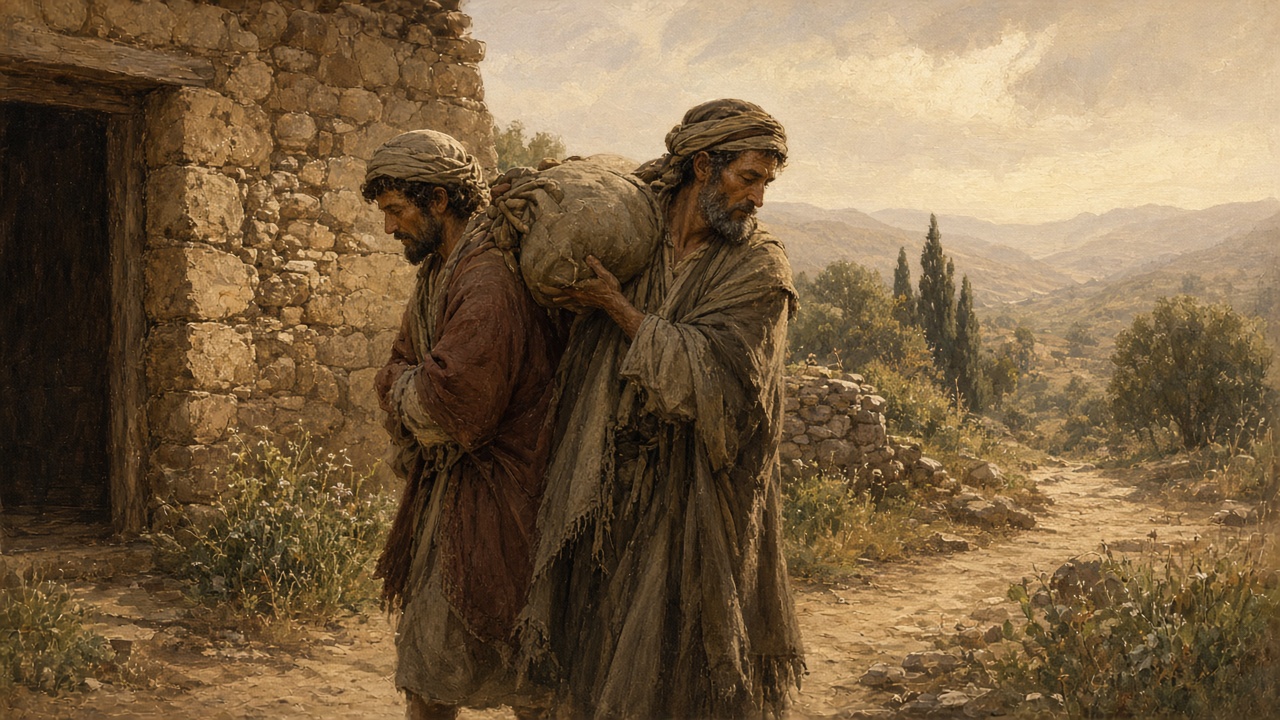
1Achim B'Moshiach, if indeed a man is overtaken in some averah, you ones with ruchniyus restore such a one in a spirit of anavah (meekness), watching out for yourself lest also you come under nisayon (temptation). 2Bear one anotherʼs burdens and thus you will fulfill the Torah of Moshiach. 3For if anyone thinks himself to be something when he is nothing, he deceives himself. 4But let each man prove his own ma'aseh and then in his own ma'asim rather than in that of his re'a (neighbor) he will find kavod. 5For each man must bear his own massa (burden).
6And let the one being taught limudei kodesh (sacred studies) in the Kitvei HaKodesh share in all good things with his rabbinic moreh. 7Do not be led astray. Hashem is not mocked. For whatever a man sows, this also he will reap. 8For the one sowing to the basar of himself, of the basar will reap churban (destruction); but the one sowing to the Ruach HaKodesh, of the Ruach HaKodesh will reap Chayyei Olam. 9Now let us not lose chozek in doing Gemilut Chasadim, for BE'ITO (in its season) we will reap, if we faint not. 10Therefore, then, as we have opportunity, we should do ma'asim tovim towards all, and especially towards the Bnei Beis HaEmunah.
Final Warnings and Blessings
11see with what groise letters i wrote to you with my own hand. 12As many as crave to be good preeners in the basar, these compel you (Goyim) to undergo bris milah; they (the mohalim of Goyim) do so only to avoid suffering redifah (persecution) for the Etz of Moshiach. 13For not even those of the party of the bris milah are shomer mitzvot themselves; they (the mohalim of Goyim) want you (Goyim) to undergo bris milah for the purpose of boasting in your basar! 14But may it not be to me to boast, except in HaEtz HaMoshiach Yehoshua Adoneinu, through whom the Olam Hazeh has become nevelah talui al HaEtz (corpse hanging on the tree) to me, and I have become a nevelah talui al HaEtz (corpse hanging on the tree) to the Olam Hazeh. 15For neither bris milah is anything, nor fehlt (the lacking) of bris milah, but a Bri'a Chadasha. 16And as many as stay in line with the Derech HaYashar (Straight Way) of these divrei torah, Shalom Hashem and Chesed Hashem be upon them, and upon the Yisroel of Hashem.
17For the rest, let no one give me any more tzoros; for I bear in my basar the chabburot haYehoshua (wounds, stripes of Yehoshua).
18Achim B'Moshiach, the Chen v'Chesed Hashem of Rebbe, Melech HaMoshiach Yehoshua Adoneinu be with your neshamah. Omein.
Did you know?
Burdens, the Harvest, and the Cross
- The chapter sets two duties side by side. Those who are spiritual should restore with gentleness someone caught in a trespass, and carry one another's burdens, which the letter calls fulfilling the law of Christ. Each person, however, should test his own work and carry his own load, rather than think he is something when he is nothing and boast by comparing himself with someone else.Sources: the Bible text itself
- The writer uses the image of sowing and reaping: God is not to be mocked, and a person reaps what he sows. The one who sows to please the flesh reaps destruction from the flesh; the one who sows to please the Spirit reaps eternal life from the Spirit. Readers are urged not to grow weary in doing good, for in due time they will reap a harvest if they do not give up, and to do good to all, especially to the family of faith.Sources: the Bible text itself
- The writer calls attention to the large letters he is using as he writes with his own hand. He says that some try to compel circumcision in order to make a good outward impression, to avoid persecution for the cross of Christ, and to boast in the flesh of others, though the circumcised do not themselves keep the law. He asks never to boast except in the cross of our Lord Jesus Christ, says that neither circumcision nor uncircumcision means anything and that what counts is a new creation, and states that he bears on his body the marks of Jesus.Sources: the Bible text itself
Notes written with AI assistance from open sources (Theographic Bible Metadata, CC BY-SA 4.0; Easton’s Bible Dictionary, public domain) and reviewed before publishing.
Credits and license for this translation
The Orthodox Jewish Bible
The Orthodox Jewish Bible - Tanakh and Orthodox Jewish Brit Chadasha - The Holy Bible
copyright © 2002-2011, 2021, 2024 Artists for Israel International
Language: English
Contributor: Artists for Israel International
THE ORTHODOX JEWISH TANAKH
Artists For Israel Intl Inc.
This version also appears with the Orthodox Yiddish Triglot which presents the Hebrew Yiddish script in Latin script and an English word for word translation, available at afii.org/Torah
To donate PayPal.Me
This translation is made available to you under the terms of the
Creative Commons Attribution license 4.0.
You may share and redistribute this Bible translation or extracts from it in any format, provided that:
You include the above copyright and source information.
If you make any changes to the text, you must indicate that you did so in a way that makes it clear that the original licensor is not necessarily endorsing your changes.
Pictures included with Scriptures and other documents on this site are licensed just for use with those Scriptures and documents.
For other uses, please contact the respective copyright owners.
Note that in addition to the rules above, revising and adapting God's Word involves a great responsibility to be true to God's Word. See Revelation 22:18-19.
2026-01-06
Section headings adapted from the Berean Standard Bible (public domain); they are not part of this translation’s text.
Source: http://ebible.org/engojb/ · eBible.org