Amos 4
The Orthodox Jewish Bible · Tap a verse to see its cross-references.
Punishment Brings No Repentance
1Hear this word, ye cows of Bashan,
that are on Mt Shomron, which oppress the poor,
which crush the needy, which say to their adonim:
Bring, and let us drink.
2Adonoi Hashem hath sworn by His Kodesh that,
hinei, the yamim shall come upon you,
that He will take you away with hooks,
and the last of you with fishhooks.
3And ye shall go out of the breaks in the wall,
every cow right behind the next;
and ye shall be cast out toward Harmon,
saith Hashem.
4Come to Beit-El, and transgress;
at Gilgal multiply peysha'im;
and bring your zevakhim every boker, and your ma'asrot (tithes) every third day;
5And offer a todah thank offering with chametz (leavened bread),
and proclaim and publish the nedavot (freewill offerings);
for this ye love, O Bnei Yisroel,
saith Adonoi Hashem.
6And I also have given you
cleanness of teeth in all your towns,
and want of lechem in all your places;
yet have ye not returned unto Me,
saith Hashem.
7And also I have withheld the geshem from you,
when there were yet shloshah chodashim to the harvest;
and I caused it to rain upon one town,
and caused it not to rain upon another town;
one chelek (part) was rained upon,
and the chelek, whereupon it rained not, withered.
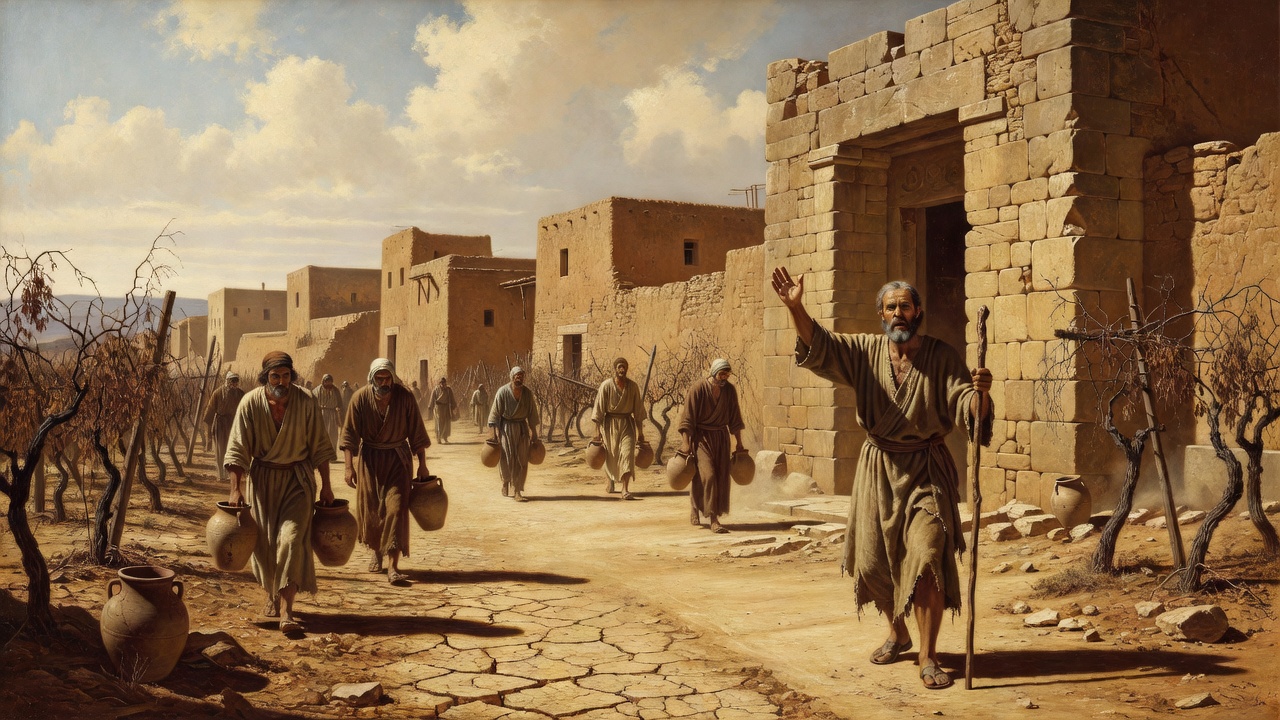
8So two or three towns wandered unto one town,
to drink mayim, but they were not satisfied;
yet have ye not returned unto Me,
saith Hashem.
9I have struck you with blight and mildew;
when your ganim (gardens) and your kramim (vineyards)
and your fig trees and your olive trees increased,
the locust devoured them;
yet have ye not returned unto Me,
saith Hashem.
10I have sent among you the dever after the manner of Mitzrayim;
your bocherim have I slain with the cherev,
and have taken away your susim;
and I have made the stench
of your machanot to come up unto your nostrils;
yet have ye not returned unto Me,
saith Hashem.
11I have overthrown some of you,
as Elohim overthrew Sodom and Amora (Gomorrah),
and ye were like a firebrand snatched from the burning;
yet have ye not returned unto Me,
saith Hashem.
12Therefore thus will I do unto thee, O Yisroel;
and because I will do this unto thee, prepare to meet Eloheicha, O Yisroel.
13For, hinei, He that formeth the harim, and createth the ruach,
and declareth unto man what is his thought,
that maketh the shachar darkness,
and treadeth upon the high places of the earth,
Hashem Elohei Tzva'os Shmo.
Did you know?
Unheeded Warnings and the God of Hosts
- Amos addresses the wealthy, exploitative women of Samaria by calling them cows of Bashan. Samaria was the hilltop capital of the northern kingdom of Israel, while Bashan was a fertile region north of Gilead known for its rich pastures.Sources: the Bible text itself · Samaria · Bashan
- The prophet sarcastically invites the people to bring sacrifices and tithes to Bethel and Gilgal. Both locations had deep historical and religious importance in Israel, but had become sites of hollow religious ritual and transgression.Sources: the Bible text itself · Bethel (of Palestine) · Gilgal
- Amos recounts a series of divine warnings through natural and military disasters, including severe drought, crop-destroying locusts, pestilence reminiscent of Egypt, and battlefield defeat. Despite each disaster, the text repeats the refrain that the people refused to return to God.Sources: the Bible text itself · Egypt
Notes written with AI assistance from open sources (Theographic Bible Metadata, CC BY-SA 4.0; Easton’s Bible Dictionary, public domain) and reviewed before publishing.
Places in this chapter
- Bashan · 32.781, 35.935 · verse 1
- Samaria · 32.276, 35.195 · verse 1
- Egypt · 30.129, 31.308 · verse 10
Only places identified with high confidence are shown (90% or more according to the scholarly sources compiled by OpenBible). Period map: DARE (Digital Atlas of the Roman Empire), CC BY 4.0; modern map: © OpenStreetMap contributors; places: OpenBible.info (CC BY 4.0).
Credits and license for this translation
The Orthodox Jewish Bible
The Orthodox Jewish Bible - Tanakh and Orthodox Jewish Brit Chadasha - The Holy Bible
copyright © 2002-2011, 2021, 2024 Artists for Israel International
Language: English
Contributor: Artists for Israel International
THE ORTHODOX JEWISH TANAKH
Artists For Israel Intl Inc.
This version also appears with the Orthodox Yiddish Triglot which presents the Hebrew Yiddish script in Latin script and an English word for word translation, available at afii.org/Torah
To donate PayPal.Me
This translation is made available to you under the terms of the
Creative Commons Attribution license 4.0.
You may share and redistribute this Bible translation or extracts from it in any format, provided that:
You include the above copyright and source information.
If you make any changes to the text, you must indicate that you did so in a way that makes it clear that the original licensor is not necessarily endorsing your changes.
Pictures included with Scriptures and other documents on this site are licensed just for use with those Scriptures and documents.
For other uses, please contact the respective copyright owners.
Note that in addition to the rules above, revising and adapting God's Word involves a great responsibility to be true to God's Word. See Revelation 22:18-19.
2026-01-06
Section headings adapted from the Berean Standard Bible (public domain); they are not part of this translation’s text.
Source: http://ebible.org/engojb/ · eBible.org