Acts 6
The Orthodox Jewish Bible · Tap a verse to see its cross-references.
The Choosing of the Seven
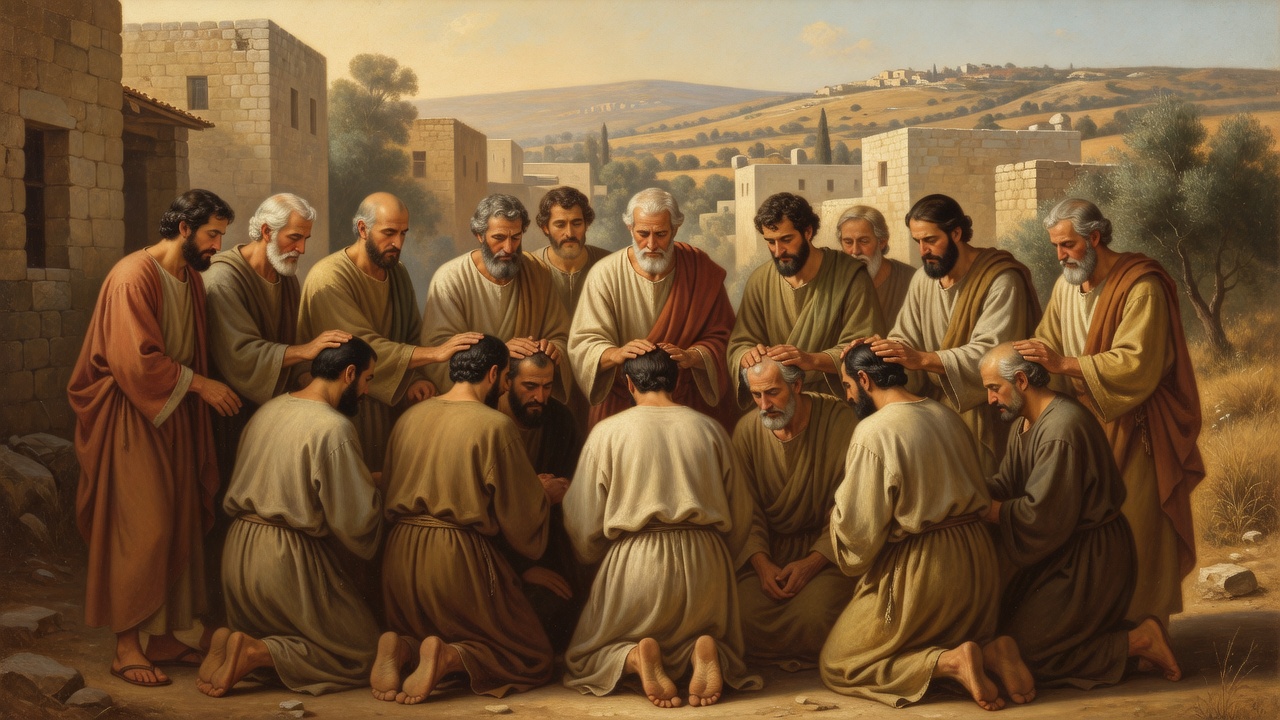
1Now in these yamim of the Messianic talmidim being increased, there was a complaint by the Greek-speaking Yehudim keneged (against) the Sabra Yehudim mitzad (as to) their Greek-speaking Jewish almanot being overlooked in the daily support. 2And the Sheneym Asar, having called the multitude of the talmidim together, said, It is not desirable for us to neglect the dvar Hashem in order to serve tishen. 3But select from among you Achim b'Moshiach, that is, shivah anashim, being of shem tov (good reputation) and full of the Ruach Hakodesh and chochmah, whom we will appoint over this duty; 4But we will be devoted to tefillah and to the avodas kodesh service of the Dvar of the Besuras HaGeulah. 5And this dvar found approval before all the multitude and they chose Stefanos, a man full of emunah (faith) and of the Ruach Hakodesh, and they also chose Philippos and Prochorus and Nikanor and Timon and Parmenas and Nicholas, a ger (proselyte) of Antioch, 6Whom they placed before the Moshiachʼs Shlichim. And having davened, Moshiachʼs Shlichim gave them s'michah, laying their hands on them.
7And the Dvar Hashem was increasing, and the number of talmidim was being greatly multiplied in Yerushalayim, and a kama (quite a number) of the kohanim were obeying the emunah (faith).
The Arrest of Stephen
8And Stefanos, full of the Chen v'Chesed Hashem and ko'ach (power), was effecting otot and moftim gedolim among the people. 9But some of the men from the shul called the Beit Knesset of the Meshuchrarim (the Freedmen) and the Cyrenians and the Alexandrians, and the ones from Cilicia and Asia, rose up and argued with Stefanos, 10And they were not able to contradict the chochmah and the Ruach Hakodesh with which he was speaking. 11Then they secretly induced anashim to say, We have heard him commit Chillul Hashem in the words he spoke keneged (against) Moshe Rabbenu and Hashem. 12And they aroused the people and the Zekenim and the Sofrim and they came upon Stefanos and they seized him and they brought him to the Sanhedrin, 13And edei sheker (false witnesses) swore falsely, saying, This man is not ceasing to speak words keneged (against) Makom HaKadosh HaZeh and the Torah. 14For we have heard him saying that this Yehoshua from Natzeret will destroy this place and will change the chukim of the Torah which Moshe Rabbenu handed down to us. 15And having stared intently at him, all the ones sitting in the Sanhedrin saw his ponem looking like the face of a malach.
Did you know?
The Seven and the Trial of Stephen
- Tension arose between Greek-speaking and Hebraic Jews over the daily distribution of food to widows, prompting the apostles to appoint seven respected men to oversee the task. Notably, all seven men named—including Nicolas, a proselyte from Antioch—carried Greek names.Sources: the Bible text itself · Nicolas
- Jews from across the Roman world had their own community synagogues in Jerusalem, such as the Synagogue of the Freedmen and gatherings for people from Cyrene, Alexandria, Cilicia, and the province of Asia. Members of these regional groups were the first to formally debate Stephen regarding his teachings.Sources: the Bible text itself · Cilicia · Asia
- When opponents failed to refute Stephen's arguments, they brought him before the Sanhedrin under charges of speaking against the temple and the law of Moses. As the council members examined him during these accusations, they observed that his face appeared like that of an angel.Sources: the Bible text itself · Stephen
Notes written with AI assistance from open sources (Theographic Bible Metadata, CC BY-SA 4.0; Easton’s Bible Dictionary, public domain) and reviewed before publishing.
Places in this chapter
- Antioch · Today: Antioch on the Orontes · 36.227, 36.172 · verse 5
- Jerusalem · 31.777, 35.234 · verse 7
- Alexandria · 31.183, 29.896 · verse 9
- Asia · 38.400, 28.300 · verse 9
- Cilicia · 36.913, 34.892 · verse 9
- Cyrene · 32.821, 21.851 · verse 9
- Nazareth · 32.702, 35.298 · verse 14
Only places identified with high confidence are shown (90% or more according to the scholarly sources compiled by OpenBible). Period map: DARE (Digital Atlas of the Roman Empire), CC BY 4.0; modern map: © OpenStreetMap contributors; places: OpenBible.info (CC BY 4.0).
Credits and license for this translation
The Orthodox Jewish Bible
The Orthodox Jewish Bible - Tanakh and Orthodox Jewish Brit Chadasha - The Holy Bible
copyright © 2002-2011, 2021, 2024 Artists for Israel International
Language: English
Contributor: Artists for Israel International
THE ORTHODOX JEWISH TANAKH
Artists For Israel Intl Inc.
This version also appears with the Orthodox Yiddish Triglot which presents the Hebrew Yiddish script in Latin script and an English word for word translation, available at afii.org/Torah
To donate PayPal.Me
This translation is made available to you under the terms of the
Creative Commons Attribution license 4.0.
You may share and redistribute this Bible translation or extracts from it in any format, provided that:
You include the above copyright and source information.
If you make any changes to the text, you must indicate that you did so in a way that makes it clear that the original licensor is not necessarily endorsing your changes.
Pictures included with Scriptures and other documents on this site are licensed just for use with those Scriptures and documents.
For other uses, please contact the respective copyright owners.
Note that in addition to the rules above, revising and adapting God's Word involves a great responsibility to be true to God's Word. See Revelation 22:18-19.
2026-01-06
Section headings adapted from the Berean Standard Bible (public domain); they are not part of this translation’s text.
Source: http://ebible.org/engojb/ · eBible.org