2 Corinthians 7
The Orthodox Jewish Bible · Tap a verse to see its cross-references.
Paul’s Joy in the Corinthians
1Therefore, having these havtachot (promises), Chaverim, let us submit to his tahorah, cleansing ourselves from every defilement of basar and ruach, perfecting kedushah (holiness) in yirat Shomayim.
2In your levavot make a cheder for us; we wronged no one, we ruined no one, we exploited no one. 3I do not say this to bring you under harsha'ah, for I have said before that you are in our levavot whether to die with you or to live with you. 4I have much ometz lev (boldness) and confidence toward you. I glory much on your behalf. I have been filled with chozek (strength). I am filled to overflowing with simcha at all of our tzoros.
5For indeed when we had come into Macedonia we had no physical mano'ach (rest) but we had tzoros everywhere: battles on the outside, fears inside. 6But Hashem who encourages the lowly, encouraged us by the coming of Titos; 7And not only by the coming of him, but also by the encouragement by which he was encouraged over you, reporting to us your longing, your mourning, your kanous (zeal) for me, so that it caused me to have even more simcha. 8Because if indeed I caused you agmat nefesh (grief) by the iggeret, I do not regret it, though I did regret it, but I see that that iggeret grieved you only briefly. 9Now I have simcha, not that you had agmat nefesh, but that your grief brought you to teshuva, for your agmat nefesh was in Hashem, so that by us you suffered in nothing.
10For the agmat nefesh that is according to Hashem produces teshuva to Yeshu'at Eloheinu, not to be regretted, but the agmat nefesh of the Olam Hazeh produces mavet. 11For, hinei, see what zerizut (diligence) this agmat nefesh of Hashem has produced in you, what defense, what indignation, what yirat Shomayim, what longing, what kanous (zeal), what onesh (punishment)! At every point you proved yourselves to be without ashma (guilt) in the matter. 12Then though I wrote an iggeret to you, it was not for the sake of the one having done hara'ah (the evil), nor for the sake of the one who was beleidikt (offended), but for the sake of your kanous (zeal) for us becoming manifest to you before Hashem. 13In this we have chozek (strength).
But in addition to our encouragement, we had still more simcha at the simcha of Titos, because his neshamah has been set at rest by all of you; 14Because if I have been somewhat boastful about you Corinthians to Titos, I was in this not put to shame, but just as everything we said to you is HaEmes, so also our boasting to Titos has proven true as well. 15And his lev (heart) goes out to you, all the more as he has zikaron of the mishma'at (obedience) of all of you as you received him B'YIRAH (with fear) and BIRA'DAH (trembling). 16I have simcha that in everything I have confidence in you.
Did you know?
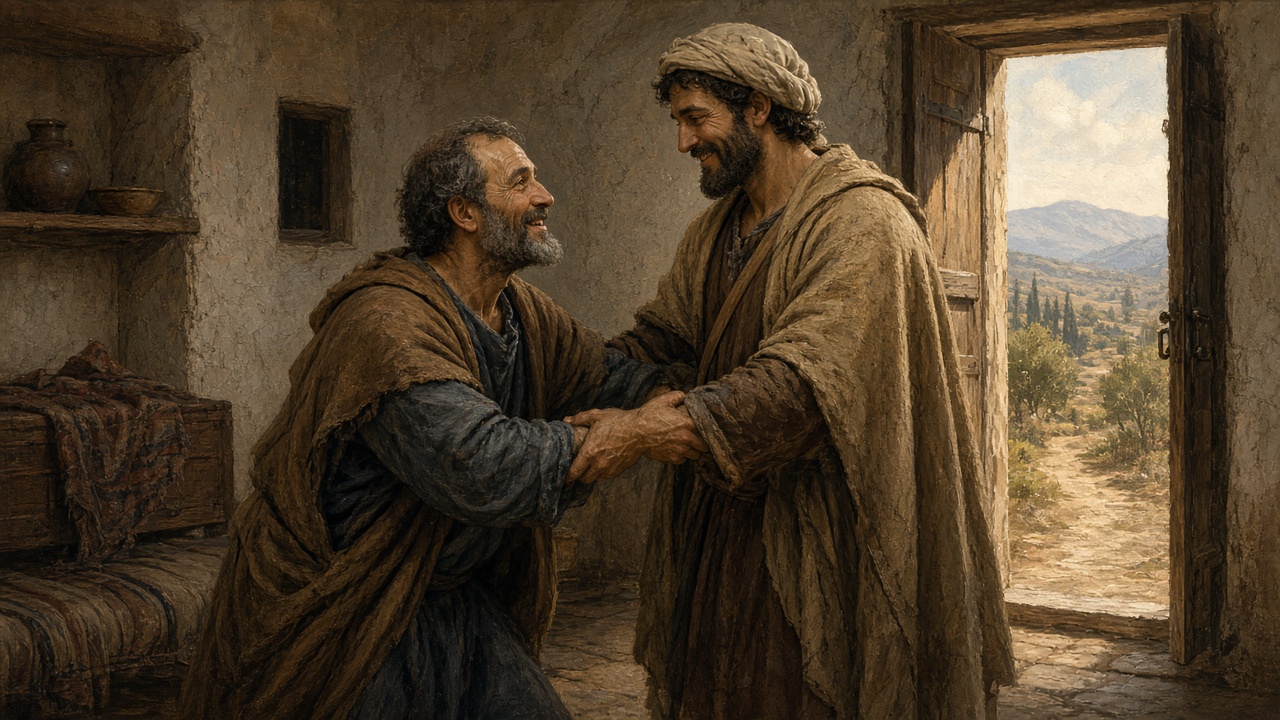
Comfort after a painful letter
- Macedonia, where Paul says he arrived with no rest in his body—conflicts outside and fears within—was a Roman province north of Greece. There, he writes, the God who comforts the downcast comforted him by the arrival of Titus.Sources: Macedonia · the Bible text itself
- Paul speaks of a letter that made them sorrowful, but only for a short time. He now rejoices not because they were sorrowful, but because that sorrow led them to repentance; he says they felt the sorrow God intended, were not harmed by him, and showed earnestness, zeal, and innocence in the matter.Sources: the Bible text itself
- A short account describes Titus as a companion of Paul, apparently a Gentile chiefly engaged in ministering to Gentiles. In this chapter Paul says Titus’s arrival comforted him, that Titus reported their longing, mourning, and zeal, and that they welcomed Titus with fear and trembling.Sources: Titus · the Bible text itself
Notes written with AI assistance from open sources (Theographic Bible Metadata, CC BY-SA 4.0; Easton’s Bible Dictionary, public domain) and reviewed before publishing.
Places in this chapter
- Macedonia · 41.600, 22.540 · verse 5
Only places identified with high confidence are shown (90% or more according to the scholarly sources compiled by OpenBible). Period map: DARE (Digital Atlas of the Roman Empire), CC BY 4.0; modern map: © OpenStreetMap contributors; places: OpenBible.info (CC BY 4.0).
Credits and license for this translation
The Orthodox Jewish Bible
The Orthodox Jewish Bible - Tanakh and Orthodox Jewish Brit Chadasha - The Holy Bible
copyright © 2002-2011, 2021, 2024 Artists for Israel International
Language: English
Contributor: Artists for Israel International
THE ORTHODOX JEWISH TANAKH
Artists For Israel Intl Inc.
This version also appears with the Orthodox Yiddish Triglot which presents the Hebrew Yiddish script in Latin script and an English word for word translation, available at afii.org/Torah
To donate PayPal.Me
This translation is made available to you under the terms of the
Creative Commons Attribution license 4.0.
You may share and redistribute this Bible translation or extracts from it in any format, provided that:
You include the above copyright and source information.
If you make any changes to the text, you must indicate that you did so in a way that makes it clear that the original licensor is not necessarily endorsing your changes.
Pictures included with Scriptures and other documents on this site are licensed just for use with those Scriptures and documents.
For other uses, please contact the respective copyright owners.
Note that in addition to the rules above, revising and adapting God's Word involves a great responsibility to be true to God's Word. See Revelation 22:18-19.
2026-01-06
Section headings adapted from the Berean Standard Bible (public domain); they are not part of this translation’s text.
Source: http://ebible.org/engojb/ · eBible.org