2 Corinthians 3
The Orthodox Jewish Bible · Tap a verse to see its cross-references.
Ministers of a New Covenant
1Do we begin again to commend ourselves? Or surely we do not need, as some do, iggrot of haskama (letters of approval, commendation) to you or from you? 2You are our iggeret, written on our levavot, being known and being read by kol Bnei Adam. 3And you show that you are an iggeret from Rebbe, Melech HaMoshiach, prepared by us, having been written not with ink but with the Ruach Hakodesh of the Elohim Chayim, not on luchot of stone but on luchot of lev basar.
4Such is the bitachon (confidence) that we have through Rebbe, Melech HaMoshiach toward Hashem. 5Not that we are competent from ourselves to claim anything as of ourselves, but our competence is from Hashem, 6Who also made us competent as klei kodesh mesharetim (ministers) of a Brit Chadasha — not b'khol chomer hadin (not by strict letter of the law, legalism), but of the Ruach Hakodesh: for kol chomer hadin (strict letter of the law) kills, but the Ruach Hakodesh gives Chayim —
The Glory of the New Covenant
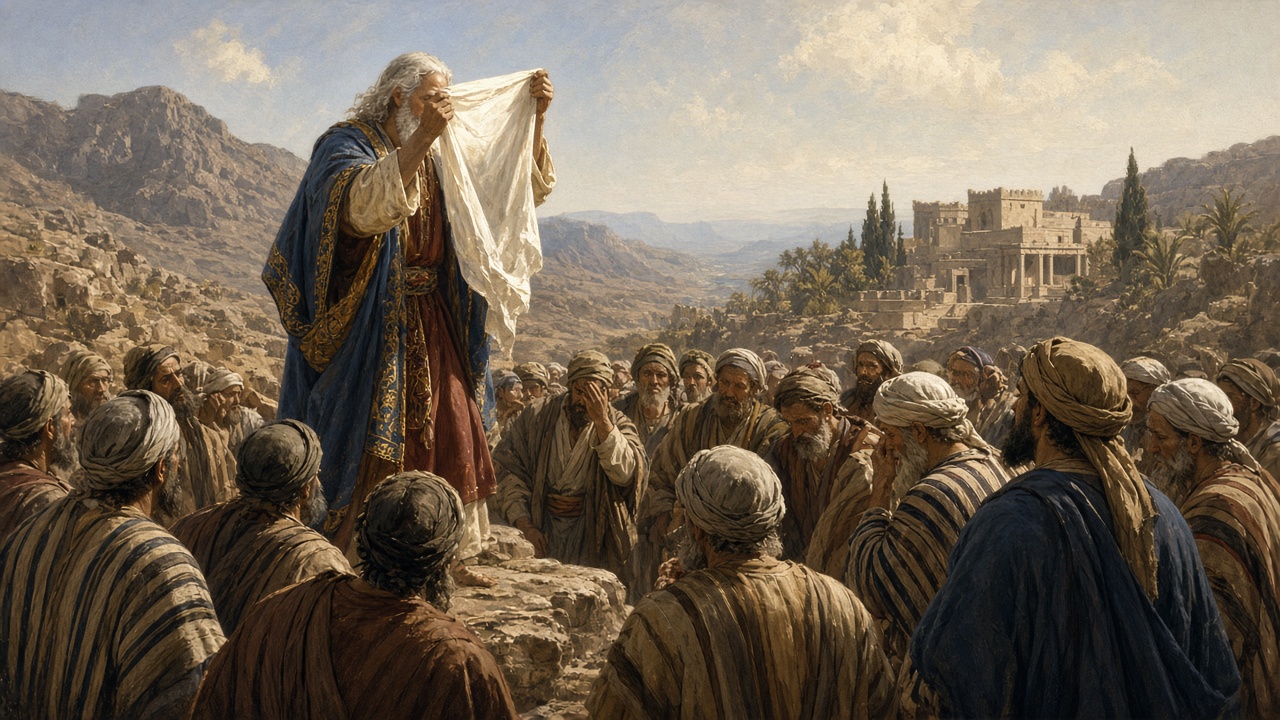
7Now if the Sherut avodas kodesh (ministry) of mavet chiseled in letters engraved on luchot of stone came with kavod, so that the Bnei Yisroel were not able to gaze into the face of Moshe because of P'NI MOSHE KI KARON (face of Moshe Rabbeinu that he was radiant) because of the kavod of his face, the kavod which is fading, 8Then how much more will the avodas kodesh ministry of the Ruach Hakodesh come in kavod (glory)? 9For if there was kavod in the Sherut avodas kodesh of harsha'ah (condemnation), how much more abounds in kavod the ministry of tzedek, 10For indeed what once had kavod has lost its kavod on account of the surpassing kavod (glory). 11For if the thing which now is fading away came with kavod, much more has that which remains come in kavod.
12Since, then, we have such a tikvah (hope), we act with much boldness. 13And we are not as Moshe, who was putting HAMASVEH AL PANAV (the veil over his face) so that the Bnei Yisroel might not see the end of the fading kavod. 14But their minds were hardened; for until the present day the same veil remains at the Kri'at HaSefer Torah (the reading of Torah in shul), because the veil is taken away in Moshiach. 15But even today, whenever Moshe is being read, a veil lies on their levavot. 16But whenever one turns to Adoneinu HAMASVEH is taken away. 17Now Adoneinu is HaRuach and where HaRuach Adoneinu is, there is cherut (freedom). 18Now all of us, with unveiled faces, seeing the kavod of Adoneinu as if reflected in a mirror, are being transformed into the same demut from kavod to kavod, even as from HaAdon, HaRuach.
Did you know?
A More Glorious Covenant
- The chapter asks whether letters of recommendation to or from the believers are needed, as some people require. It answers that the believers themselves are a letter from Christ, the result of this ministry, inscribed on the ministers' hearts and known and read by everyone.Sources: the Bible text itself
- The chapter contrasts ink and tablets of stone with the Spirit of the living God writing on human hearts. It calls the ministry engraved in letters on stone a ministry of death and condemnation, and describes a new covenant of the Spirit, for the letter kills but the Spirit gives life.Sources: the Bible text itself
- The Israelites could not gaze at Moses's face because of a glory that was fading, and Moses put a veil over his face so they would not look at the end of what was passing away. The chapter says that a veil still covers their hearts when Moses is read, and that it is taken away whenever anyone turns to the Lord.Sources: the Bible text itself
Notes written with AI assistance from open sources (Theographic Bible Metadata, CC BY-SA 4.0; Easton’s Bible Dictionary, public domain) and reviewed before publishing.
Credits and license for this translation
The Orthodox Jewish Bible
The Orthodox Jewish Bible - Tanakh and Orthodox Jewish Brit Chadasha - The Holy Bible
copyright © 2002-2011, 2021, 2024 Artists for Israel International
Language: English
Contributor: Artists for Israel International
THE ORTHODOX JEWISH TANAKH
Artists For Israel Intl Inc.
This version also appears with the Orthodox Yiddish Triglot which presents the Hebrew Yiddish script in Latin script and an English word for word translation, available at afii.org/Torah
To donate PayPal.Me
This translation is made available to you under the terms of the
Creative Commons Attribution license 4.0.
You may share and redistribute this Bible translation or extracts from it in any format, provided that:
You include the above copyright and source information.
If you make any changes to the text, you must indicate that you did so in a way that makes it clear that the original licensor is not necessarily endorsing your changes.
Pictures included with Scriptures and other documents on this site are licensed just for use with those Scriptures and documents.
For other uses, please contact the respective copyright owners.
Note that in addition to the rules above, revising and adapting God's Word involves a great responsibility to be true to God's Word. See Revelation 22:18-19.
2026-01-06
Section headings adapted from the Berean Standard Bible (public domain); they are not part of this translation’s text.
Source: http://ebible.org/engojb/ · eBible.org