1 Samuel 3
The Orthodox Jewish Bible · Tap a verse to see its cross-references.
The LORD Calls Samuel
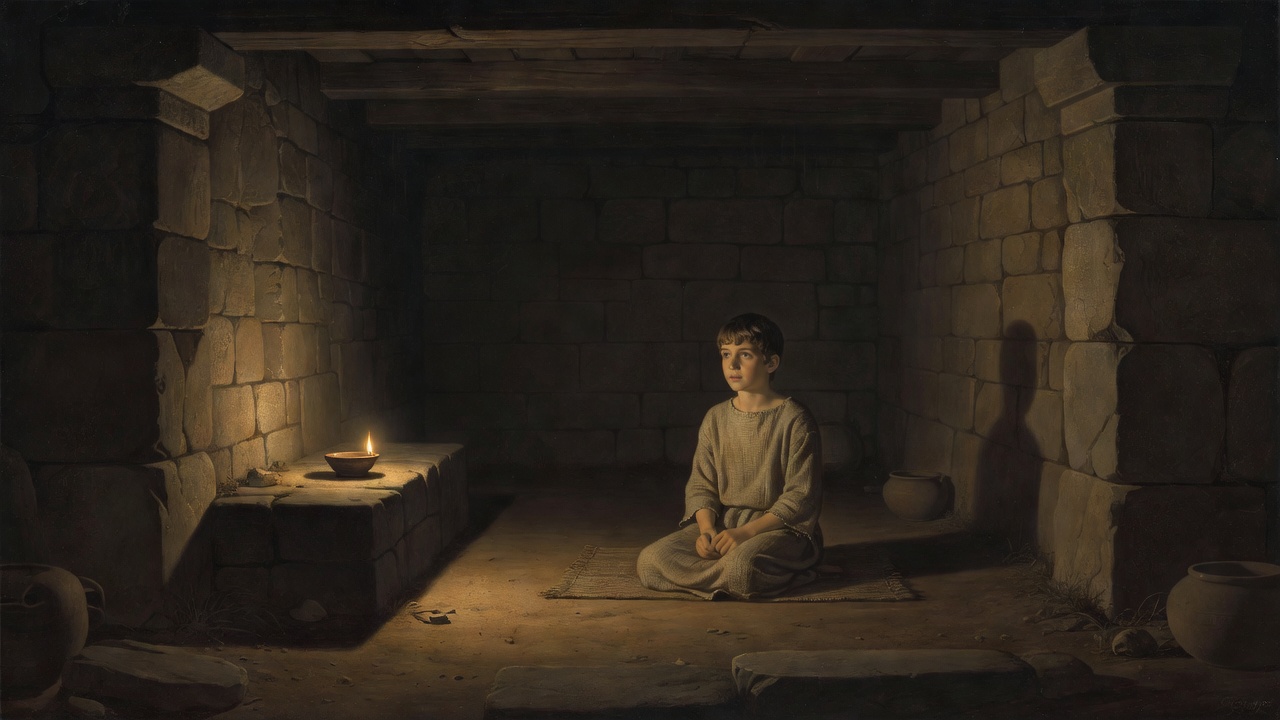
1And the na'ar Shmuel ministered unto Hashem before Eli. And the Devar Hashem was yakar (precious, dear, rare) in those days; there was no chazon nifratz [prophetic] vision open, spread out, common. 2And it came to pass at that time, when Eli was lying down in his makom (his eyes had began to grow dim, that he could not see); 3And the Ner Elohim had not yet gone out in the Heikhal Hashem, where the Aron Elohim was, and Shmuel was lying down; 4That Hashem called Shmuel; and he answered, Hineni. 5And he ran unto Eli, and said, Hineni; for thou calledst me. And he said, I called not; lie down again. And he went and lay down.
6And Hashem called yet again, Shmuel. And Shmuel got up and went to Eli, and said, Hineni; for thou didst call me. And he answered, I called not, beni; lie down again.
7Now Shmuel did not yet know Hashem; the Devar Hashem was not yet revealed unto him.
8And Hashem called Shmuel again the third time. And he got up and went to Eli, and said, Hineni; for thou didst call me. And Eli perceived that Hashem was calling the na'ar. 9Therefore Eli said unto Shmuel, Go, lie down; and it shall be, if He call thee, that thou shalt say, Speak, Hashem; for Thy eved (servant) shomei'a (is listening). So Shmuel went and lay down in his makom. 10And Hashem came, and stood, and called as at other times, Shmuel, Shmuel. Then Shmuel answered, Speak; for Thy eved shomei'a. 11And Hashem said to Shmuel, Hinei, I am doing a thing in Yisroel, at which both the oznayim of every one that heareth it shall tingle. 12In that day I will perform against Eli all things which I have spoken concerning his Bais; from beginning even to the end. 13For I have told him that I will judge his Bais ad olam for the avon (iniquity) which he knoweth; because his banim brought klalot (curses) upon themselves, and he restrained them not. 14And therefore I have sworn unto the Bais Eli, that there shall be no kapporah for the avon Bais Eli by zevach nor minchah ad olam.
Samuel Shares the Vision
15And Shmuel lay until boker, and opened the dlatot Beis Hashem. And Shmuel feared to show Eli the mareh (vision). 16Then Eli called Shmuel, and said, Shmuel, beni. And he answered, Hineni. 17And he said, What is the davar that Hashem hath said unto thee? Now hide it not from me; Elohim do so to thee, and more also, if thou hide anything from me of all the things that He said unto thee. 18And Shmuel told him everything, and hid nothing from him. And he said, It is Hashem; let Him do what seemeth Him tov.
19And Shmuel grew, and Hashem was with him, and did let none of his words fall to the ground. 20And kol Yisroel from Dan even to Be'er-Sheva knew that Shmuel was established to be a navi of Hashem. 21And Hashem appeared again in Shiloh; for Hashem revealed Himself to Shmuel in Shiloh by the Devar Hashem.
Did you know?
The Calling of Samuel
- The sanctuary housing the ark of God was located at Shiloh, where the young Samuel ministered under the high priest Eli. The text notes that direct divine revelations and visions were rare in those days, prior to the Lord revealing Himself to Samuel at Shiloh.Sources: the Bible text itself · Shiloh · Eli
- Eli served as high priest and judged Israel for forty years, but his failure to sternly reprove his corrupt sons, Hophni and Phinehas, brought a divine sentence of judgment against his household. The priestly office remained in Eli's lineage until King Solomon later removed Abiathar and installed Zadok.Sources: Eli · the Bible text itself
- The phrase from Dan to Beersheba designates the entire territory of the Promised Land, from its northern boundary at Dan to its southern limit at Beersheba, a distance of about 144 miles. Its mention emphasizes that the whole nation recognized Samuel as an established prophet.Sources: Beersheba · the Bible text itself
Notes written with AI assistance from open sources (Theographic Bible Metadata, CC BY-SA 4.0; Easton’s Bible Dictionary, public domain) and reviewed before publishing.
Places in this chapter
- Dan · Today: Tel Dan · 33.249, 35.652 · verse 20
- Shiloh · Today: Khirbet Seilun · 32.056, 35.290 · verse 21
Only places identified with high confidence are shown (90% or more according to the scholarly sources compiled by OpenBible). Period map: DARE (Digital Atlas of the Roman Empire), CC BY 4.0; modern map: © OpenStreetMap contributors; places: OpenBible.info (CC BY 4.0).
Credits and license for this translation
The Orthodox Jewish Bible
The Orthodox Jewish Bible - Tanakh and Orthodox Jewish Brit Chadasha - The Holy Bible
copyright © 2002-2011, 2021, 2024 Artists for Israel International
Language: English
Contributor: Artists for Israel International
THE ORTHODOX JEWISH TANAKH
Artists For Israel Intl Inc.
This version also appears with the Orthodox Yiddish Triglot which presents the Hebrew Yiddish script in Latin script and an English word for word translation, available at afii.org/Torah
To donate PayPal.Me
This translation is made available to you under the terms of the
Creative Commons Attribution license 4.0.
You may share and redistribute this Bible translation or extracts from it in any format, provided that:
You include the above copyright and source information.
If you make any changes to the text, you must indicate that you did so in a way that makes it clear that the original licensor is not necessarily endorsing your changes.
Pictures included with Scriptures and other documents on this site are licensed just for use with those Scriptures and documents.
For other uses, please contact the respective copyright owners.
Note that in addition to the rules above, revising and adapting God's Word involves a great responsibility to be true to God's Word. See Revelation 22:18-19.
2026-01-06
Section headings adapted from the Berean Standard Bible (public domain); they are not part of this translation’s text.
Source: http://ebible.org/engojb/ · eBible.org