1 Kings 1
The Orthodox Jewish Bible · Tap a verse to see its cross-references.

About this book
About 1 Kings
- Easton's Bible Dictionary (1897) treats the authorship of the books of Kings as uncertain. A tradition that Jeremiah wrote them is, in Easton's view, supported by passages almost identical with parts of Jeremiah and by events Jeremiah knew personally, yet Easton thinks it more probable that Ezra, after the Captivity, compiled the books from earlier documents, perhaps written by David, Solomon, Nathan, Gad, and Iddo. Easton dates the composition between 561 B.C., when Jehoiachin was released from captivity by Evil-merodach, and 538 B.C., the decree of Cyrus.Sources: Easton: Kings, The Books of
- Easton says these books contain the annals of the kingdom from Solomon's accession until Nebuchadnezzar and the Babylonians subdued it, a period he estimates at about 453 years. 1 Kings opens while David is dying: Adonijah, his fourth son, who had become heir-apparent to the throne after the deaths of Amnon and Absalom, has himself proclaimed king, but Nathan and Bathsheba persuade David to enthrone Solomon at once. Solomon, David's son by Bathsheba, whose history is recorded in 1 Kings 1-11, came to the throne, Easton suggests, at about sixteen or eighteen.Sources: Easton: Kings, The Books of · Adonijah · Solomon
- In the Hebrew Scriptures the two books of Kings originally formed one book; the Septuagint first divided them and, with the Vulgate, numbers them as the third and fourth books of Kings, the books of Samuel being the first and second. Easton notes that Chronicles gives greater prominence to the priestly or Levitical office, while Kings gives greater prominence to the royal office, and that in the threefold division of the Scriptures by the Jews these books are ranked among the Prophets. The narrative points to earlier sources: the book of the acts of Solomon and the chronicles of the kings of Judah and of Israel.Sources: Easton: Kings, The Books of
- After Solomon's death the ten tribes revolted and invited Jeroboam, son of Nebat, to be their king; Easton calls him the first king of those tribes and dates his reign from 976 to 945 B.C. He had fled to Egypt under the protection of Shishak I, and later moved his residence from Shechem, his first capital, to Tirzah, which remained the chief residence of Israel's kings until Omri bought the hill of Shomeron from Shemer for two talents of silver and built Samaria. The later narrative includes Ahab, Omri's son and the seventh king of Israel, whose wife was Jezebel: to the calf worship introduced by Jeroboam he added the worship of Baal, and he was severely admonished by the prophet Elijah.Sources: Jeroboam · Tirzah · Samaria · Ahab
Notes written with AI assistance from open sources (Theographic Bible Metadata, CC BY-SA 4.0; Easton’s Bible Dictionary, public domain) and reviewed before publishing.
Abishag Cares for David
1Now HaMelech Dovid was zaken and stricken in yamim; and they covered him with begadim, but he could get no warmth. 2Wherefore his avadim said unto him, Let there be sought for adoni HaMelech a na'arah betulah; and let her stand before HaMelech, and let her care for him, and let her lie at thy kheyk (bosom), that adoni HaMelech may be warm.
3So they sought for a na'arah yafeh throughout all the territory of Yisroel, and found Avishag HaShunammit, and brought her to HaMelech. 4And the na'arah was yafeh ad me'od, and cared for HaMelech, and waited on him; but HaMelech knew her not.
Adonijah Usurps the Kingdom
5Then Adoniyah Ben Chaggit put himself forward, saying, I will be Melech; and he prepared him merkavot and parashim, and chamishim ish to run before him. 6And Aviv had not rebuked him at any time in saying, Why hast thou done so? And he also was tov to'ar (good looking); and bore him after Avshalom.
7And he conferred with Yoav Ben Tzeruyah, and with Evyatar (Abiathar) HaKohen; and they lent ezer (help), following after Adoniyah. 8But Tzadok HaKohen, and Benayah Ben Yehoyada, and Natan HaNavi, and Shime'i, and Re'i, and the Gibborim which belonged to Dovid, were not with Adoniyah.
9And Adoniyah sacrificed tzon and bakar and fatted bull at the Even Zochelet (Stone of Zoheleth), which is Ein-Rogel, and invited all his achim, the Bnei HaMelech, and all the anshei Yehudah who were avadim of HaMelech; 10But Natan HaNavi, and Benayah, and the Gibborim, and Sh'lomo his brother, he invited not.
Nathan and Bathsheba before David
11Wherefore Natan spoke unto Bat-Sheva em Sh'lomo, saying, Hast thou not heard that Adoniyah Ben Chaggit became Melech, and Dovid adoneinu knoweth it not? 12Therefore come, let me, now, give thee counsel, that thou mayest save thine own nefesh, and the nefesh of thy ben Sh'lomo. 13Go and get thee in unto HaMelech Dovid, and say unto him, Didst not thou, adoni, O HaMelech, swear unto thine amah (maid servant, handmaid) saying, Assuredly Sh'lomo thy ben shall reign as Melech after me, and he shall sit upon my kisse? Why then doth Adoniyah reign as Melech? 14Hinei, while thou yet speakest there with HaMelech, I also will come in after thee, and confirm thy devarim.
15And Bat-Sheva went in unto HaMelech into the cheder; and HaMelech was zaken me'od; and Avishag HaShunammit attended unto HaMelech. 16And Bat-Sheva bowed, and did obeisance unto HaMelech. And HaMelech said, What wouldest thou? 17And she said unto him, Adoni, thou didst swear by Hashem Eloheicha unto thine amah, saying, Assuredly Sh'lomo thy ben shall reign as Melech after me, and he shall sit upon my kisse.
18And now, hinei, Adoniyah reigneth as Melech; and now, adoni HaMelech, thou knowest it not; 19And he hath sacrificed shor and fatted bull and tzon in abundance, and hath invited all the Bnei HaMelech, and Evyatar (Abiathar) HaKohen, and Yoav the Sar HaTzava; but Sh'lomo thy eved hath he not invited. 20And thou, adoni HaMelech, the eyes of kol Yisroel are upon thee, that thou shouldest tell them who shall sit on the kisse adoni HaMelech after him. 21Otherwise it shall come to pass, when adoni HaMelech shall lie with his avot, that I and beni (my son) Sh'lomo shall be counted chatta'im.
22And, hinei, while she yet was speaking with HaMelech, Natan HaNavi also came in. 23And they told HaMelech, saying, Hinei Natan HaNavi! And when he was come in before HaMelech, he bowed himself before HaMelech with his face to the ground. 24And Natan said, Adoni HaMelech, hast thou said, Adoniyah shall reign as Melech after me, and he shall sit upon my kisse? 25For he has gone down this day, and hath sacrificed shor and fatted bull and tzon in abundance, and hath invited all the Bnei HaMelech, and the sarei hatzava, and Evyatar (Abiathar) HaKohen; and, behold, they eat and drink before him, and say, Yechi HaMelech Adoniyahu (long live HaMelech Adoniyah)! 26But me, even me thy eved, and Tzadok HaKohen, and Benayah Ben Yehoyada, and thy eved Sh'lomo, hath he not invited. 27Is this thing done by adoni HaMelech, and thou hast not showed it unto thy eved, even who should sit on the kisse adoni HaMelech after him?
David Renews His Oath to Bathsheba
28Then HaMelech Dovid answered and said, Call me Bat-Sheva. And she came into the presence of HaMelech, and stood before HaMelech. 29And HaMelech swore a shevu'a (oath), and said, As Hashem liveth, that hath redeemed my nefesh out of kol tzarah, 30Even as I swore a shevu'a unto thee by Hashem Elohei Yisroel, saying, Assuredly Sh'lomo thy ben shall reign as Melech after me, he shall sit upon my kisse in my place; so will I certainly do this day.
31Then Bat-Sheva bowed with her face to eretz, and did reverence to HaMelech, and said, Yechi adoni HaMelech Dovid l'olam (long live adoni HaMelech forever)!
Solomon Anointed King
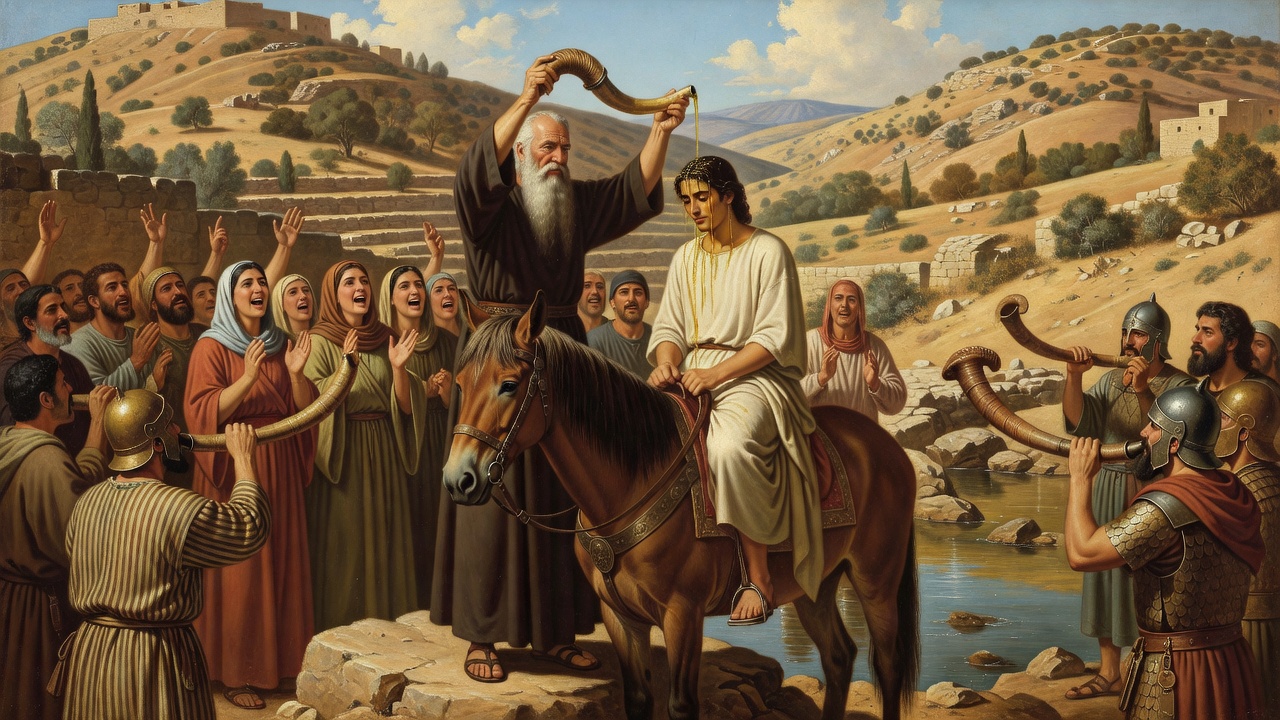
32And HaMelech Dovid said, Call me Tzadok HaKohen, and Natan HaNavi, and Benayah Ben Yehoyada. And they came before HaMelech. 33HaMelech also said unto them, Take with you the avadim of adoneichem, and have Sh'lomo beni (my son) to ride upon mine own mule, and bring him down to Gichon; 34And let Tzadok HaKohen and Natan HaNavi mashach (anoint) him there Melech over Yisroel; and blow ye with the shofar, and say, Yechi HaMelech Sh'lomo. 35Then ye shall come up after him, that he may come and sit upon my kisse; for he shall be Melech in my place; and I have appointed him to be Nagid (ruler) over Yisroel and over Yehudah.
36And Benayah Ben Yehoyada answered HaMelech, and said, Omein; And so may Hashem Elohei adoni HaMelech say. 37As Hashem hath been with adoni HaMelech, even so may He be with Sh'lomo, and make his kisse greater than the kisse of adoni HaMelech Dovid.
38So Tzadok HaKohen, and Natan HaNavi, and Benayah Ben Yehoyada, and the Kereti, and the Peleti, went down, and had Sh'lomo ride upon the mule of HaMelech Dovid, and brought him to Gichon. 39And Tzadok HaKohen took a keren of shemen out of the ohel, and mashach (anointed) Sh'lomo. And they blew the shofar; and kol HaAm shouted, Yechi HaMelech Sh'lomo! 40And kol HaAm came up after him, and the people played chalilim (flutes), and rejoiced with simchah gedolah, so that ha'aretz split with the sound of them.
Adonijah Learns of Solomon’s Kingship
41And Adoniyah and kol hakeru'im (all the invited ones) that were with him heard it as they had made an end of eating. And when Yoav heard the kol hashofar, he said, Why is the sound of the Ir in an uproar?
42And while he yet spoke, hinei, Yonatan Ben Evyatar (Abiathar) HaKohen came; and Adoniyah said unto him, Come, for thou art an ish chayil, and tov tevaser (bringest good tidings). 43And Yonatan answered and said to Adoniyah, Just the opposite! Verily adoneinu HaMelech Dovid hath made Sh'lomo Melech! 44And HaMelech hath sent with him Tzadok HaKohen, and Natan HaNavi, and Benayah Ben Yehoyada, and the Kereti, and the Peleti, and they have had him ride upon pirdah (mule) of HaMelech: 45And Tzadok HaKohen and Natan HaNavi have anointed him Melech at Gichon; and they are come up from there rejoicing, so that the city rang out. This is the noise that ye have heard. 46And also Sh'lomo sitteth on the kisse hameluchah. 47And moreover the avadim of HaMelech came to make a brocha on adoneinu HaMelech Dovid, saying, May your G-d make the shem of Sh'lomo more famous than thy shem, and make his kisse greater than thy kisse. And HaMelech bowed himself upon the mishkav (bed). 48Also so said HaMelech, Baruch Hashem Elohei Yisroel, Who hath given one to sit on my kisse this day, mine eyes even seeing it.
49And kol hakeruvim (all the invited ones) that were with Adoniyah were terrified, and rose up, and went every ish his own derech. 50And Adoniyah feared because of Sh'lomo, and arose, and went, and caught hold of the karnayim of the Mizbe'ach.
51And it was told Sh'lomo, saying, Hinei, Adoniyah feareth HaMelech Sh'lomo; for, hinei, he hath caught hold of the karnayim of the Mizbe'ach, saying, Let Melech Sh'lomo swear a shevua (oath) unto me today that he will not slay his eved with the cherev.
52And Sh'lomo said, If he will show himself a ben chayil (a son of worthiness), there shall not a hair of him fall to ha'aretz; but if ra'ah (wickedness) shall be found in him, he shall die.
53So HaMelech Sh'lomo sent, and they brought him down from the Mizbe'ach. And he came and bowed himself to Melech Sh'lomo; and Sh'lomo said unto him, Go to thine bais.
Did you know?
The Succession to David's Throne
- As David's oldest surviving son after the deaths of Amnon and Absalom, Adonijah claimed the royal succession, backed by the military commander Joab and the high priest Abiathar. However, David chose his younger son Solomon, who was supported by the prophet Nathan, the priest Zadok, and the royal bodyguard under Benaiah.Sources: Adonijah · Solomon · the Bible text itself
- Riding the king's own mule was a decisive public declaration of royal authority. By David's explicit instruction, Solomon was escorted down to the spring of Gihon, where Zadok anointed him king with oil taken from the tabernacle to the sound of ram's horns and popular celebration.Sources: Gihon · Zadok · the Bible text itself
- Upon hearing of Solomon's public coronation, Adonijah fled in terror and sought asylum by taking hold of the horns of the sacrificial altar. Solomon granted him conditional clemency, sparing his life so long as he proved himself a worthy man.Sources: Adonijah · the Bible text itself
Notes written with AI assistance from open sources (Theographic Bible Metadata, CC BY-SA 4.0; Easton’s Bible Dictionary, public domain) and reviewed before publishing.
Places in this chapter
- Shunem · Today: Sulam · 32.606, 35.334 · verse 3
- Serpent’s Stone · Today: within 100 m of Bir Ayub · 31.767, 35.236 · verse 9
- Gihon · Today: Gihon Spring · 31.773, 35.236 · verses 33, 38, 44, 45
- Jerusalem · 31.777, 35.234 · verse 40
Only places identified with high confidence are shown (90% or more according to the scholarly sources compiled by OpenBible). Period map: DARE (Digital Atlas of the Roman Empire), CC BY 4.0; modern map: © OpenStreetMap contributors; places: OpenBible.info (CC BY 4.0).
Credits and license for this translation
The Orthodox Jewish Bible
The Orthodox Jewish Bible - Tanakh and Orthodox Jewish Brit Chadasha - The Holy Bible
copyright © 2002-2011, 2021, 2024 Artists for Israel International
Language: English
Contributor: Artists for Israel International
THE ORTHODOX JEWISH TANAKH
Artists For Israel Intl Inc.
This version also appears with the Orthodox Yiddish Triglot which presents the Hebrew Yiddish script in Latin script and an English word for word translation, available at afii.org/Torah
To donate PayPal.Me
This translation is made available to you under the terms of the
Creative Commons Attribution license 4.0.
You may share and redistribute this Bible translation or extracts from it in any format, provided that:
You include the above copyright and source information.
If you make any changes to the text, you must indicate that you did so in a way that makes it clear that the original licensor is not necessarily endorsing your changes.
Pictures included with Scriptures and other documents on this site are licensed just for use with those Scriptures and documents.
For other uses, please contact the respective copyright owners.
Note that in addition to the rules above, revising and adapting God's Word involves a great responsibility to be true to God's Word. See Revelation 22:18-19.
2026-01-06
Section headings adapted from the Berean Standard Bible (public domain); they are not part of this translation’s text.
Source: http://ebible.org/engojb/ · eBible.org