1 Corinthians 7
The Orthodox Jewish Bible · Tap a verse to see its cross-references.
Principles of Marriage
1Now, concerning the things in your iggeret, letʼs take up the next inyan (topic): “It is beneficial for a man not to touch an isha.” 2But, because of the acts of zenut, let each Ben Adam have his own Isha, and let each Isha have her own Ba'al (Husband). 3Let the ba'al render the conjugal choiv (debt) to his isha, and likewise also the isha to her ba'al (husband). 4It is not the isha who has samchut (authority) over her own body, but the ba'al (husband); likewise, also it is not the ba'al (husband) who has samchut over his own body, but the isha. 5Do not deprive each other, unless by agreement for a set time, that you may renew zerizut (diligence) to tefillah (prayer) and again you may be together, lest HaSatan lead you into nissayon (temptation) because of your lack of shlitah atzmi (self-control).
6But I say this according to concession, not according to mitzvoh. 7But, I wish kol Bnei Adam even to be as I am; however, [this is impossible since] each has his own matanah (gift) from Hashem: one this; and another that.
8But, I say to the bochrim and the almanot (widows), it is beneficial for them if they remain as I am; 9But if they do not have shlitah atzmi, let them marry. For better it is to marry than with Eish to be set ablaze.
10But to the ones having entered bibrit hanissuim (in covenant of marriage), I charge, not I but Rebbe, Melech HaMoshiach Adoneinu, an isha is not to separate from her ba'al (husband). 11But, if indeed she is separated, let her remain so, or be reconciled to her basherter; and a ba'al should not leave his isha.
12But, to the rest I — Sha'ul — not Rebbe, Melech HaMoshiach Adoneinu, say: if any Ach b'Moshiach has an isha who is an Apikoros and she is willing to live with him, let him not leave her; 13And if an isha has a ba'al (husband) who is an Apikoros, and he is willing to dwell with her, let her not leave her ba'al (husband). 14For, the ba'al who is an Apikoros is mekudash b'Ruach Hakodesh (set apart as holy in the Ruach Hakodesh) by the isha, and the isha who is an Apikoros likewise by the Ach b'Moshiach; otherwise, your yeladim are tema'im (unclean); but now they are tehorim (clean). 15But, if the one who is an Apikoros separates and departs, let the separation occur; the Ach b'Moshiach has not been enslaved, or the Achot b'Moshiach in such cases; but Hashem has given you a kri'ah b'shalom. 16For how do you know, isha, if you will not bring your basherter (destined mate), your ba'al, to Yeshu'at Eloheinu?
Live Your Calling
17Only each of you walk the derech to which you were called by Hashem. This is my charge in all the kehillot of Moshiach. 18If as a ben Berit with bris milah anyone received their kri'ah, let him not conceal it; if anyone without bris milah has been called, let him without bris milah not undergo bris milah. 19Bris milah is not everything; nor is the lack of it; but being shomer mitzvot Hashem. 20Each one walk the derech of his kri'ah (calling, summons), and remain there. 21If while a bond servant you were called, do not let it consume you, although if you can gain your deror (freedom, liberty), do so. 22For, the one in Hashem having been called while a bond servant is Adoneinuʼs ben Chorin (freedman); likewise, the one having been called while a ben Chorin is the Rebbe, Melech HaMoshiachʼs bond servant. 23You were bought with a pidyon nefesh price; do not become avadim haBnei Adam. 24Each one wherever on the derech of Chayyim he was called, Achim b'Moshiach, there let him remain in deveykus with Hashem.
The Unmarried and Widowed
25Next sugya (topic): concerning the betulot (virgins). A mitzvoh of Rebbe, Melech HaMoshiach Adoneinu I do not have, but a bit of wisdom I offer as one who by the rachamim Hashem is ne'eman (faithful). 26I consider therefore, it to be beneficial, because of the impending Crisis that you remain as you are. 27Have you entered bibrit hanissuim (in covenant of marriage) with an isha? Do not seek to be free. Are you freed from an isha? Do not seek an isha. 28But if indeed you enter bibrit hanissuim (in covenant of marriage), there is no chet; and if the betulah (virgin) marries, there is no averah in that for her. But such will have tzoros in the basar, which I am trying to spare you. 29Now this I say, Achim b'Moshiach, the time [until HaKetz] has been shortened. From now on, let those having nashim live as if not having nashim, 30And let the ones weeping as not weeping, and let the ones having simcha as not having simcha, and let the ones buying as not possessing, 31And let the ones using the Olam Hazeh as not fully using it, for the present form of the Olam Hazeh is passing away.
32But I would have you free from de'agot (worries). The ben Adam without isha cares for the things of Hashem, how he may please Hashem. 33But the one having taken an isha cares for the things of the Olam Hazeh, how he may please his isha, 34And he has been divided. Both the isha free of a ba'al or the betulah cares for the things of Hashem, that she may be tehorah spiritually and physically. But the isha with a ba'al cares for the things of the Olam Hazeh, how she may please her ba'al. 35Now, this I say for your own benefit, not that I may throw a noose on your deror (freedom), but I speak with respect to what is decent, seemly, and sits well with Hashem, without distraction [in avodas kodesh].
36However, if anyone thinks he does not have proper hitnahagut (conduct) toward the betulah of his eirusin (betrothal, engagement), and if he thinks his basherte (destined mate) is getting along in years, and thus it has to be, what he desires, let him do; there is no chet, let them enter bibrit hanissuim (in covenant of marriage). 37But he who in his lev has settled the decision, not having the need [of conjugal intimacy], but having mastery concerning his own desire, and thus he in his lev has decided, not to enter bibrit hanissuim with his betulah (virgin), he does well. 38So then both the one entering bibrit hanissuim with his betulah does well, and the one not entering bebrit hanissuim with his arusah (betrothed) will do better.
39An isha has been bound (bibrit hanissuim, in covenant of marriage) for so long a time as her ba'al lives, but if her ba'al should sleep the sleep of the mesim, she is free to enter bibrit hanissuim with the ba'al she desires, but only in Rebbe, Melech HaMoshiach Adoneinu. 40However, happy is she, and even more so, if she remains as she is; and I think in this bit of wisdom I am offering that I have the Ruach Hakodesh.
Did you know?
Counsel on marriage and the present crisis
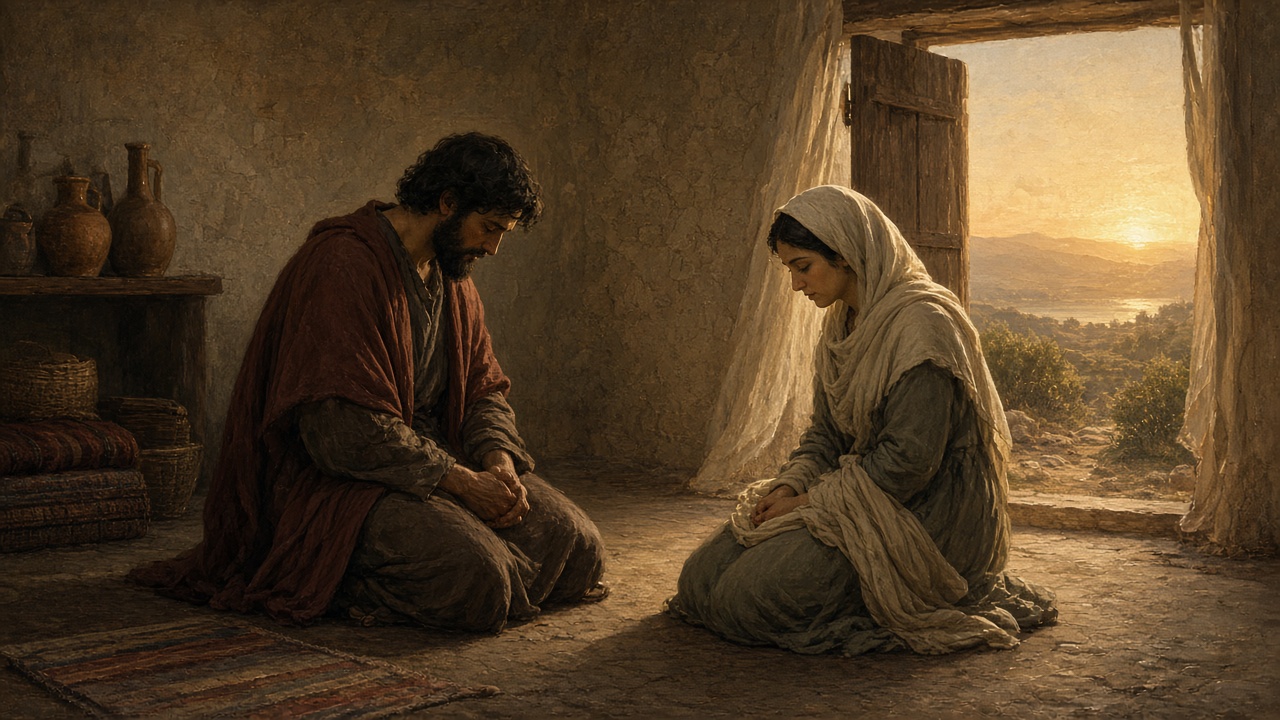
- The chapter opens as a reply to matters the readers had written about. The writer says it is good to abstain from sexual relations, yet, because there is so much sexual immorality, each man should have his own wife and each woman her own husband. He presents this as a concession, not as a command, and says that each person has their own gift from God.Sources: the Bible text itself
- In marriage, the writer says the wife does not have authority over her own body, but the husband does, and likewise the husband does not have authority over his own body, but the wife does. They should not deprive each other except by mutual consent and for a time, so they may devote themselves to prayer, and then come together again, so that Satan will not tempt them through lack of self-control. Easton's Bible Dictionary (1897) presents the name Satan as “adversary” or “accuser,” and notes that he tempted Jesus in the wilderness.Sources: the Bible text itself · Satan
- The writer distinguishes a command he attributes to the Lord—a wife must not separate from her husband, and a husband must not divorce his wife—from his own judgment where he says he, not the Lord, is speaking, including marriages with an unbeliever and questions about virgins. Because of what he calls the present crisis, and because he says the time is short and this world in its present form is passing away, he thinks it good to remain as one is. He adds that to marry is not to sin, though those who marry will face troubles in this life.Sources: the Bible text itself
Notes written with AI assistance from open sources (Theographic Bible Metadata, CC BY-SA 4.0; Easton’s Bible Dictionary, public domain) and reviewed before publishing.
Credits and license for this translation
The Orthodox Jewish Bible
The Orthodox Jewish Bible - Tanakh and Orthodox Jewish Brit Chadasha - The Holy Bible
copyright © 2002-2011, 2021, 2024 Artists for Israel International
Language: English
Contributor: Artists for Israel International
THE ORTHODOX JEWISH TANAKH
Artists For Israel Intl Inc.
This version also appears with the Orthodox Yiddish Triglot which presents the Hebrew Yiddish script in Latin script and an English word for word translation, available at afii.org/Torah
To donate PayPal.Me
This translation is made available to you under the terms of the
Creative Commons Attribution license 4.0.
You may share and redistribute this Bible translation or extracts from it in any format, provided that:
You include the above copyright and source information.
If you make any changes to the text, you must indicate that you did so in a way that makes it clear that the original licensor is not necessarily endorsing your changes.
Pictures included with Scriptures and other documents on this site are licensed just for use with those Scriptures and documents.
For other uses, please contact the respective copyright owners.
Note that in addition to the rules above, revising and adapting God's Word involves a great responsibility to be true to God's Word. See Revelation 22:18-19.
2026-01-06
Section headings adapted from the Berean Standard Bible (public domain); they are not part of this translation’s text.
Source: http://ebible.org/engojb/ · eBible.org