1 Corinthians 10
The Orthodox Jewish Bible · Tap a verse to see its cross-references.
Warnings from Israel’s Past
1I do not want you to be without da'as, Achim b'Moshiach, that Avoteinu all were under the anan (cloud) and passed through the sea, 2And all into Moshe Rabbenu were given tevilah in the anan (cloud) and in the sea, 3And all of the same spiritual okhel (food) ate, 4And all of the same spiritual drink drank, for they were drinking from a spiritual TZUR following them, and that TZUR was Moshiach. 5But Hashem was not pleased with most of them, for they were strewn about in the desert, VAYISHCHATEM BAMIDBAR (then He slaughtered them in the desert).
6Now these things occurred as moftim (examples) for us, in order that we would not crave what is ra'ah as they did. 7Neither should you become ovdei elilim (idolaters), as some of them did, as it has been written, “And the people sat to eat and to drink and they got up to revel.” 8Neither should we commit zenut as some of them committed zenut and fell in one day twenty-three thousand. 9Neither let us tempt Moshiach, as some of them put Moshiach to the test, and by nechashim (serpents) were being destroyed. 10Neither should we murmur and grumble even as some of them VAYILONU (and they murmured) and they were destroyed by the destroyer. 11Now, these things happened to those ones as moftim (examples), but it was written for our admonition, to whom the Kitzei HaOlamim has come. 12So then the one that presupposes that he stands, let him take care lest he fall. 13No nissayon (temptation) has overtaken you, except that which is common to Bnei Adam, but, Hashem is ne'eman (faithful), who will not let you to be brought into nissayon beyond what you are able, but will make with the nissayon also the derech [Tzaddikim] as a way out for you to be able to endure.
Flee from Idolatry
14Therefore, my chaverim, flee from avodah zarah. 15I speak as to thinking men; you judge what I say. 16The Kos HaBracha (Cup of Blessing) over which we say the Bracha, is it not a [Mizbe'ach] sharing and deveykus participation in the Korban Pesach death and kapporah of Moshiach? The matzoh which we break, is this not a sharing and a deveykus participation in the Guf HaMoshiach? 17Because the matzoh is echad, we, many as we are, are one body, one new humanity, for we all partake of the matzoh echad. 18Observe Yisroel according to the basar. Are not the ones eating the korbanot (sacrifices) partakers of the Mizbe'ach (altar)? 19What then am I saying? That a sacrifice to an elil (idol) is anything or that an idol is anything? 20No, the things which they sacrifice, YIZB'CHU LASHEDIM LO ELOHIM (They sacrificed to demons which were not G-d). Now I do not want you to become sharers with the shedim (demons). 21You are not able to drink from the Kos of Hashem and also from the Kos HaShedim; you are not able to partake of the shulchan of Hashem and the shulchan of shedim (demons). 22Or is it that you would move Hashem to kinah (jealousy)? We don't think we are stronger than He, do we?
All to God’s Glory
23“All things are lawful?” But not all things are beneficial; “All things are lawful?” But not all things edify. 24Let no one seek his own benefit but the benefit of the other. 25Everything being sold in a meat market eat without raising qualms of matzpun (conscience). 26For LAHASHEM HA'ARETZ UMELOAH (The earth is the L-rdʼs and the fullness thereof). 27If anyone of the Apikorosim invites you and you want to go, eat everything being set before you without raising qualms of matzpun (conscience). 28But if anyone should say to you, “Zeh nizbach l'elil!” (This is sacrificed to an idol!), do not eat out of consideration for that man who informed you and because of matzpun (conscience). 29But I speak not about your matzpun but about the matzpun of the other man, for why is my cherut (freedom) brought into mishpat (judgment) by anotherʼs matzpun (conscience)? 30If I partake with Birkat Hamazon (grace after meals), why am I blamed for what I give todah (thanks)?
31Whether, therefore, you eat or you drink or whatever you do, do all things to the kavod (glory) of Hashem. 32Be without michshol both to Yehudim and to Yevanim and to the Kehillah of Hashem, 33even as I also please Bnei Adam in all things, not seeking my own advantage but that of the many, that they may be brought to Yeshu'at Eloheinu.
Did you know?
Wilderness Warnings and the Lord's Table
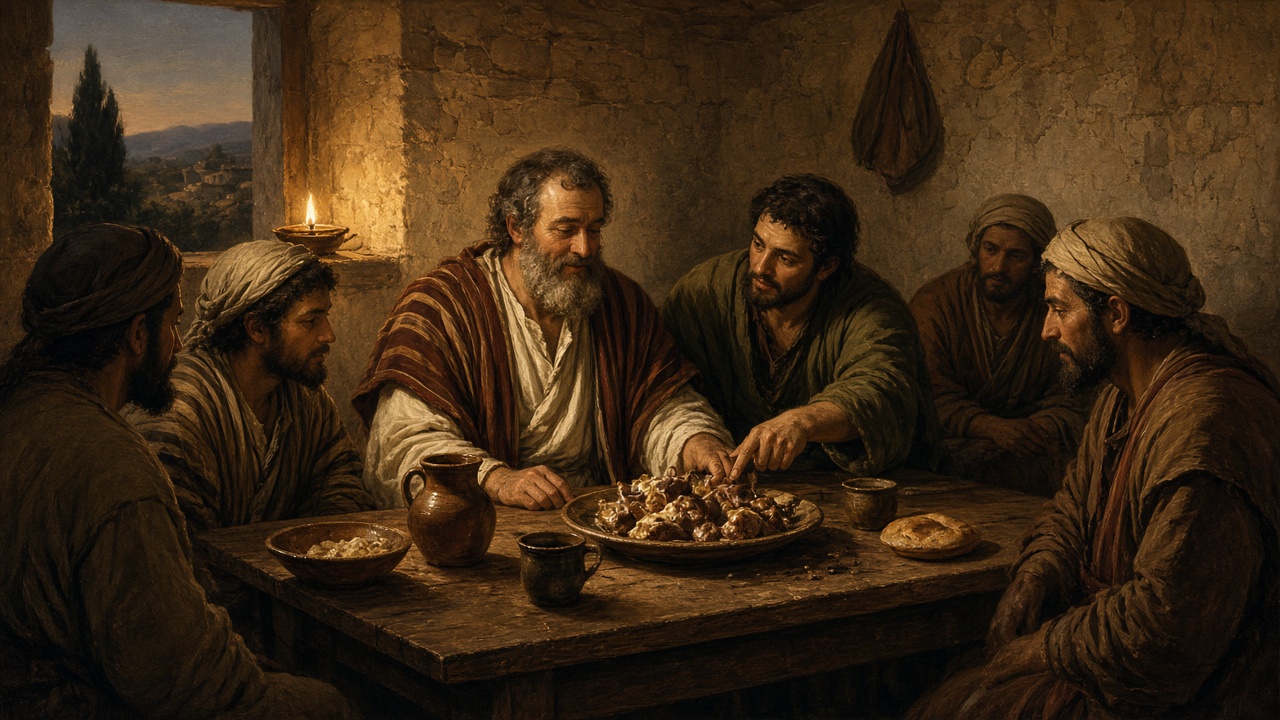
- Paul says he does not want the Corinthians unaware that the forefathers were all under the cloud and all passed through the sea, and that they were baptized into Moses in the cloud and in the sea. They all ate the same spiritual food and drank the same spiritual drink from the spiritual rock that accompanied them, and he says that rock was Christ.Sources: the Bible text itself
- Paul says God was not pleased with most of them, for they were struck down in the wilderness. He lists idolatry, sexual immorality in which twenty-three thousand died in one day, testing Christ, which brought death by snakes, and complaining, punished by the destroying angel, and calls these events examples written down as warnings.Sources: the Bible text itself
- He calls the cup of blessing and the bread that is broken a participation in the blood and body of Christ, and says pagan sacrifices are offered to demons, not to God, so the two tables cannot be shared. Food sold in the meat market may be eaten without raising questions of conscience, for "The earth is the Lord's, and the fullness thereof," but if someone says it was offered to idols, it should be refused for that person's conscience.Sources: the Bible text itself
Notes written with AI assistance from open sources (Theographic Bible Metadata, CC BY-SA 4.0; Easton’s Bible Dictionary, public domain) and reviewed before publishing.
Credits and license for this translation
The Orthodox Jewish Bible
The Orthodox Jewish Bible - Tanakh and Orthodox Jewish Brit Chadasha - The Holy Bible
copyright © 2002-2011, 2021, 2024 Artists for Israel International
Language: English
Contributor: Artists for Israel International
THE ORTHODOX JEWISH TANAKH
Artists For Israel Intl Inc.
This version also appears with the Orthodox Yiddish Triglot which presents the Hebrew Yiddish script in Latin script and an English word for word translation, available at afii.org/Torah
To donate PayPal.Me
This translation is made available to you under the terms of the
Creative Commons Attribution license 4.0.
You may share and redistribute this Bible translation or extracts from it in any format, provided that:
You include the above copyright and source information.
If you make any changes to the text, you must indicate that you did so in a way that makes it clear that the original licensor is not necessarily endorsing your changes.
Pictures included with Scriptures and other documents on this site are licensed just for use with those Scriptures and documents.
For other uses, please contact the respective copyright owners.
Note that in addition to the rules above, revising and adapting God's Word involves a great responsibility to be true to God's Word. See Revelation 22:18-19.
2026-01-06
Section headings adapted from the Berean Standard Bible (public domain); they are not part of this translation’s text.
Source: http://ebible.org/engojb/ · eBible.org