1 Chronicles 24
The Orthodox Jewish Bible · Tap a verse to see its cross-references.
Twenty-Four Divisions of Priests
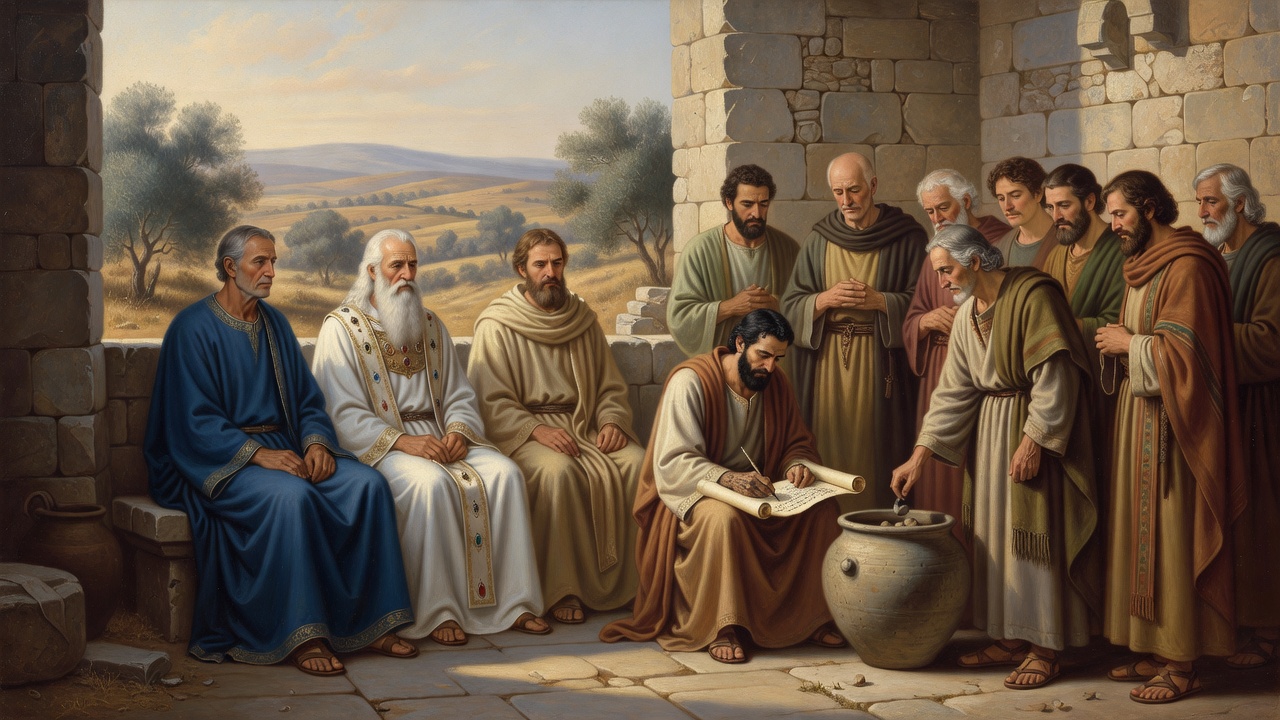
1Now these are the divisions of the Bnei Aharon; the Bnei Aharon; Nadav, and Avihu, El'azar, and Itamar. 2But Nadav and Avihu died before avihem (their father), and had no banim; therefore El'azar and Itamar became Kohanim. 3And Dovid with both Tzadok of the Bnei El'azar, and Achimelech of the Bnei Itamar, divided them according to their pekudim (offices, assignments) in their avodah. 4And there were more Rashei HaGevarim found of the Bnei El'azar than of the Bnei Itamar, and thus were they divided. Among the Bnei El'azar there were sixteen Rashim l'Bais Avot, and eight among the Bnei Itamar according to the Bais of their Avot. 5Thus were they divided by goralot (lots) with one another; for the Sarei Kodesh and Sarei HaElohim, were of the Bnei El'azar, and of the Bnei Itamar. 6And Shema'yah ben Netan'el the Sofer, one of the Levi'im, wrote them before HaMelech, and the Sarim, and Tzadok HaKohen, and Achimelech ben Evyatar (Abiathar), and before the Rashei HaAvot of the Kohanim and Levi'im, Bais Avechad being chosen for El'azar, and one chosen for Itamar.
7Now the first goral (lot) came forth to Yehoyariv, the second to Yedayah, 8The third to Charim, the fourth to Seorim, 9The fifth to Malkiyah, the sixth to Miyamin, 10The seventh to Hakotz, the eighth to Aviyah, 11The ninth to Yeshua, the tenth to Shekanyahu, 12The eleventh to Elyashiv, the twelfth to Yakim, 13The thirteenth to Chuppah, the fourteenth to Yeshevav, 14The fifteenth to Bilgah, the sixteenth to Immer, 15The seventeenth to Chezir, the eighteenth to Happitzetz, 16The nineteenth to Petachyah, the twentieth to Yechezkel, 17The one and twentieth to Yachin, the two and twentieth to Gamul, 18The three and twentieth to Delayahu, the four and twentieth to Ma'azyahu. 19These were the pekudim (offices, assigments) of them in their avodah to come into the Bais Hashem, according to their mishpatim (regulations), under Aharon Avihem just as Hashem Elohei Yisroel had commanded him.
The Rest of the Levites
20And the rest of the Bnei Levi were these: Of the Bnei Amram: Shuva'el; of the Bnei Shuva'el: Yechdeyahu. 21Concerning Rechavyahu, of the Bnei Rechavyahu, the first was Yishiyah. 22Of the Yitzhari: Shelomot; of the Bnei Shelomot: Yachat. 23And [the Bnei Chevron]: Yeriyahu the first, Amaryahu the second, Yachaziel the third, Yekam'am the fourth. 24Of the Bnei Uzziel: Michah; of the Bnei Michah: Shamir. 25The brother of Michah was Yishiyah; of the Bnei Yishiyah: Zecharyah. 26The Bnei Merari were Machli and Mushi; the Bnei Ya'aziyahu, Beno. 27The Bnei Merari: by Ya'aziyahu: Beno, and Shoham, and Zakkur, and Ivri. 28Of Machli came El'azar, who had no banim. 29Concerning Kish: the ben Kish was Yerachme'el. 30The Bnei Mushi: Machli, and Eder, and Yerimot. These were the Bnei HaLevi'im after the Bais Avoteihem. 31These likewise cast goralot (lots) corresponding to their brethren the Bnei Aharon in the presence of Dovid HaMelech, and Tzadok, and Achimelech, and the Rashei HaAvot LaKohanim and Levi'im, even the Avot HaRosh as well as Achiv HaKatan.
Did you know?
Organization of the Priests and Levites
- Because Aaron's two eldest sons, Nadab and Abihu, died without children after offering unauthorized fire, only the lines of Eleazar and Ithamar continued the priesthood. King David organized these descendants into twenty-four rotational divisions, sixteen from Eleazar and eight from Ithamar, to manage sanctuary duties.Sources: the Bible text itself · Eleazar · Ithamar · Nadab
- To ensure fairness between the two ancestral lines, the order of service was determined by casting lots in the presence of King David, Zadok, and Ahimelech. The scribe Shemaiah, a Levite, recorded the name of each family as their lot was drawn.Sources: the Bible text itself · Zadok · Ahimelech
- The remaining Levite clans, including descendants of Kohath and Merari, were also assigned their responsibilities by casting lots. The selection was conducted without regard to age or rank, treating family heads and their younger brothers equally.Sources: the Bible text itself · Merari
Notes written with AI assistance from open sources (Theographic Bible Metadata, CC BY-SA 4.0; Easton’s Bible Dictionary, public domain) and reviewed before publishing.
Places in this chapter
- Holy Place · Today: on Mount Moriah · 31.778, 35.236 · verse 5
Only places identified with high confidence are shown (90% or more according to the scholarly sources compiled by OpenBible). Period map: DARE (Digital Atlas of the Roman Empire), CC BY 4.0; modern map: © OpenStreetMap contributors; places: OpenBible.info (CC BY 4.0).
Credits and license for this translation
The Orthodox Jewish Bible
The Orthodox Jewish Bible - Tanakh and Orthodox Jewish Brit Chadasha - The Holy Bible
copyright © 2002-2011, 2021, 2024 Artists for Israel International
Language: English
Contributor: Artists for Israel International
THE ORTHODOX JEWISH TANAKH
Artists For Israel Intl Inc.
This version also appears with the Orthodox Yiddish Triglot which presents the Hebrew Yiddish script in Latin script and an English word for word translation, available at afii.org/Torah
To donate PayPal.Me
This translation is made available to you under the terms of the
Creative Commons Attribution license 4.0.
You may share and redistribute this Bible translation or extracts from it in any format, provided that:
You include the above copyright and source information.
If you make any changes to the text, you must indicate that you did so in a way that makes it clear that the original licensor is not necessarily endorsing your changes.
Pictures included with Scriptures and other documents on this site are licensed just for use with those Scriptures and documents.
For other uses, please contact the respective copyright owners.
Note that in addition to the rules above, revising and adapting God's Word involves a great responsibility to be true to God's Word. See Revelation 22:18-19.
2026-01-06
Section headings adapted from the Berean Standard Bible (public domain); they are not part of this translation’s text.
Source: http://ebible.org/engojb/ · eBible.org