Jonah 4
Open English Bible (U. S. spelling) · Tap a verse to see its cross-references.
Jonah sulks
1But this seemed very wrong to Jonah and he became angry. 2He prayed to the Lord and said, “Ah, Lord, wasn’t this what I said when I was still in my own country? That was why I fled at once to Tarshish; for I knew that you are a gracious and merciful God, patient, and loving and ready to forgive. 3Therefore, Lord, I beg you, take my life from me; for it is better for me to die than to live!” 4But the Lord said, “Are you doing right in being angry?”
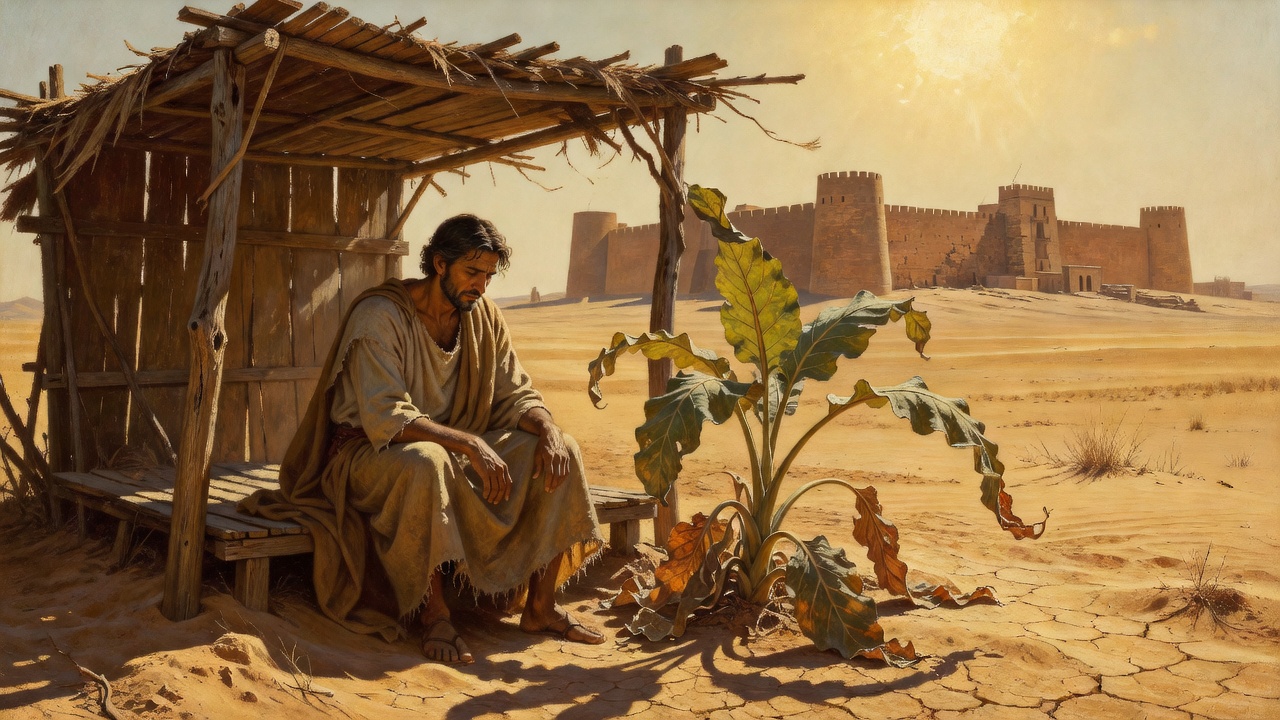
5Then Jonah went out of the city and sat down on the east side, and there made a hut for himself and sat under it, waiting to see what would become of the city. 6And the Lord arranged for a bush to grow up over Jonah as a shade for his head to make him comfortable. The bush gave Jonah great pleasure; 7but at dawn the next day God arranged for a worm which attacked the bush, so that it wilted. 8And when the sun rose, God arranged a hot east wind. And the sun beat upon Jonah’s head, so that he was faint and begged that he might die, saying, “It is better for me to die than to live.” 9But God said to Jonah, “Are you doing right in being angry about the bush?” He replied, “I have every right to be as angry as I could possibly be!”
Jonah is rebuked
10The Lord said, “You care about a bush which has cost you no trouble and which you have not made grow, which came up in a night and wilted in a night. 11Should I not care for the great city Nineveh, in which there are one hundred and twenty thousand people who do not know their right hand from their left; and many cattle too?”
Did you know?
Jonah's Anger and God's Compassion
- Jonah admits that he originally attempted to flee toward Tarshish precisely because he knew God is gracious, compassionate, slow to anger, and relents from sending disaster. His distress arose when God chose to spare Nineveh rather than destroy it.Sources: the Bible text itself · Tarshish
- Nineveh, the flourishing capital of the Assyrian empire, is described at the conclusion of the book as home to more than 120,000 people who cannot discern between their right and left hand, along with many cattle. God highlights this massive population to contrast divine compassion with Jonah's concern for a single withered plant.Sources: the Bible text itself · Nineveh
Notes written with AI assistance from open sources (Theographic Bible Metadata, CC BY-SA 4.0; Easton’s Bible Dictionary, public domain) and reviewed before publishing.
Places in this chapter
- Nineveh · 36.359, 43.153 · verse 11
Only places identified with high confidence are shown (90% or more according to the scholarly sources compiled by OpenBible). Period map: DARE (Digital Atlas of the Roman Empire), CC BY 4.0; modern map: © OpenStreetMap contributors; places: OpenBible.info (CC BY 4.0).
Credits and license for this translation
Open English Bible (U. S. spelling)
The Holy Bible, Open English Bible translation, U. S. spelling edition
Public Domain
Language: English
Translation by: OpenEnglishBible.org
Please see OpenEnglishBible.org/ for information about this translation.
2026-10-02
Source: http://ebible.org/engoebus/ · eBible.org