Genesis 32
Open English Bible (U. S. spelling) · Tap a verse to see its cross-references.
1Jacob went on his way and the messengers of God met him. 2When he saw them, Jacob said, “This is God’s camp;” so he named the place “Mahanaim.”
Jacob prepares to meet Esau
3Jacob sent messengers before him to his brother Esau, to the land of Seir, which is the territory of the Edomites. 4He gave them this command, “Say to my lord Esau: ‘Your servant Jacob declares, I have lived with Laban and have stayed until now. 5I have oxen and donkeys, flocks and male and female slaves, and I have sent to tell my lord, in order that I may win your favor.’” 6The messengers returned to Jacob with the report, “We came to your brother Esau, even as he was coming to meet you with four hundred men.”
7Then Jacob was greatly alarmed and worried. So he divided the people that were with him and the flocks and the herds and the camels into two parts 8and said, “If Esau comes to the one and attacks and destroys it, then the other which is left can escape.”
9Jacob also prayed, “God of my father Abraham and God of my father Isaac, Lord who said to me, ‘Return to your country, and to your relatives, and I will do well by you,’ 10I am not worthy of the least of all the mercies and all the faithfulness which you have shown to me, your servant. I passed over the Jordan river with only my staff, and now I have these two groups, 11deliver me, I pray, from the hand of my brother, from the hand of Esau, for I fear that he will come and attack me and kill the mothers and the children. 12Remember your promise to make me prosper and my descendants as many as the sand of the seashore, uncountable.”
13After spending the night there, Jacob took from his livestock as a present for his brother Esau, 14two hundred female goats and twenty male goats, two hundred ewes and twenty rams, 15thirty milch camels and their young, forty cows and ten bulls, twenty female donkeys and ten young donkeys. 16These he put, each drove by itself, in the care of his servants and said to them, “Go on before me and leave a space between the droves.”
17He gave those in front this command: “When my brother Esau meets you and asks you, ‘To whom do you belong? And where are you going? And whose are these before you?’ 18then you must say, ‘To your servant Jacob; it is a present sent by him to my lord Esau; and Jacob himself is just behind us.’” 19Jacob also commanded the second, and the third, and all that followed the droves, to make the same answer, 20and to say, “Jacob himself is just behind us.” For he said to himself, “I will please him with the present that goes before me, and then, when I meet him, perhaps he will welcome me.” 21So he sent the present over before him; but he himself spent that night in the camp.
22Later that night he rose up and took his two wives, his two slave-girls, and his eleven children, and sent them over the river Jabbok.
Jacob wrestles
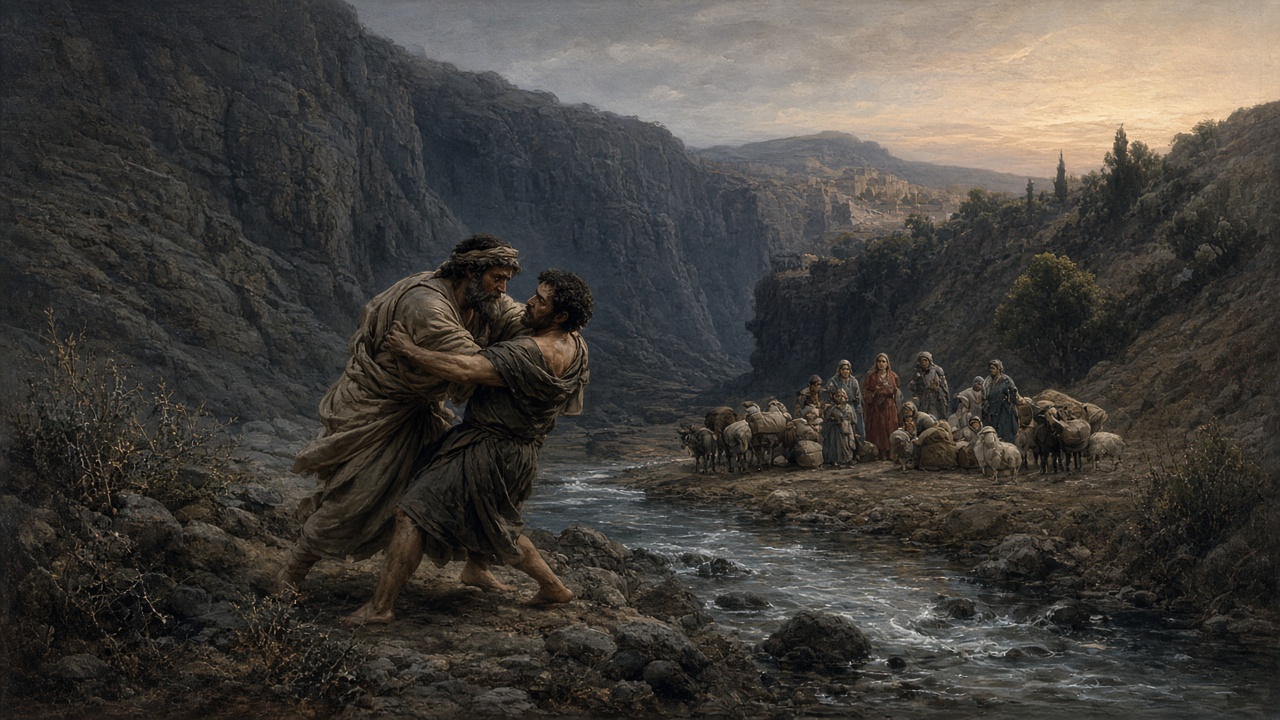
23After he had sent them across with all his belongings, 24Jacob was left alone, and someone wrestled with him until daybreak. 25When he saw that he did not win against Jacob, he struck the socket of his hip, and the socket of Jacob’s hip was dislocated, as he wrestled with him. 26Then he said, “Let me go, for the dawn is breaking.” But Jacob replied, “I will not let you go unless you bless me.” 27So he said to him, “What is your name?” He answered, “Jacob.” 28Then he said, “Your name will be no longer Jacob, but Israel, for you have struggled with God and with mortals and have won.” 29Jacob asked him, “Tell me, I pray, your name.” He said, “Why do you ask my name?” So he blessed him there. 30Jacob called the place Penuel, for he said, “I have seen God face to face, and my life has been saved.”
31The sun rose as soon as he had passed beyond Penuel, and he limped because of his hip. 32This is why to this day the Israelites do not eat the thigh muscle, which is at the socket of the hip, because he touched the socket of Jacob’s hip on the thigh muscle.
Did you know?
At the Jabbok, on the Way to Esau
- Mahanaim means “two camps.” Jacob gave that name to the place near the Jabbok, beyond the Jordan, when the angels of God met him and he said, “This is the camp of God.” There he also divided his people, flocks, herds, and camels into two camps, hoping one might escape if Esau attacked the other.Sources: Mahanaim · the Bible text itself
- The Jabbok, whose name is explained as “a pouring out, or a wrestling,” is a stream east of the Jordan. It joins the Jordan about midway between the Sea of Galilee and the Dead Sea, after a course of about 65 miles through a wild, deep ravine. At its ford Jacob sent his two wives, two maidservants, eleven sons, and all he owned across, then remained alone and wrestled with a man until daybreak.Sources: Jabbok · the Bible text itself
- Jacob sent messengers to Esau in the land of Seir, the country of Edom, calling him lord and himself a servant. Seir is a mountainous region along the east side of the Arabah, from the southeastern end of the Dead Sea toward Akabah, the eastern branch of the Red Sea; the Edomites occupied it, and it was allotted to Esau’s descendants. Esau, the firstborn twin and a hunter, had sold his birthright for red lentil stew and was also called Edom, “red,” while Jacob—whose name means “one who follows on another’s heels,” or “supplanter”—had conspired with his mother to deceive Isaac.Sources: the Bible text itself · Seir · Esau (Edom) · Jacob (Israel)
Notes written with AI assistance from open sources (Theographic Bible Metadata, CC BY-SA 4.0; Easton’s Bible Dictionary, public domain) and reviewed before publishing.
Places in this chapter
- Edom · 30.746, 35.604 · verse 3
- Jordan · Today: Jordan River · 31.761, 35.558 · verse 10
- Jabbok · Today: Zarqa River · 32.115, 35.543 · verse 22
Only places identified with high confidence are shown (90% or more according to the scholarly sources compiled by OpenBible). Period map: DARE (Digital Atlas of the Roman Empire), CC BY 4.0; modern map: © OpenStreetMap contributors; places: OpenBible.info (CC BY 4.0).
Credits and license for this translation
Open English Bible (U. S. spelling)
The Holy Bible, Open English Bible translation, U. S. spelling edition
Public Domain
Language: English
Translation by: OpenEnglishBible.org
Please see OpenEnglishBible.org/ for information about this translation.
2026-10-02
Source: http://ebible.org/engoebus/ · eBible.org