Genesis 28
Open English Bible (U. S. spelling) · Tap a verse to see its cross-references.
1Then Isaac called Jacob, and blessed him, and instructed him, “You must not marry any of the daughters of Canaan. 2Arise, go to Paddan-aram, to the house of Bethuel your mother’s father; and marry one of the daughters of Laban, your mother’s brother. 3May God Almighty bless you, and make you fruitful and numerous, so that you may become a great people, 4and may he give the blessing of Abraham to you and to your descendants with you so that you may inherit the land you have settled in, which God gave to Abraham.”
5So Isaac sent away Jacob, and he went to Paddan-aram to Laban, the son of Bethuel the Aramean, the brother of Rebekah, Jacob and Esau’s mother. 6Now when Esau saw that Isaac had blessed Jacob and send him away to Paddan-aram, to find a wife there, and that, as he blessed him, he instructed him: “You must not take a wife of the daughters of Canaan”, 7and that Jacob had obeyed his father and mother, and had gone to Paddan-aram, 8and when Esau also saw that the daughters of Canaan did not please Isaac his father, 9then Esau went to Ishmael, and in addition to the wives that he had, married Mahalath the daughter of Ishmael, Abraham’s son, the sister of Nebaioth.
Jacob and the ladder
10Then Jacob set out from Beersheba and went toward Haran. 11When he arrived at a certain holy place, he passed the night there, because the sun had set. He took one of the stones from its place and put it under his head and lay down to sleep. 12Then he dreamed and saw a ladder set up on the earth, and its top reached to heaven; and the messengers of God were going up and down on it.
13The Lord also stood beside him and said, “I am the Lord, God of Abraham and God of Isaac. The land on which you lie I will give to you and to your children. 14Your descendants will be as countless as the dust of the earth and you will spread abroad to the west, and to the east, and to the north, and to the south, and all the families of the earth will wish for a blessing like yours and that of your descendants. 15See, I am with you, and will keep you wherever you go and will bring you again to this land; for I will not leave you until I have done what I have promised you.”
16When Jacob woke up, he said, “Surely the Lord is in this place, and I did not know it.” 17And he was filled with awe and said, “This place is the house of God, and this is the gate of heaven.”
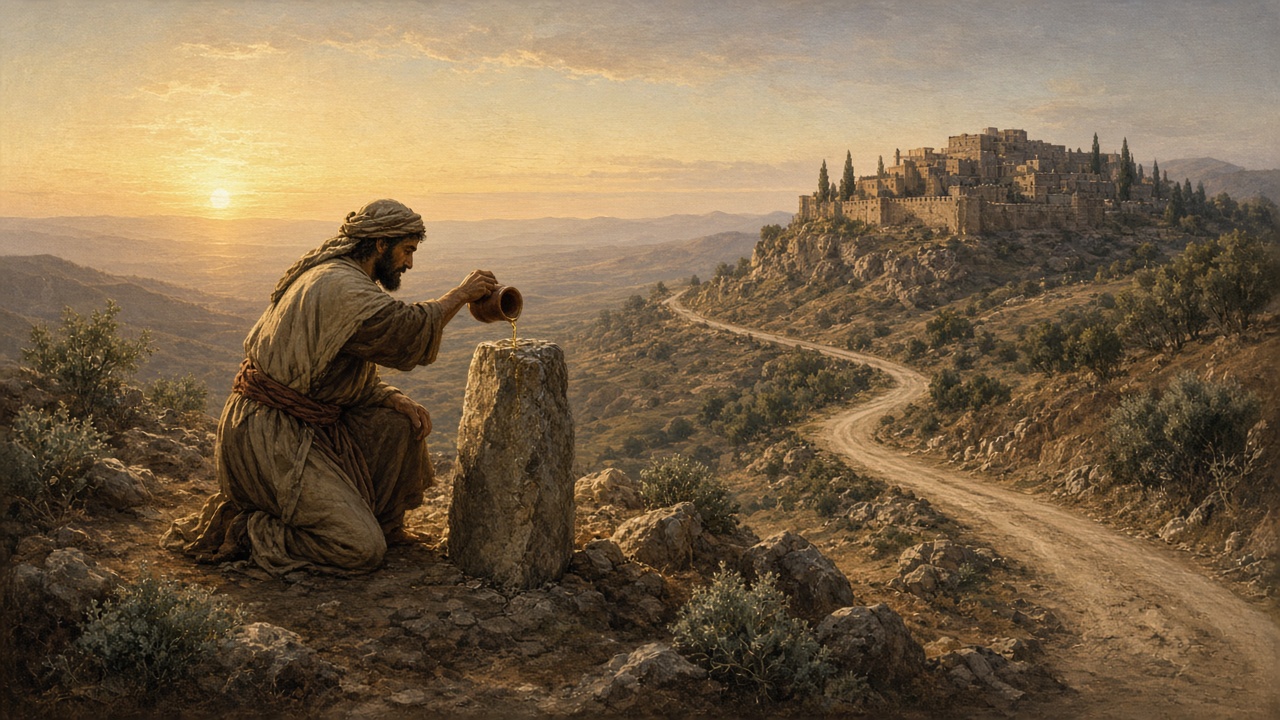
18So Jacob rose early in the morning and took the stone that he had put under his head and set it up as a pillar and poured oil upon the top of it. 19He named that place Bethel. (The earlier name of the town was Luz.) 20Jacob also made this promise, “If God will be with me and protect me on this journey which I am making and give me bread to eat and clothing to put on, 21and if I return safe and sound to my father’s house, then the Lord will be my God, 22and this stone which I have set up as a pillar will be a house of God. And of all that you give me I will surely give a tenth to you.”
Did you know?
Jacob's Journey and Dream at Bethel
- Isaac sent Jacob from Beersheba to Paddan-aram to take a wife from the daughters of Laban, his mother Rebekah's brother, rather than from the Canaanite women. Paddan-aram, called the plain of Aram, is commonly regarded as the Mesopotamian district around Haran, where Laban lived; Haran, also called the city of Nahor, was where Abraham stayed after leaving Ur until his father Terah died.Sources: the Bible text itself · Paddan-aram · Haran · Laban
- The place where Jacob dreamed, set up as a pillar the stone he had put under his head, and poured oil on it was the royal Canaanite city of Luz; he renamed it Bethel. Easton's Bible Dictionary (1897) locates Bethel in central Palestine, about ten miles north of Jerusalem, and notes that the name was at first apparently given to a sanctuary in the neighborhood of Luz, and was not given to the city itself until after the tribe of Ephraim conquered it.Sources: the Bible text itself · Luz · Bethel (of Palestine)
- When Esau learned that Isaac had blessed Jacob and ordered him not to marry a Canaanite woman, he went to Ishmael and married Mahalath, sister of Nebaioth and daughter of Abraham's son Ishmael, in addition to the wives he already had. Easton's Bible Dictionary (1897) also calls her Bashemath and notes that Esau's three wives receive different names in the Edomite genealogy of Genesis 36 from those given in the narrative of Genesis 26 and 28.Sources: the Bible text itself · Bashemath
Notes written with AI assistance from open sources (Theographic Bible Metadata, CC BY-SA 4.0; Easton’s Bible Dictionary, public domain) and reviewed before publishing.
Places in this chapter
- Canaan · 32.767, 35.333 · verses 1, 6, 8
- Haran · Today: Harran · 36.864, 39.033 · verse 10
- Luz · Today: Beitin · 31.923, 35.241 · verse 19
Only places identified with high confidence are shown (90% or more according to the scholarly sources compiled by OpenBible). Period map: DARE (Digital Atlas of the Roman Empire), CC BY 4.0; modern map: © OpenStreetMap contributors; places: OpenBible.info (CC BY 4.0).
Credits and license for this translation
Open English Bible (U. S. spelling)
The Holy Bible, Open English Bible translation, U. S. spelling edition
Public Domain
Language: English
Translation by: OpenEnglishBible.org
Please see OpenEnglishBible.org/ for information about this translation.
2026-10-02
Source: http://ebible.org/engoebus/ · eBible.org