Genesis 2
Open English Bible (Commonwealth Spelling) · Tap a verse to see its cross-references.
1So the heavens and the earth were finished, and everything in them.
2When on the seventh day God finished the work which he had done,
he rested that day from all his work.
3God blessed the seventh day and set it apart,
for in it he rested from all the creative work which he had done.
The garden
4This is the story of the heavens and earth when they were created.
At the time when the Lord God made earth and heaven, 5there were not yet any plants on the earth, and no vegetation had sprung up; for the Lord God had not sent rain upon the earth, and there was no one to till the soil. 6A mist used to rise from the earth and water all the surface of the ground.
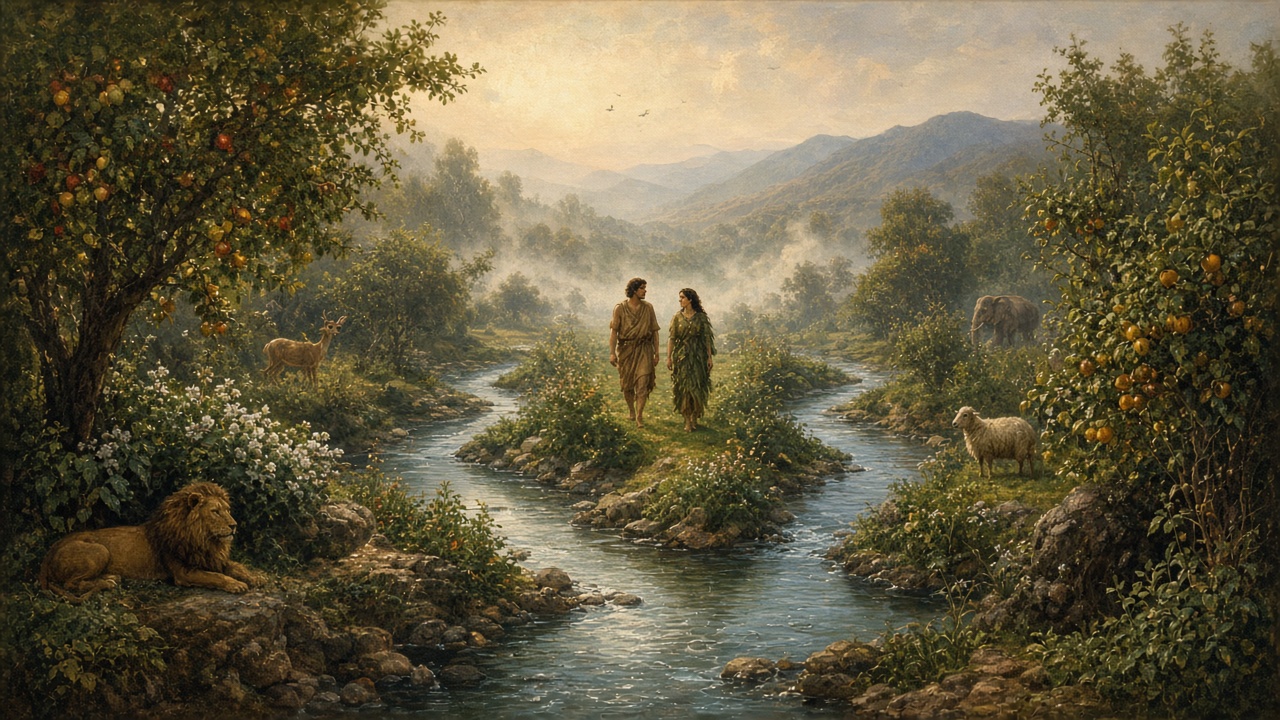
7Then the Lord God moulded a human being out of dust taken from the ground and breathed into his nostrils the breath of life, and he became a living being. 8The Lord God planted a garden in Eden, far in the East; and placed the human he had formed there. 9From the soil the Lord God made grow all kinds of trees that are pleasant to look at and good for food, with the tree of life also in the middle of the garden and the tree that gives the knowledge of good and evil.
10A river flowed out of Eden and watered the garden, and from there branched into four. 11The name of the first is Pishon, which flows round the whole land of Havilah, where there is gold. 12The gold of that land is pure, and aromatic resins and onyx stone are found there. 13The name of the second river is Gihon, which flows round the whole land of Cush, 14and the name of the third river is the Tigris, which heads toward the east of Asshur. The fourth river is the Euphrates.
15Then the Lord God took the human and placed him in the garden of Eden to till it and to care for it. 16The Lord God also gave the human this command: ‘You may freely eat from every tree of the garden, 17except from the tree that gives the knowledge of good and evil; from this you must not eat, for on the day that you eat from it you will surely die.’
18Then the Lord God said, ‘It is not good for the human to be alone; I will make a helper suited to him.’ 19So out of the ground the Lord God formed all the wild beasts and birds, and made them come to the human to see what he would call them. Whatever he called each living creature, that was its name. 20So the human, Adam gave names to all cattle and all the wild birds and beasts. But there was no companion suitable for him.
21Then the Lord God caused the human to fall into a deep sleep, and while he slept, he took one of his ribs and closed up its place with flesh. 22With the rib which he had taken from the human, the Lord built up a woman and brought her to the human. 23Then the human said, ‘This now is bone of my bone and flesh of my flesh. She will be called Woman, for from man she was taken.’ 24For this reason a man leaves his father and his mother and clings to his wife, and the two become one flesh.
25The man and his wife were both naked, yet felt no shame.
Did you know?
Adam, Eden, and the Four Rivers
- Adam, meaning “red,” is a Babylonian word and the ordinary name for a human being, with the same sense in Hebrew and in Assyrian. It was given to the first man. He was formed from the dust of the ground—hence the name—and God breathed into his nostrils the breath of life.Sources: Adam · the Bible text itself
- A river flowed out of Eden and divided into four headwaters: the Pishon, the Gihon, the Hiddekel, and the Euphrates. Some identify the Pishon with the Phasis or the Halys, others with the Indus, the Ganges, or still other rivers; the Gihon has been identified with the Nile, and others regard it as the Oxus, the Araxes, or the Ganges. The Hiddekel is the Tigris, called by the Accadians the river of Idikla; Gesenius understood the name as “the rapid Tigris.”Sources: the Bible text itself · Pison · Gihon · Hiddekel
- The site of Eden, the garden in which the first parents lived, has been discussed more than almost any other geographical question. It has been placed in Armenia, in the region west of the Caspian Sea, in Media, near Damascus, in Palestine, in southern Arabia, and in Babylonia. Easton's Bible Dictionary (1897) seeks it along the Tigris and the Euphrates of western Asia, in the land of Shinar, or Babylonia.Sources: Eden
Notes written with AI assistance from open sources (Theographic Bible Metadata, CC BY-SA 4.0; Easton’s Bible Dictionary, public domain) and reviewed before publishing.
Places in this chapter
- Assyria · 36.359, 43.153 · verse 14
- Euphrates · Today: Euphrates River · 31.004, 47.442 · verse 14
- Tigris · Today: Tigris River · 31.004, 47.442 · verse 14
Only places identified with high confidence are shown (90% or more according to the scholarly sources compiled by OpenBible). Period map: DARE (Digital Atlas of the Roman Empire), CC BY 4.0; modern map: © OpenStreetMap contributors; places: OpenBible.info (CC BY 4.0).
Credits and license for this translation
Open English Bible (Commonwealth Spelling)
The Holy Bible, Open English Bible translation, with Commonwealth spelling
Public Domain
Language: English
Translation by: OpenEnglishBible.org
Please see OpenEnglishBible.org/ for information about this translation.
2026-10-02
Source: http://ebible.org/engoebcw/ · eBible.org