Amos 6
Open English Bible (Commonwealth Spelling) · Tap a verse to see its cross-references.
The Destruction of Israel
1Sorrow awaits who are carefree in Zion,
overconfident on the mountain of Samaria!
The elite of this, the best of nations,
on whom the people of Israel rest their hopes!
2You say to the people:
Cross over to Calneh and see,
go from there to Hamath the great,
then go down to Gath of the Philistines:
Are they better than these kingdoms?
Is their territory larger than yours?
3You push away all thoughts of the evil day,
yet have instituted a rule of violence.
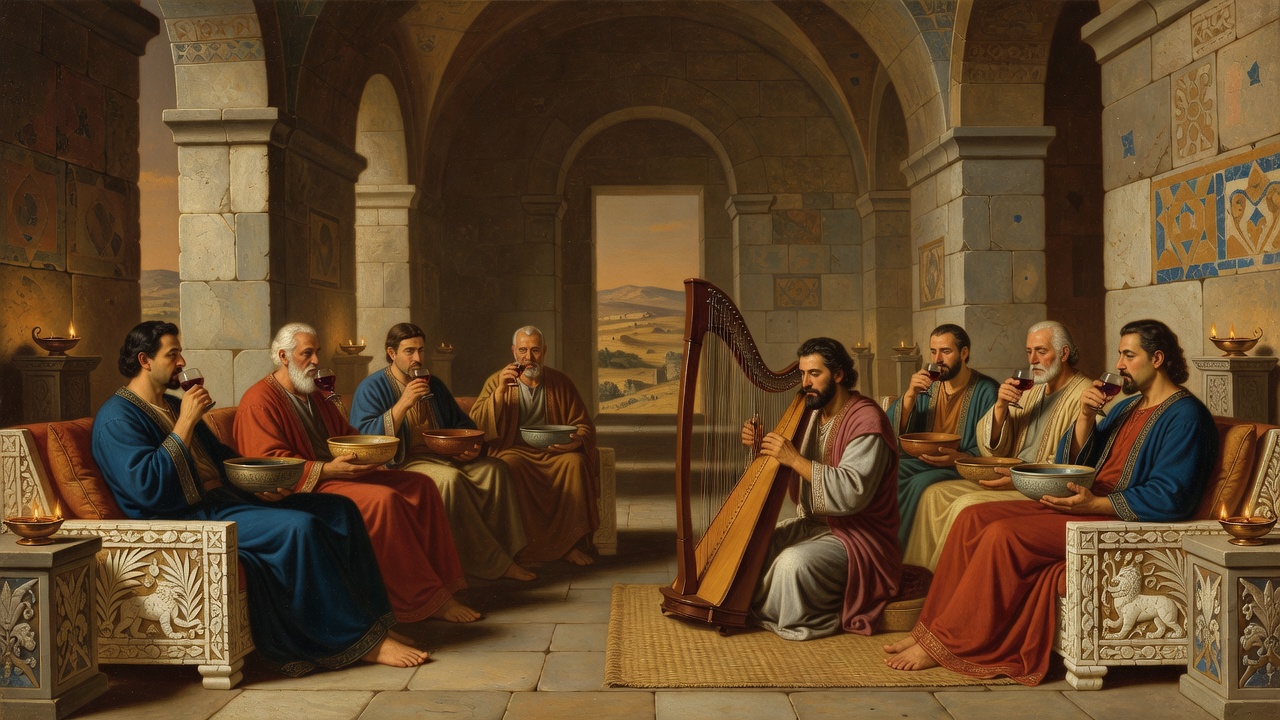
4They lie on ivory couches,
sprawl on their divans,
eat choice lambs from the flock,
and fattened calves from the stall.
5They idly sing to the sound of the lyre,
thinking themselves songwriters like David,
6they drink bowlfuls of wine,
and anoint themselves with the finest of oil.
But they do not grieve over the ruin of Joseph.
7Therefore now they must go into exile
at the head of the captives,
and hushed will be the revelry of the sprawlers.
8The Lord God,
the Lord, the God of hosts, has sworn by himself:
I abhor the pride of Jacob,
I hate his palaces,
therefore I will deliver up the city
and all that is in it to their enemies.
9If ten people remain in one house, then they will die. 10When the uncle and another member of the family of a dead man come to carry the body out of the house for burial, they will call to someone in a corner of the house, “Any more there?” and he will answer, “No”, and then he will add, “Be quiet!” – for the name of the Lord must not be mentioned.
11Look! The Lord is giving the command!
He will smash the large house to bits,
the small house into fragments.
12Do horses gallop on crags?
Does one plough the sea with oxen?
Yet you turn justice into poison weed,
and the fruit of righteousness into bitter wormwood.
13You who are so proud
of capturing Lo-debar,
who say, “Have we not by our own strength
taken Karnaim for ourselves?”
14I am now raising up against you,
Israel, a nation,
says the Lord, the God of hosts.
They will oppress you,
from the entrance of Hamath
to the brook of the Arabah.
Did you know?
Complacency and Impending Exile
- Amos addresses the ruling elite who felt secure in both Zion, the fortified hill of Jerusalem, and Mount Samaria, the capital of the northern kingdom built on an elevated summit by King Omri. Despite the natural defenses and prestige of these cities, their leaders are warned that their ease and overconfidence would end in captivity.Sources: Zion · Samaria · the Bible text itself
- The prophet challenges Israel to look at renowned foreign cities such as Calneh near the Euphrates, Hamath on the Orontes in Upper Syria, and the Philistine stronghold of Gath. These neighboring powers were neither smaller nor less protected, yet they could not escape destruction.Sources: Calneh · Hamath · Gath · the Bible text itself
- Amos criticizes the aristocracy for indulging in extravagant banquets, resting on beds inlaid with ivory, and improvising music on harps like David, all while ignoring the impending ruin of Joseph. The name Joseph here designates the northern tribes of Israel, whose moral decay and social injustice were neglected by their wealthy leaders.Sources: David · Joseph (son of Jacob) · the Bible text itself
Notes written with AI assistance from open sources (Theographic Bible Metadata, CC BY-SA 4.0; Easton’s Bible Dictionary, public domain) and reviewed before publishing.
Places in this chapter
- Samaria · 32.276, 35.195 · verses 1, 8
- Zion · Today: Jerusalem · 31.777, 35.234 · verse 1
- Hamath · Today: Hama · 35.136, 36.750 · verse 2
- Philistia · 31.664, 34.546 · verse 2
Only places identified with high confidence are shown (90% or more according to the scholarly sources compiled by OpenBible). Period map: DARE (Digital Atlas of the Roman Empire), CC BY 4.0; modern map: © OpenStreetMap contributors; places: OpenBible.info (CC BY 4.0).
Credits and license for this translation
Open English Bible (Commonwealth Spelling)
The Holy Bible, Open English Bible translation, with Commonwealth spelling
Public Domain
Language: English
Translation by: OpenEnglishBible.org
Please see OpenEnglishBible.org/ for information about this translation.
2026-10-02
Source: http://ebible.org/engoebcw/ · eBible.org