Jeremiah 47
George Noyes Bible · Tap a verse to see its cross-references.
Judgment on the Philistines
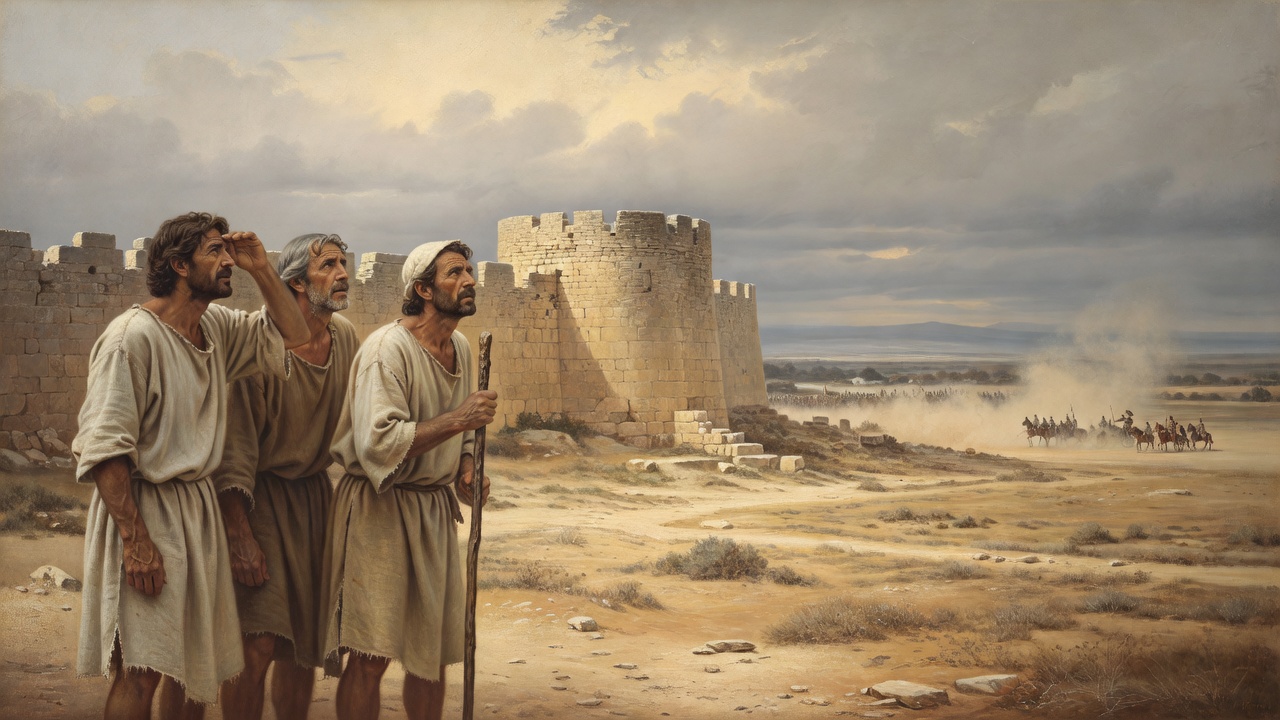
1The word of Jehovah which came to Jeremiah the prophet concerning the Philistines, before Pharaoh had smitten Gaza. 2Thus saith Jehovah: Behold, waters rise up out of the North, And they shall become an overflowing torrent, And shall overflow the land, and all that is therein,—The city, and them that dwell therein; And the men shall cry aloud, And all the inhabitants of the land shall wail. 3At the noise of the stamping of the horses, At the rattling of his chariots, And at the rumbling of his wheels, Fathers look not back for their children, For feebleness of hands, 4Because of the day which cometh, To lay waste all the Philistines, To cut off from Tyre and from Sidon Every helper that remaineth. For Jehovah will lay waste the Philistines, The remnant of the country of Caphtor. 5Baldness is come upon Gaza, Askelon is in ruins, And the remnant of their valley! How long wilt thou cut thyself? 6Ah! sword of Jehovah, How long ere thou wilt be quiet? Retire into thy scabbard, Rest, and be still! 7But how canst thou be at rest, Since Jehovah hath given thee a charge against Askelon, And against the coast of the sea? There hath he appointed it.
Did you know?
Judgment on the Philistines
- Jeremiah refers to the Philistines as the remnant from the coasts of Caphtor. Biblical traditions identify Caphtor as the place of origin of the Philistines, a location widely associated by scholars with Crete or parts of the eastern Mediterranean coast.Sources: the Bible text itself · Caphtor
- The chapter directs its warnings against Gaza and Ashkelon, two of the five prominent Philistine cities along the Mediterranean coast. Both were ancient centers known for their strategic position and trade links connecting Egypt and the surrounding regions.Sources: the Bible text itself · Gaza · Ashkelon
- The prophecy notes that the coming destruction would cut off every remaining ally from Tyre and Sidon. These two major Phoenician ports to the north were key maritime centers whose interests were closely intertwined with the coastal region.Sources: the Bible text itself · Tyre · Sidon
Notes written with AI assistance from open sources (Theographic Bible Metadata, CC BY-SA 4.0; Easton’s Bible Dictionary, public domain) and reviewed before publishing.
Places in this chapter
- Gaza · Today: Tell Harube · 31.504, 34.464 · verses 1, 5
- Sidon · Today: Sandikli archaeological site in Sidon · 33.561, 35.372 · verse 4
- Tyre · 33.271, 35.196 · verse 4
- Ashkelon · Today: Tel Ashkelon · 31.664, 34.546 · verses 5, 7
- Great Sea · Today: Mediterranean Sea · 31.805, 34.170 · verse 5
- Philistia · 31.664, 34.546 · verse 5
Only places identified with high confidence are shown (90% or more according to the scholarly sources compiled by OpenBible). Period map: DARE (Digital Atlas of the Roman Empire), CC BY 4.0; modern map: © OpenStreetMap contributors; places: OpenBible.info (CC BY 4.0).
Credits and license for this translation
George Noyes Bible
The Holy Bible, translated into English by George Noyes (1869)
Public Domain
Language: English
Dialect: archaic British
Translation by: George Noyes
2019-10-24
Section headings adapted from the Berean Standard Bible (public domain); they are not part of this translation’s text.
Source: http://ebible.org/engnoy/ · eBible.org