Acts 15
George Noyes Bible · Tap a verse to see its cross-references.
AI-generated narration · text: George Noyes Bible (public domain)
1And there came down certain men from Judaea, and taught the brethren, Unless ye are circumcised after the custom of Moses, ye cannot be saved. 2But when Paul and Barnabas had had no small dissension and debate with them, they determined that Paul and Barnabas, and certain others of them, should go up to Jerusalem to the apostles and elders about this question. 3They therefore, having been sent forward by the church, passed through Phoenicia and Samaria, declaring the conversion of the gentiles; and they caused great joy to all the brethren. 4And having come to Jerusalem, they were welcomed by the church, and by the apostles and elders, and they related what great things God had wrought with them. 5But there rose up certain believers of the sect of the Pharisees, saying, It is necessary to circumcise them, and to command them to keep the law of Moses. 6And the apostles and the elders came together to consider this matter. 7And after much debate, Peter rose up and said to them, Brethren, ye know that a long time ago God made choice among you, that by my mouth the gentiles should hear the word of the glad tidings, and believe. 8And God, who knoweth the heart, bore them witness, giving them the Holy Spirit, as he gave it to us; 9and made no difference between us and them, having purified their hearts by faith. 10Now therefore why do ye provoke the anger of God, by putting a yoke upon the neck of the disciples, which neither our fathers nor we were able to bear? 11But we believe that we shall be saved through the grace of the Lord Jesus, in the same manner as they. 12And all the multitude became silent, and listened to Barnabas and Paul, while they related what great signs and wonders God had wrought among the gentiles by them. 13And after they had done speaking, James answered, saying, Brethren, hearken to me. 14Simeon hath related how God first visited the gentiles, to take out of them a people for his name. 15And with this agree the words of the Prophets, as it is written: 16“After this I will return, and will rebuild the tabernacle of David which hath fallen; and I will rebuild its ruins, and will set it up; 17that the rest of men may seek after the Lord, and all the gentiles, who have been called by my name, saith the Lord, who doeth these things, 18which were known from the beginning.” 19Wherefore my judgment is, that we should not trouble those who from among the gentiles are turning to God; 20but that we should write to them by letter to abstain from pollutions of idols, and from fornication, and from that which hath been strangled, and from blood. 21For Moses from the times of old hath had in every city those who preach him, being read in the synagogues every sabbath. 22Then it was decided by the apostles and the elders, with the whole church, to choose men from among themselves, and send them to Antioch, with Paul and Barnabas, namely, Judas called Barsabbas, and Silas, leading men among the brethren. 23And they wrote by them, “The apostles, and the elders, and the brethren, to the brethren who are from the gentiles in Antioch and Syria and Cilicia, greeting. 24Whereas we have heard, that some who went out from us have troubled you with words, subverting your souls, to whom we gave no command; 25it seemed good to us, having become of one mind, to choose men and send them to you, with our beloved Barnabas and Paul, 26men who have hazarded their lives for the name of our Lord Jesus Christ. 27We have sent therefore Judas and Silas, who will themselves tell you the same things by word of mouth. 28For it seemed good to the Holy Spirit and to us, to lay upon you no further burden except these necessary things: 29to abstain from meats offered to idols, and from blood, and from things strangled, and from fornication; from which if ye keep yourselves, ye will do well. Farewell.” 30They therefore being sent away came to Antioch; and when they had gathered the multitude together, they delivered the letter. 31And when they had read it, they rejoiced over the encouragement. 32And Judas and Silas, who were themselves prophets, exhorted the brethren with many words and confirmed them. 33And when they had remained some time, they were dismissed with peace from the brethren to those who sent them. 35But Paul and Barnabas continued in Antioch, teaching and publishing, with many others also, the glad tidings of the word of the Lord. 36And some days after, Paul said to Barnabas, Let us go again and visit the brethren in every city where we have preached the word of the Lord, and see how they are. 37And Barnabas determined to take with them John, called Mark. 38But Paul did not think it proper to take with them a man who had left them in Pamphylia, and went not with them to the work. 39And there arose a sharp contention, so that they parted from each other, and Barnabas took Mark and sailed to Cyprus. 40And Paul chose Silas and went forth, having been commended by the brethren to the grace of the Lord. 41And he went through Syria and Cilicia, confirming the churches.
Did you know?
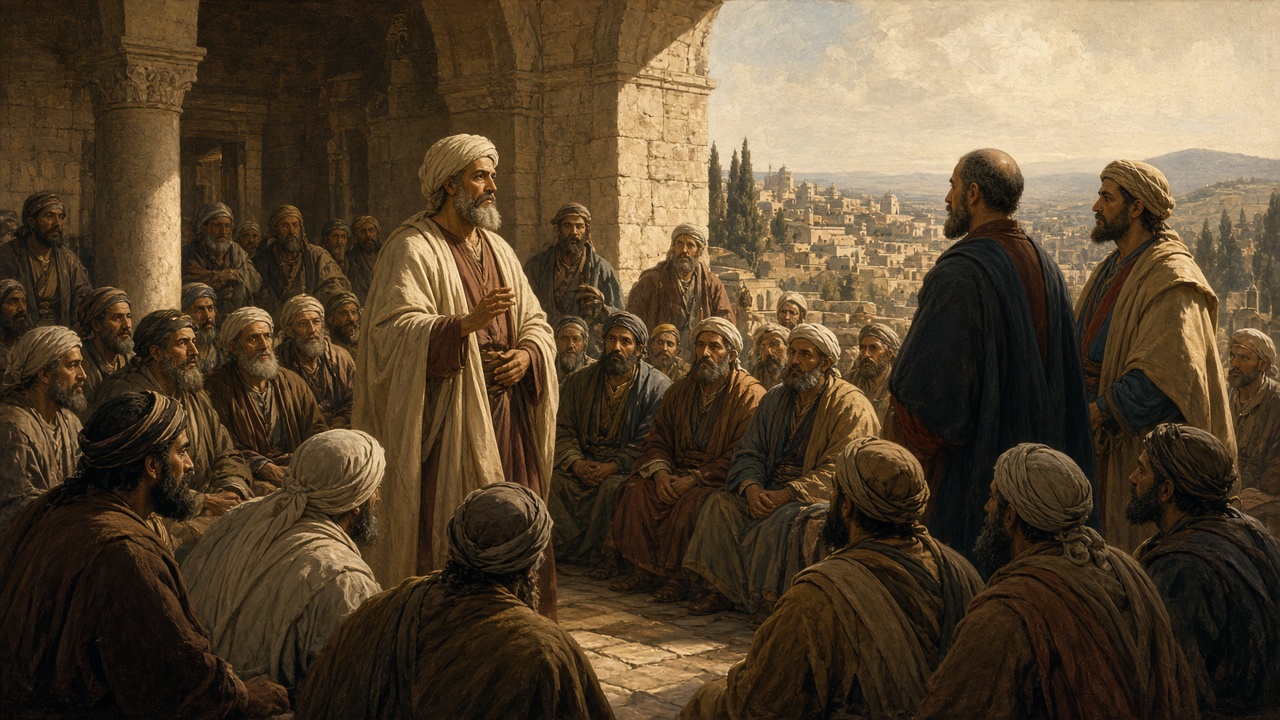
The Council on Gentile Believers
- The dispute began in Antioch, on the Orontes about three hundred miles north of Jerusalem, then ranked third among the cities of the Roman empire, after Rome and Alexandria. On the way to the council, Paul and Barnabas passed through Phoenicia, a coastal strip about one hundred twenty miles long, and through Samaria. A chronological note dates the Jerusalem Council to AD 46.Sources: Antioch (Syria) · Phenicia · the Bible text itself · Jerusalem Council
- Easton's Bible Dictionary (1897) says that James, whom it calls the brother or near kinsman of Jesus, headed the church in Jerusalem and presided at the council on the Gentiles. The letter that followed was addressed to Gentile believers in Antioch, Syria, and Cilicia. Cilicia, Paul's home province and a maritime Roman province in the southeast of Asia Minor since 67 BC, included his native city of Tarsus.Sources: James (Brother of Jesus) · the Bible text itself · Cilicia · Paul
- Judas, called Barsabbas, and Silas, also known as Silvanus, were prophets and leading men of the Jerusalem church, sent to confirm the council's decision in person. A later sharp disagreement over John Mark, cousin of Barnabas, separated the two missionaries: Barnabas took Mark and sailed for Cyprus, while Paul chose Silas. A chronological note dates that parting to AD 47.Sources: the Bible text itself · Silas · John Mark · Paul and Barnabas part ways
Notes written with AI assistance from open sources (Theographic Bible Metadata, CC BY-SA 4.0; Easton’s Bible Dictionary, public domain) and reviewed before publishing.
Places in this chapter
- Antioch · Today: Antioch on the Orontes · 36.227, 36.172 · verses 1, 22, 23, 30, 35
- Judea · Today: Judea 1 · 31.777, 35.234 · verse 1
- Jerusalem · 31.777, 35.234 · verses 2, 3, 4, 22, 23, 33
- Phoenicia · 33.271, 35.196 · verse 3
- Samaria · Today: Samaria 2 · 32.276, 35.195 · verse 3
- Cilicia · 36.913, 34.892 · verses 23, 41
- Syria · Today: Syria 2 · 33.511, 36.306 · verses 23, 41
- Pamphylia · 37.000, 31.000 · verse 38
- Cyprus · 35.000, 33.000 · verse 39
Only places identified with high confidence are shown (90% or more according to the scholarly sources compiled by OpenBible). Period map: DARE (Digital Atlas of the Roman Empire), CC BY 4.0; modern map: © OpenStreetMap contributors; places: OpenBible.info (CC BY 4.0).
Credits and license for this translation
George Noyes Bible
The Holy Bible, translated into English by George Noyes (1869)
Public Domain
Language: English
Dialect: archaic British
Translation by: George Noyes
2019-10-24
Source: http://ebible.org/engnoy/ · eBible.org