Genesis 2
Nyangumarta English Bible · Tap a verse to see its cross-references.
1This next day he did not make another thing. He said about that day, “Already I have finished making everything. I was working, now I have left off working. This day truly I did not make another thing. Because of that this day is different, without work. I have left off work for today.” [Avoiding word for 'rest', which also means 'sleep'.]
GOD PUT A MAN AT A REALLY GOOD WATER-HOLE (2:7-25)
7Like this God made a/the person. He got dust from the ground. He made a man from that dust. Then he breathed in the nose of the man, then wind/breath from God entered the man. For that reason the man became alive. The name of that man was Adam.
8After that in the country, in Eden, there God put a big water-hole/permanent camp, a truly good one. He put the man he had made at that water-hole. 9At that water-hole he put different kinds of good trees. There were different kinds having very good food there. In the middle of the trees God put one tree. He named that tree, 'One That Keeps People Alive'. After a person eats from that tree he will live for ever, he will stay without death. He put another tree in the middle of the others, that was a thing associated with making knowledgeable. He named that tree, 'One That Teaches People About Good And Bad'.
15At the water-hole in Eden he put that (previously-referred to) person to dig the ground and to care for the water-hole. 16He said to him, “You can eat food from all the trees at the water-hole. 17(Fruit) from one tree leave, do not eat it, from the tree which makes knowledgeable. I named it, 'One That Teaches People About Good And Bad'. From that tree don't eat. If you eat from that tree truly you will die.”
18Then he said, “The man should not be alone. I will make a companion for him, he will be one with a companion.” 19Already God had made all the animals and winged creatures from the ground. He brought them to the man to give them names. That man gave names to the animals and winged creatures and other creatures. They kept the names in accord with the man's word. Among them all there was not one like the man, a companion for him.
21Then God put the man to sleep, he got a bone from the man's side, then he covered the hole with flesh. 22From the bone he made a woman, he took her to the man. 23Then the man said, “At last! This one is like me! He made her from my body. Her name is 'Woman'.”
24Because of that God left us this track/pattern of behaviour. A/the man will leave mother and father and they will become one, he and his own wife. Truly those two will be one.
25At the water-hole Eden that couple, Adam and his wife, were staying naked, they stayed well, naked, those two, without shame.
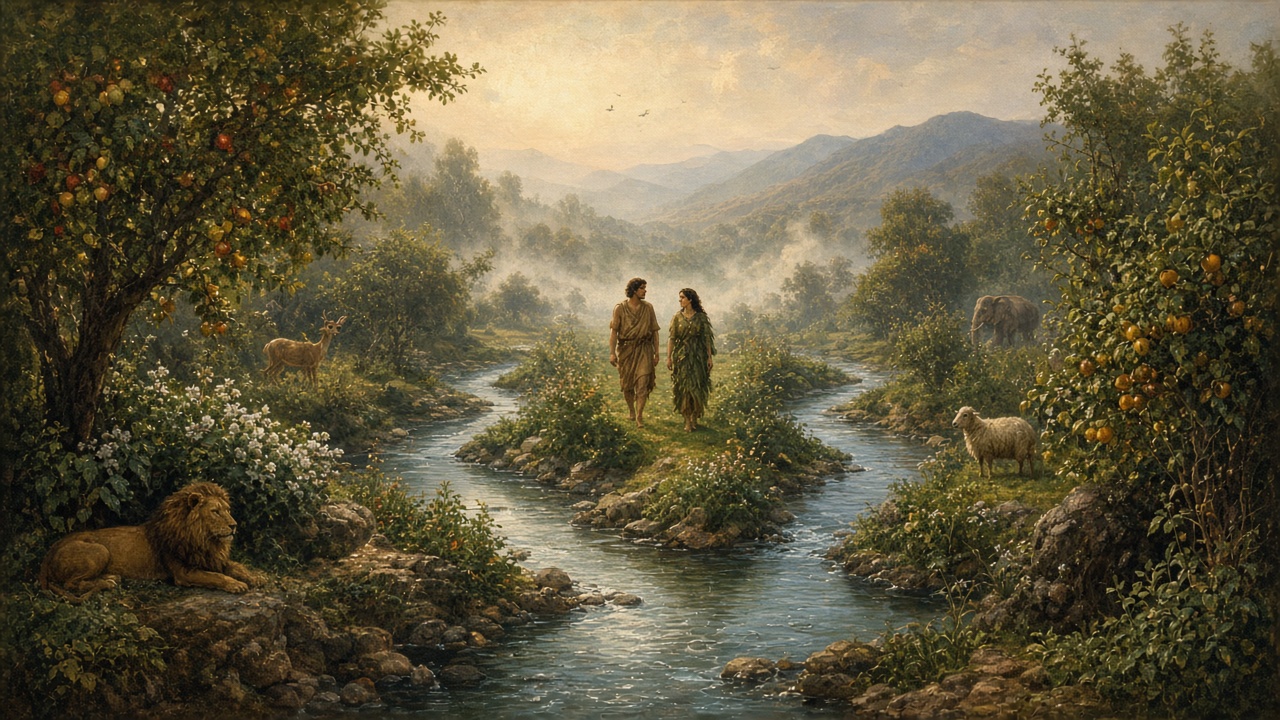
Did you know?
Adam, Eden, and the Four Rivers
- Adam, meaning “red,” is a Babylonian word and the ordinary name for a human being, with the same sense in Hebrew and in Assyrian. It was given to the first man. He was formed from the dust of the ground—hence the name—and God breathed into his nostrils the breath of life.Sources: Adam · the Bible text itself
- A river flowed out of Eden and divided into four headwaters: the Pishon, the Gihon, the Hiddekel, and the Euphrates. Some identify the Pishon with the Phasis or the Halys, others with the Indus, the Ganges, or still other rivers; the Gihon has been identified with the Nile, and others regard it as the Oxus, the Araxes, or the Ganges. The Hiddekel is the Tigris, called by the Accadians the river of Idikla; Gesenius understood the name as “the rapid Tigris.”Sources: the Bible text itself · Pison · Gihon · Hiddekel
- The site of Eden, the garden in which the first parents lived, has been discussed more than almost any other geographical question. It has been placed in Armenia, in the region west of the Caspian Sea, in Media, near Damascus, in Palestine, in southern Arabia, and in Babylonia. Easton's Bible Dictionary (1897) seeks it along the Tigris and the Euphrates of western Asia, in the land of Shinar, or Babylonia.Sources: Eden
Notes written with AI assistance from open sources (Theographic Bible Metadata, CC BY-SA 4.0; Easton’s Bible Dictionary, public domain) and reviewed before publishing.
Places in this chapter
- Assyria · 36.359, 43.153 · verse 14
- Euphrates · Today: Euphrates River · 31.004, 47.442 · verse 14
- Tigris · Today: Tigris River · 31.004, 47.442 · verse 14
Only places identified with high confidence are shown (90% or more according to the scholarly sources compiled by OpenBible). Period map: DARE (Digital Atlas of the Roman Empire), CC BY 4.0; modern map: © OpenStreetMap contributors; places: OpenBible.info (CC BY 4.0).
Credits and license for this translation
Nyangumarta English Bible
Portions of the Holy Bible in English, translated to be a companion to the Nyangumarta Bible
copyright © 1980-2010 Wycliffe Bible Translators, Inc.
Language: English
Bible translation copyright © 1980-2010 Wycliffe Bible Translators, Inc.
Reader Series (book XXC) copyright © 1996 Bible Society Australia. Bible overview (XXA) copyright © 1996 Mission Publications of Australia (PO Box 21, Lawson NSW 2783)
This translation is made available to you under the terms of the
Creative Commons Attribution-Noncommercial-No Derivatives license 4.0.
You may share and redistribute this Bible translation or extracts from it in any format, provided that:
You include the above copyright and source information.
You do not sell this work for a profit.
You do not change any of the words or punctuation of the Scriptures.
Pictures included with Scriptures and other documents on this site are licensed just for use with those Scriptures and documents.
For other uses, please contact the respective copyright owners.
2026-01-06
Source: http://ebible.org/engnna/ · eBible.org