Acts 2
Nyangumarta English Bible · Tap a verse to see its cross-references.

About this book
About Acts
- Ancient tradition, which Easton's Bible Dictionary (1897) calls uniform, attributes Acts to Luke, the "beloved physician," although the writer never names himself. Easton notes that the style and the words and phrases shared by Luke's Gospel and Acts support that view. Easton says the narrator first appears at Acts 16:11, later travels with Paul, including at Rome, and wrote much of that history from personal observation, drawing on Paul's instruction for what lay beyond his own experience.Sources: Easton: Acts of the Apostles
- Easton's Bible Dictionary (1897) dates the writing no earlier than A.D. 61 or 62, because the narrative extends to the close of the second year of Paul's first imprisonment at Rome.Sources: Easton: Acts of the Apostles
- Antioch in Syria, on the river Orontes about sixteen miles from the Mediterranean and some three hundred miles north of Jerusalem, is described as ranking third, after Rome and Alexandria, among the cities of the Roman empire. Christianity was introduced there early, and the name "Christian" was first applied in that city to those who professed the faith. Caesarea, built by Herod the Great on the Mediterranean shore and the seat of the Roman procurators of Judea, is where Festus, successor of Felix in A.D. 60, heard the prisoner Paul and sent him to Rome after Paul appealed to Caesar.Sources: Antioch (Syria) · Caesarea · Portius Festus
- Easton presents Acts as the sequel to Luke's Gospel: that Gospel ends with Jesus taken up from his disciples into heaven, and the opening of Acts expands those closing words. He describes the book as continuing the history of the church after the ascension and as illustrating the gospel preached among all nations, "beginning at Jerusalem." In his account it is only a book of beginnings, a history of the founding of churches and a cycle of "representative events," and it follows Peter and Paul rather than all the apostles.Sources: Easton: Acts of the Apostles
- The book was early called "The Acts," "The Gospel of the Holy Ghost," and "The Gospel of the Resurrection." Easton observes that the later title "Acts of the Apostles" is broader than the contents, since John is noticed only three times and all that is recorded of James, the son of Zebedee, is his execution by Herod.Sources: Easton: Acts of the Apostles
Notes written with AI assistance from open sources (Theographic Bible Metadata, CC BY-SA 4.0; Easton’s Bible Dictionary, public domain) and reviewed before publishing.
8...we all hear them, they are speaking in our own words.
Did you know?
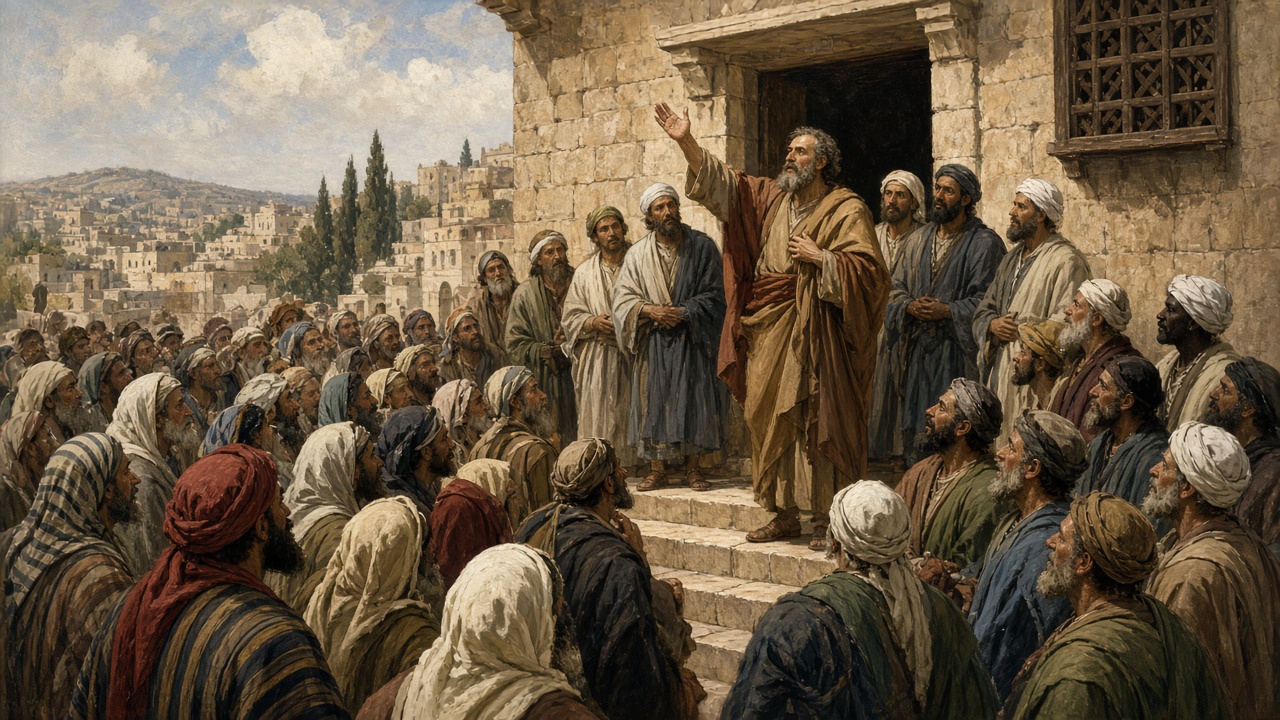
The Spirit Comes at Pentecost
- God-fearing Jews from every nation under heaven were already living in Jerusalem when a sound like a mighty rushing wind came from heaven and filled the house, and the speakers began to declare God’s wonders in other languages. In this chapter, “Asia” is the Roman province of Proconsular Asia, in the western part of Asia Minor, whose capital was Ephesus—not the continent of that name. Pontus, along the southern coast of the Euxine Sea, was a Roman province in the apostles’ time and a resort of many Jews of the Dispersion; Cappadocia was the easternmost and largest province of Asia Minor.Sources: the Bible text itself · Asia · Pontus · Cappadocia
- The crowd was amazed that the speakers were Galileans. The one who stood with the Eleven and addressed them was Simon Peter, originally called Simon—that is, Simeon, meaning “hearing”—a fisherman from Bethsaida, on the western coast of the Sea of Galilee, whom his younger brother Andrew first brought to Jesus.Sources: the Bible text itself · Simon Peter
- Peter said this was what the prophet Joel had spoken. Joel, the second of the twelve minor prophets, was the son of Pethuel, and his personal history is known only from his book. Peter also quoted David, the eighth and youngest son of Jesse of Bethlehem, and told the crowd that this patriarch had died and been buried, and that his tomb was still with them in Jerusalem.Sources: the Bible text itself · Joel · David
Notes written with AI assistance from open sources (Theographic Bible Metadata, CC BY-SA 4.0; Easton’s Bible Dictionary, public domain) and reviewed before publishing.
Places in this chapter
- Jerusalem · 31.777, 35.234 · verses 5, 14
- Galilee · 32.760, 35.527 · verse 7
- Asia · 38.400, 28.300 · verse 9
- Cappadocia · 38.671, 34.839 · verse 9
- Judea · Today: Judea 1 · 31.777, 35.234 · verses 9, 14
- Mesopotamia · Today: Aram-naharaim · 36.864, 39.033 · verse 9
- Pontus · 40.680, 37.830 · verse 9
- Cyrene · 32.821, 21.851 · verse 10
- Egypt · 30.129, 31.308 · verse 10
- Libya · 32.821, 21.851 · verse 10
- Pamphylia · 37.000, 31.000 · verse 10
- Phrygia · 39.000, 31.000 · verse 10
- Rome · 41.892, 12.485 · verse 10
- Nazareth · 32.702, 35.298 · verse 22
Only places identified with high confidence are shown (90% or more according to the scholarly sources compiled by OpenBible). Period map: DARE (Digital Atlas of the Roman Empire), CC BY 4.0; modern map: © OpenStreetMap contributors; places: OpenBible.info (CC BY 4.0).
Credits and license for this translation
Nyangumarta English Bible
Portions of the Holy Bible in English, translated to be a companion to the Nyangumarta Bible
copyright © 1980-2010 Wycliffe Bible Translators, Inc.
Language: English
Bible translation copyright © 1980-2010 Wycliffe Bible Translators, Inc.
Reader Series (book XXC) copyright © 1996 Bible Society Australia. Bible overview (XXA) copyright © 1996 Mission Publications of Australia (PO Box 21, Lawson NSW 2783)
This translation is made available to you under the terms of the
Creative Commons Attribution-Noncommercial-No Derivatives license 4.0.
You may share and redistribute this Bible translation or extracts from it in any format, provided that:
You include the above copyright and source information.
You do not sell this work for a profit.
You do not change any of the words or punctuation of the Scriptures.
Pictures included with Scriptures and other documents on this site are licensed just for use with those Scriptures and documents.
For other uses, please contact the respective copyright owners.
2026-01-06
Section headings adapted from the Berean Standard Bible (public domain); they are not part of this translation’s text.
Source: http://ebible.org/engnna/ · eBible.org