Joshua 21
NET Bible · Tap a verse to see its cross-references.
Forty-Eight Cities for the Levites
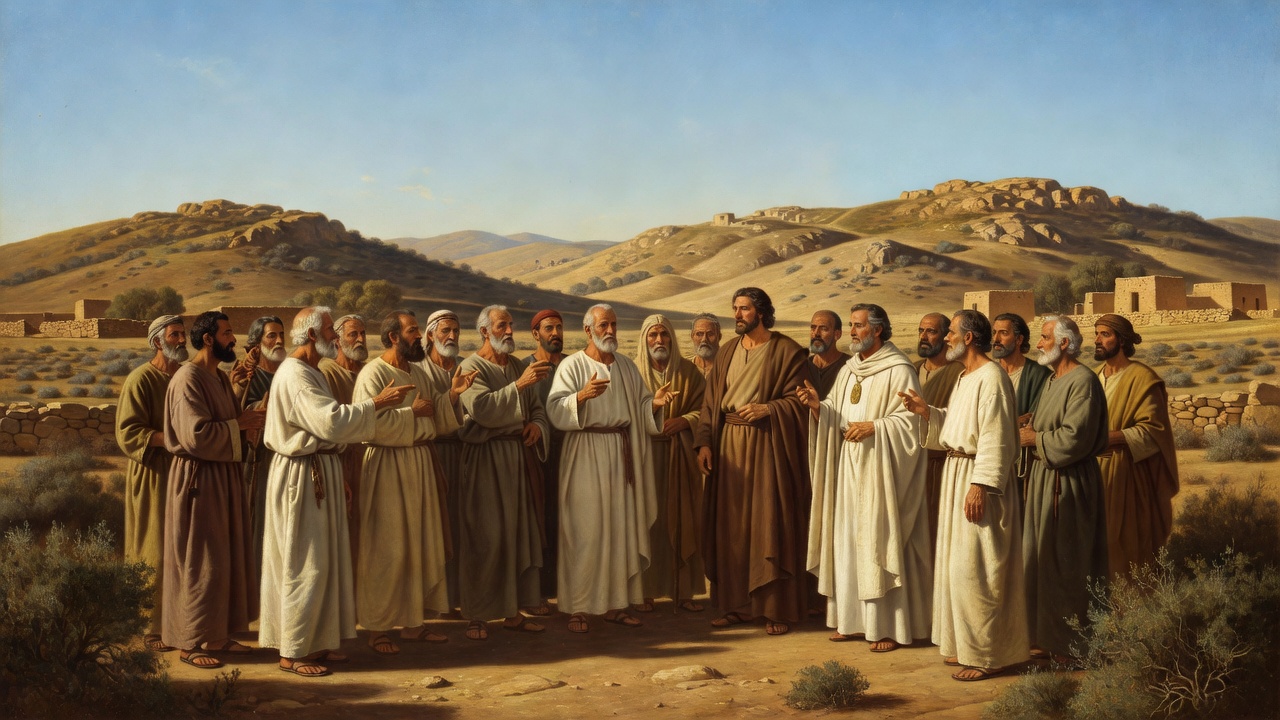
1The tribal leaders of the Levites went before Eleazar the priest and Joshua son of Nun and the Israelite tribal leaders 2in Shiloh in the land of Canaan and said, “The Lord told Moses to assign us cities in which to live along with the grazing areas for our cattle.” 3So the Israelites assigned these cities and their grazing areas to the Levites from their own holdings, as the Lord had instructed.
4The first lot belonged to the Kohathite clans. The Levites who were descendants of Aaron the priest were allotted thirteen cities from the tribes of Judah, Simeon, and Benjamin. 5The rest of Kohath’s descendants were allotted ten cities from the clans of the tribe of Ephraim, and from the tribe of Dan and the half-tribe of Manasseh. 6Gershon’s descendants were allotted thirteen cities from the clans of the tribe of Issachar, and from the tribes of Asher and Naphtali and the half-tribe of Manasseh in Bashan. 7Merari’s descendants by their clans were allotted twelve cities from the tribes of Reuben, Gad, and Zebulun. 8So the Israelites assigned to the Levites by lot these cities and their grazing areas, as the Lord had instructed Moses.
9They assigned from the tribes of Judah and Simeon the cities listed below. 10They were assigned to the Kohathite clans of the Levites who were descendants of Aaron, for the first lot belonged to them. 11They assigned them Kiriath Arba (Arba was the father of Anak), that is, Hebron, in the hill country of Judah, along with its surrounding grazing areas. 12(Now the city’s fields and surrounding towns they had assigned to Caleb son of Jephunneh as his property.) 13So to the descendants of Aaron the priest they assigned Hebron (a city of refuge for one who committed manslaughter), Libnah, 14Jattir, Eshtemoa, 15Holon, Debir, 16Ain, Juttah, and Beth Shemesh, along with the grazing areas of each – a total of nine cities taken from these two tribes. 17From the tribe of Benjamin they assigned Gibeon, Geba, 18Anathoth, and Almon, along with the grazing areas of each – a total of four cities. 19The priests descended from Aaron received thirteen cities and their grazing areas.
20The rest of the Kohathite clans of the Levites were allotted cities from the tribe of Ephraim. 21They assigned them Shechem (a city of refuge for one who committed manslaughter) in the hill country of Ephraim, Gezer, 22Kibzaim, and Beth Horon, along with the grazing areas of each – a total of four cities. 23From the tribe of Dan they assigned Eltekeh, Gibbethon, 24Aijalon, and Gath Rimmon, along with the grazing areas of each – a total of four cities. 25From the half-tribe of Manasseh they assigned Taanach and Gath Rimmon, along with the grazing areas of each – a total of two cities. 26The rest of the Kohathite clans received ten cities and their grazing areas.
27They assigned to the Gershonite clans of the Levites the following cities: from the half-tribe of Manasseh: Golan in Bashan (a city of refuge for one who committed manslaughter) and Beeshtarah, along with the grazing areas of each – a total of two cities; 28from the tribe of Issachar: Kishon, Daberath, 29Jarmuth, and En Gannim, along with the grazing areas of each – a total of four cities; 30from the tribe of Asher: Mishal, Abdon, 31Helkath, and Rehob, along with the grazing areas of each – a total of four cities; 32from the tribe of Naphtali: Kedesh in Galilee (a city of refuge for one who committed manslaughter), Hammoth Dor, and Kartan, along with the grazing areas of each – a total of three cities. 33The Gershonite clans received thirteen cities and their grazing areas.
34They assigned to the Merarite clans (the remaining Levites) the following cities: from the tribe of Zebulun: Jokneam, Kartah, 35Dimnah, and Nahalal, along with the grazing areas of each – a total of four cities; 36from the tribe of Reuben: Bezer, Jahaz, 37Kedemoth, and Mephaath, along with the grazing areas of each – a total of four cities; 38from the tribe of Gad: Ramoth in Gilead (a city of refuge for one who committed manslaughter), Mahanaim, 39Heshbon, and Jazer, along with the grazing areas of each – a total of four cities. 40The Merarite clans (the remaining Levites) were allotted twelve cities.
41The Levites received within the land owned by the Israelites forty-eight cities in all and their grazing areas. 42Each of these cities had grazing areas around it; they were alike in this regard.
43So the Lord gave Israel all the land he had solemnly promised to their ancestors, and they conquered it and lived in it. 44The Lord made them secure, in fulfillment of all he had solemnly promised their ancestors. None of their enemies could resist them. 45Not one of the Lord’s faithful promises to the family of Israel was left unfulfilled; every one was realized.
Did you know?
The Cities of the Levites
- Unlike the other tribes of Israel, the tribe of Levi did not receive a continuous regional territory. Instead, they were allotted forty-eight individual cities along with their surrounding pasturelands, distributed among the lands of all the other tribes.Sources: the Bible text itself
- The allocation of these cities occurred at Shiloh in Canaan, where the heads of the Levitical families presented their petition to the priest Eleazar, Joshua, and the tribal leaders according to the commands previously given through Moses.Sources: the Bible text itself · Shiloh · Canaan
- Several prominent Levitical cities also served as designated cities of refuge for individuals seeking protection after accidental killings, including Hebron in Judah, Shechem in Ephraim, and Golan in Bashan.Sources: the Bible text itself · Hebron · Bashan
Notes written with AI assistance from open sources (Theographic Bible Metadata, CC BY-SA 4.0; Easton’s Bible Dictionary, public domain) and reviewed before publishing.
Places in this chapter
- Canaan · 32.767, 35.333 · verse 2
- Shiloh · Today: Khirbet Seilun · 32.056, 35.290 · verse 2
- Bashan · 32.781, 35.935 · verses 6, 27
- Hebron · Today: Tel Rumeida · 31.525, 35.102 · verses 11, 13
- Jattir · Today: Khirbet Attir · 31.352, 35.016 · verse 14
- Gibeon · Today: El Jib · 31.847, 35.183 · verse 17
- Gezer · Today: Tel Gezer · 31.859, 34.919 · verse 21
- Shechem · Today: Tell Balatah · 32.214, 35.282 · verse 21
- Beth-horon · Today: Beit Ur al Tahta · 31.895, 35.084 · verse 22
- Taanach · Today: Tell Ta’anakh · 32.522, 35.219 · verse 25
- Galilee · 32.760, 35.527 · verse 32
- Jokneam · Today: Tel Yokneam · 32.664, 35.108 · verse 34
- Gilead · Today: Gilead 1 · 32.187, 35.692 · verse 38
- Ramoth · Today: Tall er Rumeith · 32.500, 36.015 · verse 38
Only places identified with high confidence are shown (90% or more according to the scholarly sources compiled by OpenBible). Period map: DARE (Digital Atlas of the Roman Empire), CC BY 4.0; modern map: © OpenStreetMap contributors; places: OpenBible.info (CC BY 4.0).
Credits and license for this translation
NET Bible
NET Bible®, New English Translation (NET)
copyright © 1996-2016 Biblical Studies Press, L. L. C.
Please see https://netbible.com/copyright/ for full NET Bible copyright and permissions information. You can also read the NET Bible at http://NETBible.org .
Language: English
Dialect (if applicable): American
Language in English: English
Translation by:
Please see https://netbible.com/copyright/ for full NET Bible copyright and permissions information. You can also read the NET Bible at http://NETBible.org .
The NET Bible (New English Translation) is a completely new translation of the Bible with 58,506 translators’ notes ! It was completed by more than 25 scholars – experts in the original biblical languages – who worked directly from the best currently available Hebrew, Aramaic, and Greek texts. Turn the pages and see the breadth of the translators’ notes, documenting their decisions and choices as they worked.
The translators’ notes make the original languages far more accessible, allowing you to look over the translator’s shoulder at the very process of translation. This level of documentation is a first for a Bible translation, making transparent the textual basis and the rationale for key renderings (including major interpretive options and alternative translations).
This unparalleled level of detail helps connect people to the Bible in the original languages in a way never before possible without years of study of Hebrew, Aramaic, and Greek. It unlocks the riches of the Bible’s truth from entirely new perspectives.
A donation is appreciated. Donate at Bible.org/donations_form so we can continue to provide our material for free for our 16,000+ articles on Bible.org and our world class Bible Study tool at lumina.bible.org .
2026-10-02
Section headings adapted from the Berean Standard Bible (public domain); they are not part of this translation’s text.
Source: http://ebible.org/engnet/ · eBible.org